
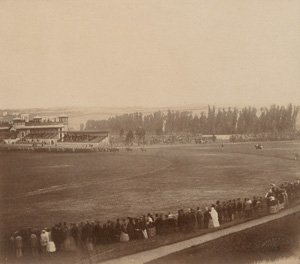
Dubois de Nehaut, Louis-Pierre-Théophile
Military exercise at the Longchamp Hippodrome, Bois de Bologne
Los 4061
Nachverkaufspreis
1.000€ (US$ 1,149)
Military exercise at the Longchamp Hippodrome, Bois de Bologne. 1857. Albumen print, mounted to card. 19,1 x 21,7 cm (mount 32,6 x 48,5 cm). Annotated "On fait sortir les curieux du terrain de maneuvres" in black ink below the image on the mount; photographer’s blindstamp in lower left corner of the print and below the image on the mount.
Chevalier Louis Pierre Dubois de Nehaut exemplifies the mid-19th-century amateur photographer, whose work reflects the early technical and aesthetic advances of the medium. Originally a magistrate in Lille, he settled in Brussels in 1851, where he pursued photography with an interest in movement, shifting light, and elevated viewpoints. The present photograph belongs to a series documenting the grand military review of the Imperial Guard held in June 1857 in the Bois de Boulogne on the occasion of the visit of the King of Bavaria. Taken on the Plaine de Longchamp, it captures the intersection of military spectacle and public leisure, with crowds gathered along the edges of the field as the terrain is cleared for maneuvers. – Some handling creases, as well as a small tear in the left margin of the mount; some scuff marks and light fading; otherwise in very good condition.
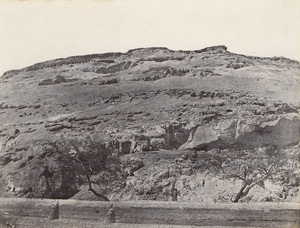
Du Camp, Maxime
Nécropole de Lycopolis; Vue générale d'Esneh
Los 4062
Nachverkaufspreis
800€ (US$ 920)
Nécropole de Lycopolis; Vue générale d'Esneh. 1850. 2 salted paper prints (Blanquard-Evrard process). 16 x 21,2 cm and 14,4 x 21,5 cm (mounts ca 31 x 45 cm). Each mounted to original card with title, photographer's and publisher's name printed above/below the image on the mount. Plate numbers 12 and 64.
Maxime du Camp produced some of the earliest systematic photographic views of Egypt’s ancient monuments along the Nile, focusing on temples, tombs, and archaeological sites from Upper Egypt to Nubia. His images are characterized by carefully structured compositions that emphasize the scale and isolation of these ruins within the surrounding landscape. Working with early paper processes under demanding conditions, he used photography as a tool of documentation, creating images that balance topographical precision with a restrained, almost austere aesthetic. – One mount with light water stain in upper left edge, both mounts time-stained in edges and with light soiling, Esneh print slightly blotchy, Nécropole print in very good condition.
Lit.: Bodo von Dewitz and Karin Schuller-Procopovici, eds. Die Reise zum Nil: 1849-1850. Göttingen: Steidl, 1997, ill. p. 76, 137.
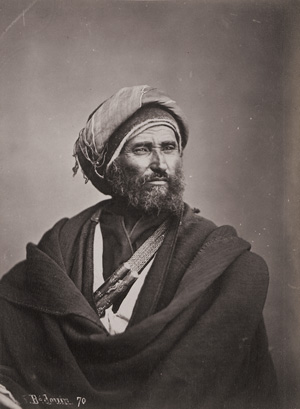
Photographers: Hippolyte Arnoux (active 1860-1891), Félix Bonfils (1831-1885), Gabriel Lekegian (1853-1920), Pascal Sébah (1823-1886), Zangaki brothers (active 1860-1890s), and others. People of Egypt. 1870s-1880s. 43 albumen prints, mounted to board. Each between ca. 14,5 x 10,2 cm and 27,2 x 21,2 cm (mounts ca. 31,7 x 24 cm). Most numbered, titled, and signed in the negative in the lower margin.
This extensive group comprises studio portraits, staged outdoor compositions, and street scenes depicting men, women, and children presented as ethnographic “types” from Egypt, including dancers and musicians, water sellers, market vendors, craftsmen, donkey riders, Bedouins, camel drivers, shoe shiners, and sakkas along the Nile, as well as architectural views and interior scenes. The photographs originate primarily from Egypt and the eastern Mediterranean and reflect the visual conventions developed by commercial studios serving the European tourist and export market at the time. – Some scuff marks and light fading, otherwise all in good to very good condition.
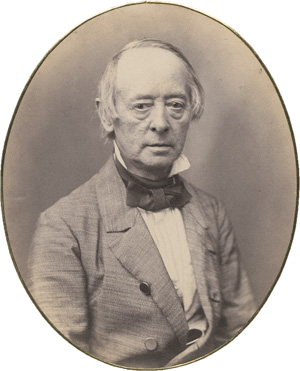
Elbing
Commemorative portrait album for Dr. W. Hertzberg
Los 4064
Ergebnis (inkl. Aufgeld) *
500€ (US$ 575)
Commemorative portrait album for Dr. W. Hertzberg, Elbing. 1858. 13 mostly oval salted paper prints, mounted to gilt-edged album pages with decorative frame lines. Each ca. 14,5 x 11,5 cm (mounts ca. 22 x 29 cm). Bound in contemporary red velvet album with gilt-stamped decorations and title.
This elaborately decorated commemorative album, dedicated to Dr. W. Hertzberg, Director der höheren Bürgerschule in Elbing, features a hand-drawn and handwritten title page and contains a compelling group of formal teacher portraits. At the beginning of the album is a particularly rare early view of Elbing, likely among the earliest known photographic representations of the town. – Lower corners of the album slightly bumped; some album pages slightly soiled with light foxing; some prints with slight fading along the edges; otherwise most with rich tones and in very good condition.
Ermakov, Dimitri Ivanovich
Construction of the Enzeli–Tehran Road
Los 4065
Ergebnis (inkl. Aufgeld) *
3.750€ (US$ 4,310)
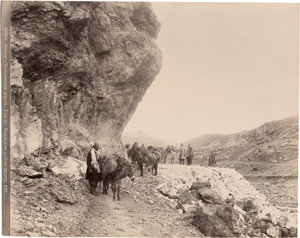
Album documenting the construction of the Enzeli-Tehran Road. 1880s. 70 albumen prints, mounted to album pages. Each between 21,5 x 27 cm and 22,2 x 28,5 cm (mounts 49,5 x 33 cm). Each with the photographer’s embossed signature stamp in the lower right corner of the prints and numbered and titled in the negative in lower margin. Bound in red half-leather album with gilt-stamped title on the cover.
This album documents the construction and development of the Enzeli-Tehran road, a strategically important route linking the Caspian Sea to the Persian capital. The images capture dramatic landscapes, engineering works, and settlements along the route, including bridges, mountain passes, and caravan traffic. Built under Russian auspices in the late 19th century, the road served both commercial and military purposes within the broader context of imperial expansion in northern Persia. Widely regarded as one of the foremost documentarians of the Caucasus and adjacent regions, Ermakov traveled extensively across Georgia, Armenia, and Persia; his legacy is preserved by the National Museum of Georgia, which holds a significant collection of his negatives.
– Edges of album slightly rubbed; some scuff marks; some rubbing, foxing, and age staining to the album pages; some foxing, scuff marks, and fading to a number of prints, otherwise all in good to very good condition.
Fenton, Roger
Bust of Dione at the British Museum
Los 4066
Ergebnis (inkl. Aufgeld) *
500€ (US$ 575)
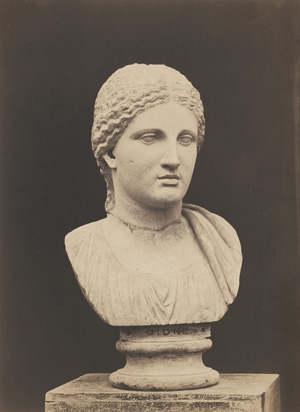
Bust of Dione at the British Museum. 1857. Salted paper print, mounted to original card. 32,5 x 24 cm (mount 58,3 x 41,8 cm). Printed annotations below the image on the mount.
In 1853, Roger Fenton was commissioned by the British Museum to photograph works from its collection, leading him to produce a series of images after classical sculpture in an open-air studio set up on the museum’s roof. Although unpaid, the project allowed Fenton to sell the prints independently, positioning these photographs within an emerging market for reproductions of canonical artworks and as tools for artistic study. The present image depicts Dione, a figure from Greek mythology often identified as a consort of Zeus and, in some traditions, the mother of Aphrodite. – Some handling creases and small tears along the margins of the mount; slight fading along the edges of the print; otherwise a strong print with rich contrast and in near excellent condition.
Furne, Charles-Paul
Douarnerez, vue prise de la baie
Los 4067
Ergebnis (inkl. Aufgeld) *
1.875€ (US$ 2,155)
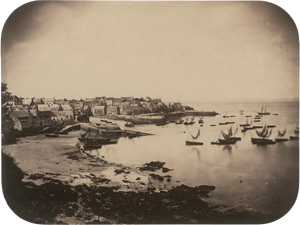
Douarnenez, vue prise de la baie. Ca 1857. Albumen print, mounted to card. 20,4 x 27,2 cm (mount 34,6 x 46 cm). With the photographer’s blindstamp below the image on the mount and negative number inscribed in pencil. Annotated in pencil in lower left corner of the mount.
Charles Paul Furne was a French photographer and publisher active in the 1850s, working within the Furne family firm on early photographic surveys of France. His activities ranged from landscape views and urban surveys to large-scale publishing ventures, including a sustained photographic survey of Brittany undertaken in 1857-1858 with Henri Alexis Omer Tournier. While Furne’s work is less widely known today than that of contemporaries such as Édouard Baldus and Gustave Le Gray, it remains significant for its contribution to the development of early French landscape photography. – Some light handling creases and foxing on the mount; a few scuff marks and traces of silver mirroring in the darker areas of the print; otherwise in very good condition.
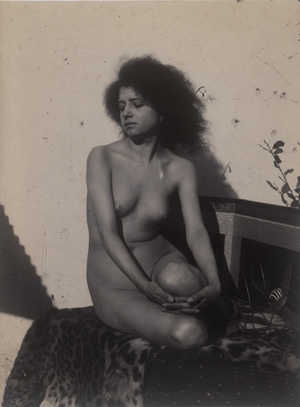
Female nude. Circa 1900. Albumen print. 22,2 x 16,5 cm. Photographer's "Via Campania lett: B Roma" studio stamp and number "974" in pencil on the verso.
Vincenzo Galdi was an Italian photographer and protégé of Wilhelm von Plüschow, known for his contributions to 19th-century nude photography. Having first appeared as a model in his mentor’s work, he soon established himself as a prolific and distinctive practitioner in Naples and later in Rome, developing a practice characterized by a direct and often unconventional approach to the genre. – A few light handling creases, otherwise in near excellent condition.
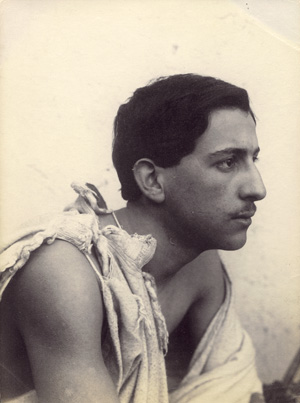
Galdi, Vincenzo
Portrait of a youth in Roman tunic
Los 4069
Ergebnis (inkl. Aufgeld) *
1.375€ (US$ 1,580)
Portrait of a youth in Roman tunic. Circa 1900. Albumen print. 22,3 x 16,6 cm. Photographer’s “Via Sardegna 55, Roma” stamp and number “1156” in pencil, as well as annotations in ballpoint pen on the verso.
Some light handling marks, pressure marks in corners from album slits, some fading in edges, otherwise in very good condition.
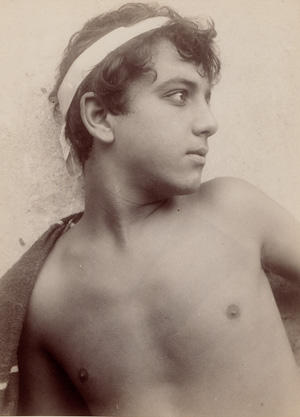
Gloeden, Wilhelm von
Young boy with headband
Los 4070
Ergebnis (inkl. Aufgeld) *
1.250€ (US$ 1,437)
Young boy with headband. 1890s. Albumen print, mounted to board. 22,5 x 16.2 cm (mount 35,5 x 28 cm).
Wilhelm von Gloeden is best known for his idealized photographs of nude Sicilian youths, staged in classical poses and settings around Taormina. Drawing on Greco-Roman aesthetics and pastoral themes, his work blends homoeroticism, ethnographic curiosity, and pictorial elegance, contributing to early discourses on photography as both fine art and social document. – Minimal stain in chest area, otherwise in excellent condition.
Lit.: Italo Zannier. Wilhelm von Gloeden Fotografie: Nudi, Paesaggi, Scene di Genere. Florence: Alinari, 2008. ill. p. 133 (images from same sitting).
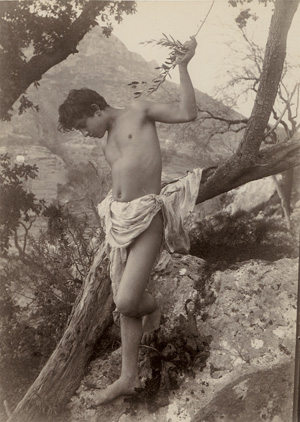
Gloeden, Wilhelm von
Young boy leaning on tree branch
Los 4071
Ergebnis (inkl. Aufgeld) *
1.250€ (US$ 1,437)
Young boy leaning on tree branch. 1900. Albumen print, mounted to board. 23 x 16,5 cm (mount 35,4 x 28 cm).
Lower left corner missing, A few light surface crimps/indentations, otherwise in very good condition.
Lit.: Italo Zannier. Wilhelm von Gloeden Fotografie: Nudi, Paesaggi, Scene di Genere. Florence: Alinari, 2008. ill. p. 114 (variant).
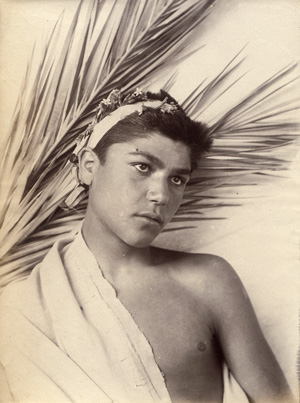
Gloeden, Wilhelm von
Youth with head band
Los 4072
Ergebnis (inkl. Aufgeld) *
1.000€ (US$ 1,149)
Youth with headband. 1890s. Albumen print. 23 x 17,2 cm. Numbered “191” and annotated “Taormina” in pencil on the verso, as well as a partially visible copyright stamp.
Some handling creases; some fading along the edges of the print, otherwise in very good condition.
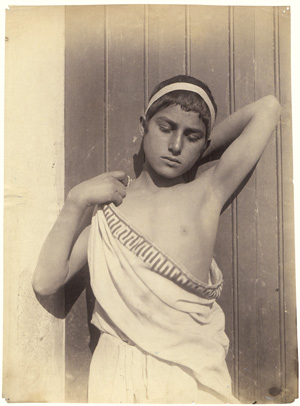
Gloeden, Wilhelm von
Young boy in toga with headband
Los 4073
Ergebnis (inkl. Aufgeld) *
1.750€ (US$ 2,011)
Young boy in toga with headband. 1890s. 2 albumen prints. Each ca. 23 x 16,8 cm. Photographer's "Taormina Sicilia" studio stamp and/or annotated in pencil on the verso.
Corners of one print with pinholes from previous mounting; some light handling marks and scuff marks, as well as some fading along the edges of the prints, otherwise in very good condition.
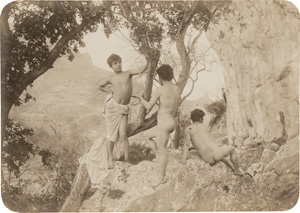
Gloeden, Wilhelm von
Three male nudes in Arcadian scene
Los 4074 [*]
Nachverkaufspreis
1.000€ (US$ 1,149)
Three male nudes in Arcadian scene. Circa 1900. Salted paper print, mounted to board. 15,2 x 21,4 cm (mount 31 x 37,5 cm). Framed under glass in wooden frame.
Two small spots, some light fading along the edges of print, otherwise in near excellent condition.
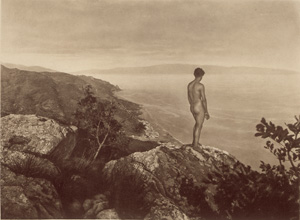
Elegie. Circa 1900. Large-format photogravure on strong vellum paper, mounted to board. 26 x 32,7 cm (mount 33,3 x 38,5 cm). Signed by the photographer in pencil and title printed in the lower margin.
This atmospheric work Elegie by Wilhelm von Gloeden was taken during the same period as Cain, one of von Gloeden’s most iconic and widely reproduced works. Here the photographer also employs a sitter in a contemplative pose with allegorical weight. Blending classical references with fin-de-siècle symbolism, the image exemplifies the photographer’s refined use of natural light, idealized male form, and mythic undertones that helped shape his enduring legacy in art photography. – Board time-stained, a few minimal spots and rubbed areas in upper right of print, otherwise a fine tonal print in very good condition.
Lit.: Volker Janssen (ed.). Wilhelm von Gloeden, Wilhelm von Plüschow, Vincenzo Galdi: Italienische Jünglings-Photographien um 1900. Berlin: Janssen, 1991, ill. p. 32.
Italo Zannier (ed.), Wilhelm von Gloeden, Fotografie: Nudi. Paesaggi. Scene di Genere, Florence: Alinari, 2008, ill. p. 78.

Photographer unknown. Panorama of Hong Kong Bay. 1880s. Panorama consisting of 4 linen-backed albumen prints, mounted on one side to board as leporello. Each ca. 19 x 26 cm (entire size: 19 x 108,5 cm).
This panorama presents a view over Hong Kong Bay taken from a high vantage point, likely Victoria Peak, looking across the harbor toward Kowloon. – Faint crease in the upper left corner; some scattered fading spots, as well as fading along the edges of the prints; otherwise in good condition.
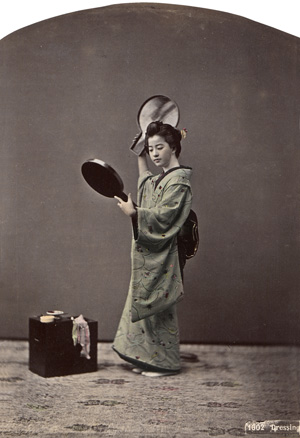
Photographers: Baron Raimund von Stillfried-Rathenitz (1839-1911), Adolfo Farsari (1841-1898), Kusakabe Kimbei (1841-1934), Kozaburo Tamamura (1856-1923?), Kazumasa Ogawa (1860-1929), and others. People and landscapes of Japan. 1860s-1890s. 34 albumen prints, mounted to board. Each between 26 x 20,5 cm and 27,3 x 21,3 cm or reverse (mounts between 26 x 32 cm and 30,5 x 37,8 cm or reverse). Some captioned and numbered in the negative in lower margin.
This group of photographs presents a rich array of genre scenes and occupational portraits - including of geishas, samurai, actors, artisans, priests, street vendors, and sedan chair bearers - alongside numerous landscape views of Tokyo, Hakone, Nikko, Kyoto, Futamatagawa, and Nagasaki. – Some fading, light scuff marks and foxing, otherwise all in good to very good condition.
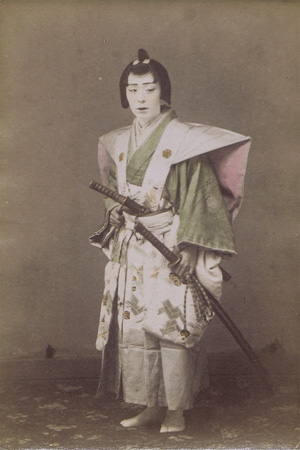
Photographers: Adolfo Farsari (1841-1898) and unknown. Japanese portraits. 1880s-1890s. 12 hand-colored albumen prints. Each ca. 13,2 x 9 cm or reverse. Some numbered and titled in the negative in the lower margin; most annotated and dated in blue ink on the verso.
The group comprises staged studio and outdoor genre portraits of Japanese men and women in traditional dress, including several portraits of geishas, a sumo wrestler, a kabuki actor holding a sword, a porter carrying a shrine, sedan chair bearers, and various domestic scenes. – Some fading and a few faint handling creases; otherwise strong prints in very good condition.
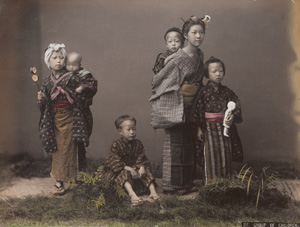
Photographer: Kusakabe Kimbei (1841-1932) and others. Selected genre scenes. 1880s-1890s. 3 hand-colored albumen prints, 2 mounted to board/mat. Between 12 x 28,8 cm and 20 x 25,5 cm (mounts between 22 x 39,5 cm and 33 x 39,3 cm). 1 with number and title in the negative in lower right edge.
In 1885, Kusakabe Kimbei - formerly an assistant and colorist for Felice Beato - acquired Beato’s Yokohama studio from Baron Raimund von Stillfried-Rathenicz, who had purchased it in 1877. From 1885-1910, Kimbei emerged as one of Japan’s leading commercial photographers and played a pivotal role in shaping the visual identity of Meiji-era Japan, contributing significantly to the early history of photography in the country. – Kimbei print with some fading in right edge and a few handling creases, some pressure marks from album page slits in corners, otherwise in very good condition.
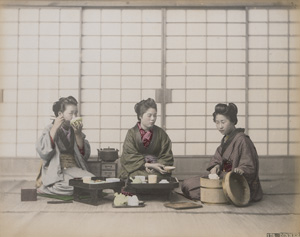
Photographer unknown. Selected images of Japan. Circa 1900. 9 albumen prints (8 hand-colored), mounted to both sides of board. Circa 18,8 x 24 cm and reverse.
Several images depict the harvesting of tea plantations, while others show wrestlers, women dining, and the bustling harbor of Hankou, China. – Some lightly faded, one with rubbed spot, some handling creases, one with buckling, one with some foxing, otherwise in good condition.
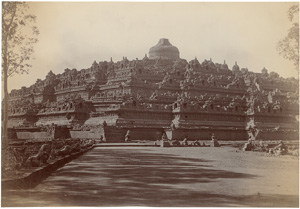
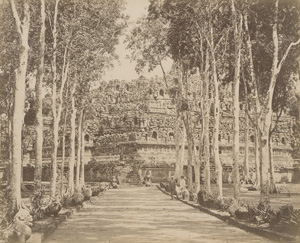
Photographer: Isidore van Kinsbergen (1821-1905). Views of Borobudur temple, Java. 1873. 3 albumen prints, mounted to card or board. Between 24,3 x 35,3 cm and 27,7 x 34 cm or reverse (mounts between 28,8 x 40 cm and 32,7 x 43 cm).
These photographs belong to the seminal corpus produced by Isidore van Kinsbergen in Java between 1863 and 1867, commissioned by the Batavian Society of Arts and Sciences to document Hindu-Buddhist monuments, and later extended through his 1873 campaign at Borobudur. Trained as an engraver and set designer, he combined a theatrical sensibility with a systematic, almost archaeological approach. For many European audiences, images from the series “Oudheden van Java” provided a first encounter with Buddhist art, particularly through widely circulated views of Borobudur. Awarded a gold medal at the Vienna World Exhibition in 1873, his work was exhibited internationally and disseminated in albums issued under Dutch governmental authority. – Corners of one board slightly chipped; some scuff marks and fading along the edges of the prints; otherwise in good condition.
Lit.: Gerda Theuns-de Boer and Saskia Asser. Isidore van Kinsbergen (1821–1905): Photo Pioneer and Theatre Maker in the Dutch East Indies. Zaltbommel: Uitgeverij Aprilis, 2005, ill. p. 271.
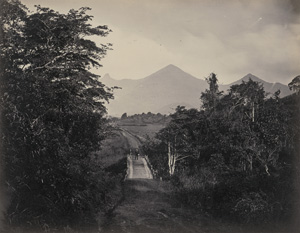
Photographers: Woodbury & Page (active 1857-1908). Views of Java and Batavia. 1860s-1870s. 50 albumen and collodion prints, mounted to card. Each ca. 17,7 x 24 cm or reverse (mounts 27 x 37 cm or reverse). Each annotated in black ink below the image on the mount. Presented in a contemporary half-leather clamshell box with marbled endpapers.
This album presents a structured visual survey of Batavia and its wider colonial environment, encompassing administrative sites such as the Stadthuis, the Paleis van Daendels, and Koningsplein, alongside private residences such as that of Ambrosius van Delden. It extends beyond the capital to Buitenzorg and its Botanical Garden, as well as to the volcanic landscapes of Mount Salak and significant cultural monuments such as Borobudur. These varied sites are situated within the geographic and institutional networks of nineteenth-century Dutch colonial presence in Java. – Some handling creases, smudge marks, and tears to the mounts, one mount with the top left corner torn off; some fading, scuff marks, and small tears to a number of prints, otherwise all in good to very good condition.
Photographers: Woodbury & Page (active 1857-1908). Views of Java. 1880s. 12 albumen prints, mounted to board. Each ca. 19 x 24 cm (mounts ca. 30,7 x 40 cm). Annotated in black ink below the image on the mount; most with the photographer’s studio stamp embossed in the lower right corner.
This lot comprises a group of views from Java, ranging from Batavia and nearby Buitenzorg (Bogor) to the Preanger Highlands, Cianjur (Tjandjoer), and the Mount Bromo region, including volcanic landscapes and the ruins of Mendut Temple. The group is complemented by genre and portrait studies depicting local dress and everyday activities, such as batik production and sarong weaving, offering a multifaceted view of life in the Dutch East Indies. – Some very light scuff marks, fading and signs of silver mirroring along edges of prints, otherwise in very good condition.
Kerguelen Islands
Expedition to the Kerguelen Islands aboard the S.M.S Gazelle
Los 4084
Ergebnis (inkl. Aufgeld) *
12.500€ (US$ 14,368)
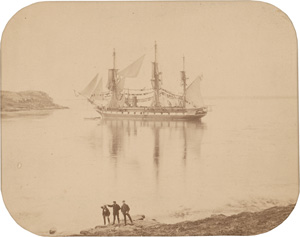
Photographer: Hermann Bobzin (1832-1881). Expedition to the Kerguelen Islands aboard the S.M.S. Gazelle. 1874. 64 albumen prints, mounted to card. Each between 11 x 13,5 cm and 11 x 15,5 cm (mounts between 15,3 x 15,5 cm and 23,6 x 30,3 cm). Each annotated in blue ink below the image on the mount. Presented in original grey canvas portfolio with leather spine, embossed ornamentation, and gilt-embossed title on the front cover: “Photographische Aufnahmen der Deutschen Expedition nach der Kerguelen Insel zur Beobachtung des Vorübergangs der Venus vor der Sonnenscheibe am 9. December 1874,” together with several maps and nautical charts.
This group of photographs documents the German scientific expedition to the Kerguelen Islands in 1874, organized to observe the transit of Venus on 9 December. The images depict expedition members and officers of the naval corvette S.M.S. Gazelle, which transported the party to the subantarctic archipelago, shown at leisure, exploring, and hunting. Further views record temporary encampments - including crew housing, observation platforms, and a portable photographic darkroom—alongside the stark rocky landscape and the island’s flora and fauna.
– Edges of portfolio slightly rubbed, with some scuff marks; edges of mounts bumped and/or chipped; some scuff marks and light fading of prints; otherwise all in good to very good condition.
Konstantinou, Dimitrios
Sculptural fragments from the Acropolis
Los 4085
Ergebnis (inkl. Aufgeld) *
1.250€ (US$ 1,437)
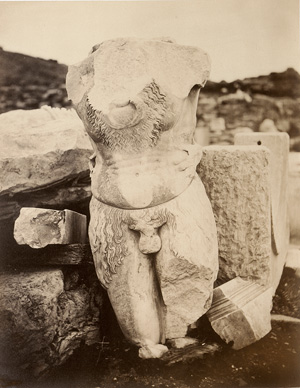
Sculptural fragments from the Acropolis. 1860s. 6 albumen prints, mounted to board. Each between 20 x 26 cm and 27 x 38,5 cm or reverse (mounts between 23,5 x 31 cm and 32 x 47,5 cm or reverse).
A rare group of early photographs documenting sculptural fragments from the Acropolis shortly after their excavation. The images include the Moschophoros (Calf-Bearer) and the Kritios Boy, both shown in their fragmentary state following exhumation, as well as representations of Dionysos and a Dionysiac relief (now in the collection of the Louvre). Several plates depict sections of the Parthenon frieze, including processional figures and horsemen. – Corners of mounts slightly bumped, with some time-staining, particularly around the edges; some scuff marks, fading, and traces of silver mirroring in the darker areas of some prints, otherwise all in good to very good condition.
Konstantinou, Dimitrios and Petros Moraites
Views of the Acropolis
Los 4086
Nachverkaufspreis
1.000€ (US$ 1,149)
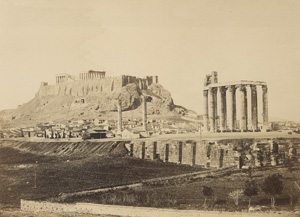
Views of the Acropolis. 1860s. 6 albumen prints, mounted to board. Each between ca. 24 x 32 cm and 27 x 38 cm or reverse (mounts 32,5 x 42,5 cm or reverse). Most signed in the negative in lower margin.
The photographs in this lot include panoramic views of the Acropolis hill with the Parthenon, the Propylaea, and the Temple of Athena Nike, as well as the Odeon of Herodes Atticus at its southern slope. Closer studies focus on architectural and sculptural details, notably sections of the Parthenon frieze and other relief fragments, forming a coherent early photographic record of the Acropolis and its classical remains. – Boards slightly time-stained, with some foxing to one; prints with some scuff marks, fading, and traces of silver mirroring, one with foxing, and two with water stains, otherwise all in good condition.
Lit.: Dorothea Ritter. Im Lichte des Helios: Griechenland und frühe Photographien aus der Sammlung Siegert. Berlin: Umschau/Braus, 1999, ill. p. 64;
Claire L. Lyons, John K. Papadopoulos, Lindsey S. Stewart, and Andrew Szegedy-Maszak, eds. Antiquity & Photography: Early Views of Ancient Mediterranean Sites. London: Thames & Hudson, 2005, ill. p. 122.
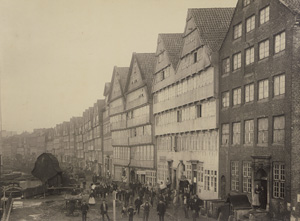
Views of Hamburg. 1905. 7 large-format albumen prints, mounted to board. Each ca. 23,5 x 31,7 cm (mounts ca. 32 x 40 cm). Each embossed below the image on the mount with the photographer’s name “Photograph G. Koppmann & Co. Hamburg” and dated “1905.”
Georg Koppmann ranks among the foremost photographers documenting Hamburg’s urban landscape in the second half of the 19th century. Renowned for his precise large-format views, Koppmann systematically recorded the city’s streets, waterways, and architecture at a moment of rapid modernization. – A few light surface scuff marks, otherwise in good to very good condition.
Lit.: Will Keller. Hamburg in frühen Photographien, 1848-1888: Sammlung Bokelberg. Hamburg: Verlag der Sammlung Bokelberg, 1980.
MacPherson, Robert
View of the Pantheon from the Piazza delle Rotunda
Los 4088
Ergebnis (inkl. Aufgeld) *
750€ (US$ 862)
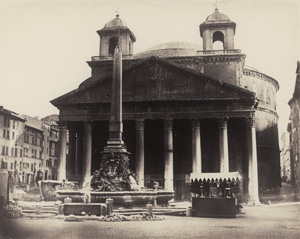
View of the Pantheon from the Piazza della Rotonda. Ca. 1860. Large-format gold-toned albumen print, mounted to card. 29 x 36 cm (mount 47,5 x 61,7 cm). Annotated in pencil in the lower right corner; with the photographer’s blindstamp in the lower margin of the mount and the negative number “237” inscribed in pencil.
Robert Macpherson was one of the leading photographers active in Rome in the mid-19th century, known for his views of ancient ruins and Renaissance monuments. A Scottish artist by training, he settled in Rome in the early 1850s and established a successful practice, working first with paper negatives and later with the albumen process. His photographs are distinguished by their clarity, rich tonal range, and carefully structured compositions, emphasizing architectural form. Produced for scholars, artists, and Grand Tour travelers, his prints were widely collected and often issued with printed captions and numbering, reflecting a systematic approach to documenting Rome’s monuments. – Some scuff marks, edges of print slightly rubbed, otherwise in very good condition.
Michel, Carl
Die Gebärdensprache dargestellt für Schauspieler sowie für Maler und Bildhauer
Los 4089
Ergebnis (inkl. Aufgeld) *
1.875€ (US$ 2,155)
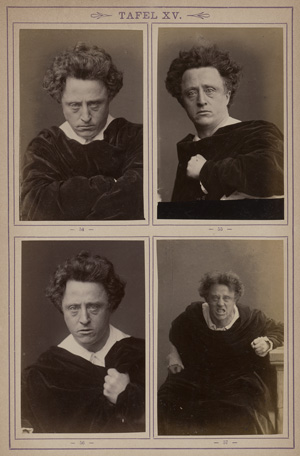
Die Gebärdensprache dargestellt für Schauspieler sowie für Maler und Bildhauer. Vol. I Text & Vol. II Text brochure with plate titles and 94 cartes de visite photos mounted to 25 plates. 25 x 18 cm. 2 contemporary brown canvas volumes with gilt-stamped cover. Cologne, M. DuMont-Schauberg, 1886.
Carl (Karl) Michel studied medicine and established a successful medical practice in Cologne, while pursuing an interest in classical theater and occasionally appearing in smaller roles. In 1892, having secured a stable financial foundation, he decided to devote himself entirely to acting, a transition that also led to the publication of the present work. In addition to extensive text on acting exercises in volume I, the second volume includes 94 photographic images showing Michel in a variety of poses, facial expressions, and dramatic gestures. – Book edges slightly rubbed. Pages toned in edges, some pages with spots, plate XX loose, some photos faded in edges, some with surface scuff marks, otherwise most in good condition.
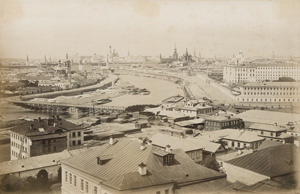
Photographer unknown. View of Moscow. 1870s. Albumen print, mounted to board. 28 x 43,5 cm.
This photograph presents a panoramic view of Moscow in the 1870s, taken from Vshivaya Hill and overlooking the Moskva River and the lower Yauza district. In the foreground, the wooden Ustinsky Bridge spans the river, while barges, warehouses, and tightly packed residential buildings emphasize the city’s pre-industrial riverside economy. – Some light scuff marks, small tears, and fading, along with foxing in the sky area of the print; otherwise in very good condition. With: Two mounted albumen prints of Emperor Alexander III and Empress Maria Feodorovna of Russia.
[*]: Regelbesteuert gemäß Auktionsbedingungen. [^]: Ausgleich von Einfuhr-Umsatzsteuer.
* Alle Angaben inkl. 25% Regelaufgeld ohne MwSt. und ohne Gewähr – Irrtum vorbehalten.
Galerie Bassenge
Erdener Str. 5A
14193 Berlin
Öffnungszeiten:
Montag bis Donnerstag, 10–18 Uhr,
Freitag, 10–16 Uhr
Telefon: +49 30 8938029-0
Fax: +49 30 8918025
E-Mail: info (at) bassenge.com
Impressum
Datenschutzerklärung
© 2026 Galerie Gerda Bassenge
Galerie Bassenge
Erdener Str. 5A
14193 Berlin
Öffnungszeiten:
Montag bis Donnerstag, 10–18 Uhr,
Freitag, 10–16 Uhr
Telefon: +49 30 8938029-0
Fax: +49 30 8918025
E-Mail: info (at) bassenge.com
Impressum
Datenschutzerklärung
© 2026 Galerie Gerda Bassenge