
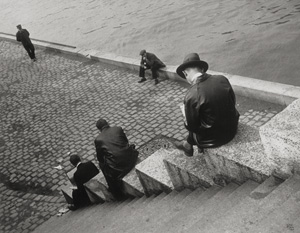
Three Men on Seine Steps. 1931. Gelatin silver print, printed later, mounted to original board. 26,5 x 34 cm. Signed and dated by the photographer in black ink in the lower right; signed, titled, and dated in ink and pencil on mount verso.
Ilse Bing's move from her birth city Frankfurt to the avant-garde and surrealist scene in Paris marked the start of the most notable period of her career. She produced images in the fields of photojournalism, architectural photography, advertising and fashion, and her work was published in magazines such as Le Monde Illustrée, Harper's Bazaar and Vogue. In 1931, Bing's work was exhibited in both France and Germany. Her rapid success as a photographer, and her position as the only professional in Paris to use an advanced Leica camera, earned her the title "Queen of the Leica", coined by the critic and photographer Emmanuel Sougez, whom she met in 1931. – Traces of previous mounting on mount verso, otherwise a rich tonal print in excellent condition.
Lit.: Larisa Dryansky and Edwynn Houk. Ilse Bing. Photography Through the Looking Glass. New York: Abrams, 2006, ill. p. 125.
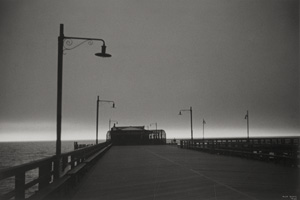
Pier, New York. 1936. Vintage gelatin silver print on Agfa-Brovira paper, mounted in corners to original board. 19 x 28 cm. Signed and dated by the photographer in white ink in lower right.
Mount with some foxing spots and traces of previous mounting on the verso; print lifting from the mount in the lower left corner, otherwise a rich tonal print in excellent condition.
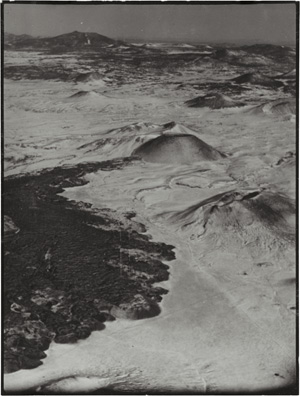
Aerial landscapes. 1930s. 5 gelatin silver prints. Each 10,3 x 7,8 cm or reverse. With the photographer’s “A Margaret Bourke-White Photograph” stamp, as well as numbered in pencil on the verso.
These small-format prints by Margaret Bourke-White belong to a significant phase of her work in the 1930s, when she pioneered aerial photography as a modern visual language. Shot from aircraft, they transform natural landscapes into graphic compositions of light, shadow, and texture, emphasizing abstraction over topographical description. Rather than simple records, these images reflect her broader modernist approach, using elevated viewpoints to reveal underlying structures and patterns, and situating her among the earliest photographers to fully exploit the camera’s ability to reimagine the world from above. – Edges slightly rubbed; some light handling creases and scuff marks, otherwise in very good condition.
Brandt, Marianne
Bauhausfotos Portfolio
Los 4142
Ergebnis (inkl. Aufgeld) *
8.125€ (US$ 9,339)
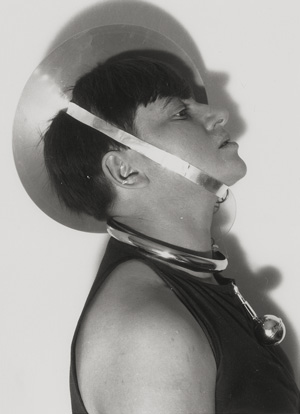
Bauhausfotos portfolio. 1927-1931. 10 gelatin silver prints, printed 1993, hinge-mounted in mats. Each ca. 23,5 x 17,5 cm. Each photograph with portfolio stamp on the verso, therein numbered “23” (of 30). Presented in original canvas clamshell box with text and colophon sheet. Sabine Hartmann and Karsten Hitz (eds.) for Bauhaus-Archiv GmbH, Berlin, 1993.
The portfolio brings together key photographs by Marianne Brandt from her Bauhaus period, reflecting her experimental engagement with reflection, material, and self-representation. Several works - including Selbstportrait in der Kugel gespiegelt, Das Atelier in der Kugel I-II, and Selbstportrait mit Schmuck zum Metallischen Fest - explore the artist’s image through mirrored surfaces and spherical distortions, dissolving the boundary between subject and object. Complementary still lifes, such as Spiegelungen (Stilleben aus Metall und Glas) and Stilleben in der Metallwerkstatt, emphasize the interplay of light, texture, and industrial materials, while Bauhausbühne I-II document performative aspects of the Bauhaus stage. The group is completed by Selbstportrait, Doppelbelichtung, in which Brandt uses photographic superimposition to further destabilize a fixed sense of identity. Together, the works exemplify the innovative spirit of Bauhaus photography, combining formal experimentation with a probing exploration of perception and modern subjectivity. – Clamshell box with a few scuff marks and light pen marks; one print with more pronounced retouching, one with a few light pressure marks, otherwise prints in excellent condition.
Lit.: Marianne Brandt. Fotografien am Bauhaus. Ostfildern-Ruit: Hatje Cantz, 2003, ill. pp. 45, 47, 49, 51, 55, 57, 71, 82, 83 and front cover.
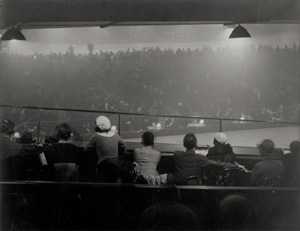
Brassaï
Six-Day cycle race at the Vélodrome d'hiver
Los 4143
Nachverkaufspreis
2.500€ (US$ 2,874)
Six-Day cycle race at the Vélodrome d’Hiver. 1931-33. Vintage ferrotyped gelatin silver print, hinge-mounted along the upper edge to mat. 23,6 x 27,5 cm. Photographer’s “Photo Brassaï, Copyright by Gyula Halász, 74, rue de la Glacière, Paris (13e)” stamp and number in pencil on the verso.
At the age of 25, Brassaï settled in Paris, where he quickly immersed himself in the city’s cultural milieu, forming close connections with figures such as Pablo Picasso, Salvador Dalí, and Henri Matisse, while engaging with the Surrealist movement and city life at night. His photographs have since become iconic, ranging from enigmatic night views of the French capital - often shrouded in fog or drenched in rain - to portraits of celebrities and ordinary people, as well as scenes of cafés, dance halls, and graffiti on Parisian walls.
Describing himself as a “creator of images,” Brassaï sought to capture fleeting moments of light within darkness, revealing a poetic dimension in everyday life. His explorations led him to document the “secret” Paris of bars, cabarets, and brothels, portraying those on the margins of society with the same immediacy and dignity as members of the cultural elite. – A few light pressure marks, otherwise in very good condition.
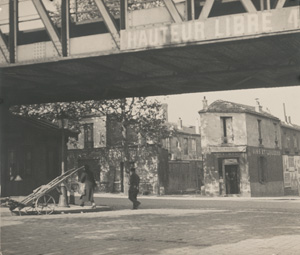
Breitenbach, Josef
Paris, Boulevard de la Gare
Los 4144
Nachverkaufspreis
1.000€ (US$ 1,149)
Paris, Boulevard de la Gare. 1935. Vintage gelatin silver print on chamois paper. 23,8 x 28 cm. Annotated and dated in pencil on the verso.
Josef Breitenbach was a self-taught photographer who turned to the medium in the early 1930s, opening his first studio in Munich in 1932, where he focused on press and studio work. Following the rise of National Socialism, he was forced to emigrate in 1933, first to Paris, where he continued his practice until 1941, and subsequently to New York. There, he established a third studio and remained active as a photographer until his death in 1984. – A few nicks in edges, otherwise in very good condition.
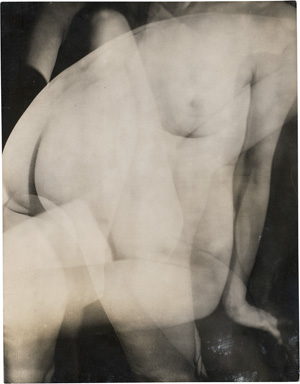
Bruguière, Francis Joseph
Experiment (multiple exposure)
Los 4145
Ergebnis (inkl. Aufgeld) *
1.625€ (US$ 1,868)
Experiment (multiple exposure). Ca. 1926. Vintage gelatin silver print on doubleweight paper. 23,8 x 18,3 cm.
Both an artist and a photographer, Francis Bruguière studied under Frank Eugene and was acquainted with Alfred Stieglitz. Between 1919-1927 he had a studio in New York while taking portraits for Harper's Bazaar, Vanity Fair and Vogue. In 1928, Bruguière moved his studio to London. In the same year he had a solo exhibition in Herbert Walden's avant-garde gallery Der Sturm in Berlin. He remained in London until 1937. – Silver mirroring along the edges in the shadow areas; some soiling and traces of previous mounting on the verso; corners bumped; small creases to the lower and upper left corners; a light spot to the upper right and a few spots to the lower right, otherwise in good condition.
Lit.: James Enyeart. Francis Bruguière: His Photographs and his Life. New York: Knopf, 1977, ill. plate 28.
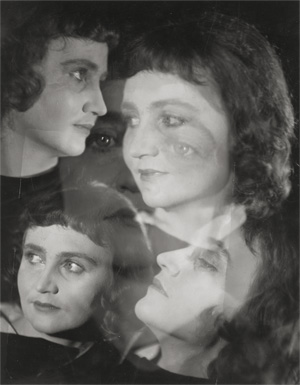
Bruguière, Francis Joseph
Portrait study, Cynthia Fuller (multiple exposure)
Los 4146
Ergebnis (inkl. Aufgeld) *
750€ (US$ 862)
Portrait study, Cynthia Fuller (multiple exposure). 1929. Vintage gelatin silver print on doubleweight paper, mounted to mat. 23,8 x 18,6 cm.
Minimal silver mirroring in corners, a few pressure marks and light scratch marks, otherwise in good condition.
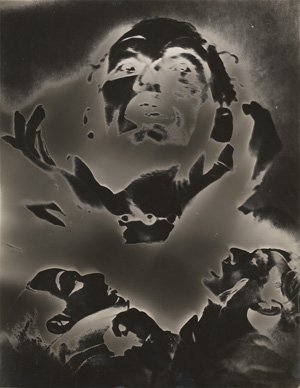
Bruguière, Francis Joseph
Solarization of a negative from "The Way"
Los 4147
Nachverkaufspreis
1.500€ (US$ 1,724)
Solarization of a negative from The Way. Ca. 1936-40. Vintage gelatin silver print on doubleweight paper. 25,2 x 20,2 cm.
Silver mirroring along the edges; some soiling on the verso; a few pressure marks and fingerprints; a small spot in the upper right, otherwise in good condition.
Lit.: James Enyeart. Francis Bruguière: His Photographs and his Life. New York: Knopf, 1977, ill. plate 100 (variant).
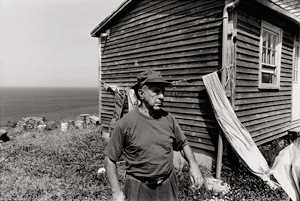
Robert Frank, Cape Breton. 1998. Gelatin silver print, printed later. 21,2 x 32 cm (sheet 27,5 x 35,5 cm). Signed, titled and dated by the photographer in pencil, as well as photographer's copyright stamp on the verso.
During his long career as a cameraman and photographer, Norbert Bunge developed close connections with a wide range of photographers. Among them was the otherwise reclusive Robert Frank, whom he met and photographed. – In excellent condition.
Lit.: Mathias Bertram, ed. Norbert Bunge: Fotografien. Leipzig: Lehmstedt 2017, ill. p. 124.
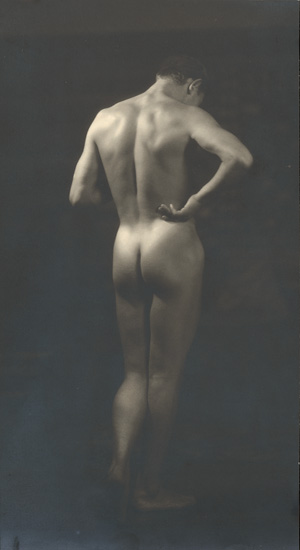
Male nude. Early 1930s. Vintage warm-toned gelatin silver print. 20 x 11 cm. Photographer's stamp on the verso.
Will Burgdorf began his career as a photographer in 1930, and by 1931, had established a studio at Lister Platz in Hanover. He specialized in portraiture and expressively posed nudes, often depicting his sitters with closed eyes, lending his images a distinctive sense of inward contemplation. With the outbreak of the Second World War, Burgdorf’s career came to an abrupt end, and he was reported missing in 1945. – Some oxidation mirroring in lower area and edge, otherwise in very good condition.
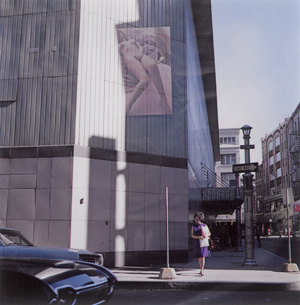
Callahan, Harry
Nude on Building, Providence
Los 4150
Ergebnis (inkl. Aufgeld) *
1.875€ (US$ 2,155)
Nude on Building, Providence. 1970. Dye transfer print, printed 1980s. 18,5 x 18,2 cm (sheet 23,7 x 20,9 cm). Signed by the photographer in pencil in lower margin.
Harry Callahan’s color photographs, produced in the later years of his career, are widely celebrated for their vivid, introspective, and often abstract qualities. Exploring a wide range of subjects - from landscapes and cityscapes to portraiture - Callahan used color to add a new dimension of depth and emotional resonance, further enriching his already distinguished body of work. – Traces of previous mounting on the verso along the upper edge; a few small spots, otherwise in very good condition.
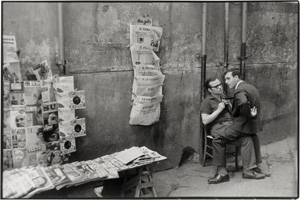
Naples, Italy. 1960. Vintage gelatin silver print. 25,5 x 16,8 cm. Monogrammed "H.C.B." in pencil in lower margin; photographer's reproduction limitation stamp, annotated and layout marks in ink/pencil as well as "Manchete" magazine stamp and text excerpt label on the verso.
Henri Cartier-Bresson is best known for his pioneering role in modern photojournalism and as a co-founder of the Magnum Photos agency. Renowned for his concept of the “decisive moment,” he possessed a rare ability to capture fleeting, unposed situations with clarity and precision, rendering his subjects natural and often unaware of the camera. His photographs are distinguished by their formal simplicity and quiet immediacy. A print of this image is held in the collection of the Museum of Modern Art, New York. – Creases and soiling in margins, corners bumped, a few handling dents, light spot to left of seated men, otherwise in good condition.
Chaldej, Jewgeni
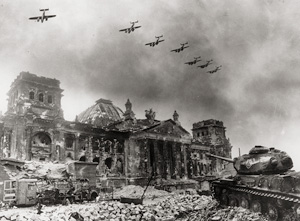
Planes over the Reichstag
Los 4152
Ergebnis (inkl. Aufgeld) *
625€ (US$ 718)
Planes over the Reichstag, Berlin. April 1945. Gelatin silver print, printed early 1990s. 30 x 40 cm. Signed by the photographer in pencil on the verso.
Jewgeni Chaldej, a Soviet photojournalist, is renowned for his photographs documenting the capture of Berlin by Soviet troops on May 2, 1945, marking the end of World War II in Europe. His images, particularly the iconic scene of the Soviet flag being raised on the Reichstag building, have become crucial visual records of this historic moment. – Slightly buckled, some nicks in edges, otherwise in very good condition.
Lit.: Ernst Volland and Heinz Krimmer, eds. Von Moskau nach Berlin: Bilder des russischen Fotografen Jewgeni Chaldej. Berlin: Parthas 1999, ill. p. 70.
Chaldej, Jewgeni
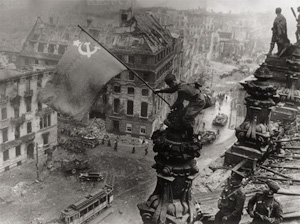
Atop the Berlin Reichstag, May 2, 1945
Los 4153
Nachverkaufspreis
800€ (US$ 920)
Atop the Berlin Reichstag, May 2, 1945. Gelatin silver print, printed later. 22,8 x 30,3 cm. Signed by the photographer and annotated by another hand in pencil on the verso.
A compelling document of this historic moment, later recounted by the photographer himself: "Early in the morning on May 2, 1945, I entered it (the Reichstag). I was surrounded by horrendous noise, Russians and Germans were all shouting in horrible confusion ... A pleasant young soldier came up to me. I had a red flag in my hand. He said, 'Lieutenant, davai, let's hurry up and climb onto the roof with the flag' ... We started out, but all the stairs were badly damaged. When we finally got up the Reichstag was on fire. ...We found a long pole. I spent lots of time trying out different compositions. I took one picture from the left, but that wasn't any good. I wanted Berlin to be clearly visible in the picture. Then I said, 'Boys, go and stand over there and raise the flag ... then try over there'. There were three of them. One was from the Ukraine, the other from Machatshkala in Dagestan and the third was a Russian. ... I shot a whole roll of film, 36 shots." (cited in Volland/Krimmer, p. 151). – In very good condition.
Lit.: Ernst Volland and Heinz Krimmer, eds. Von Moskau nach Berlin: Bilder des russischen Fotografen Jewgeni Chaldej. Berlin: Parthas 1999, ill. pp. 65-67 (images from the same series).
[*]: Regelbesteuert gemäß Auktionsbedingungen. [^]: Ausgleich von Einfuhr-Umsatzsteuer.
* Alle Angaben inkl. 25% Regelaufgeld ohne MwSt. und ohne Gewähr – Irrtum vorbehalten.
Galerie Bassenge
Erdener Str. 5A
14193 Berlin
Öffnungszeiten:
Montag bis Donnerstag, 10–18 Uhr,
Freitag, 10–16 Uhr
Telefon: +49 30 8938029-0
Fax: +49 30 8918025
E-Mail: info (at) bassenge.com
Impressum
Datenschutzerklärung
© 2026 Galerie Gerda Bassenge
Galerie Bassenge
Erdener Str. 5A
14193 Berlin
Öffnungszeiten:
Montag bis Donnerstag, 10–18 Uhr,
Freitag, 10–16 Uhr
Telefon: +49 30 8938029-0
Fax: +49 30 8918025
E-Mail: info (at) bassenge.com
Impressum
Datenschutzerklärung
© 2026 Galerie Gerda Bassenge