
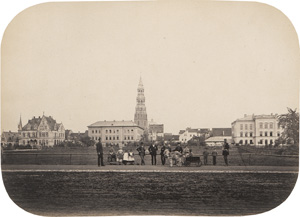
Views of Zwickau. 1870s. 12 albumen prints, mounted to cards. Each 11,3 x 15,8 cm (mounts 21,6 x 29,5 cm). Each with printed caption “Zwickau und Umgebung,” copyright information, and numbered and annotated in pencil below the image on the mount. Presented in the original green canvas portfolio with gilt-embossed title and decorative borders.
A cohesive group of 19th-century topographical photographs depicting Zwickau and its surroundings, combining views of prominent civic buildings, historic landmarks, and residential architecture with river landscapes and urban panoramas. The series presents both the city’s medieval heritage - such as the Gothic Gewandhaus - and its rapid late 19th-century development through Gründerzeit public and private buildings, reflecting Zwickau’s growing economic importance. – Edges of portfolio slightly rubbed; cards slightly age-stained. Some very light scuff marks and minor fading; otherwise strong tonal prints in near excellent condition.
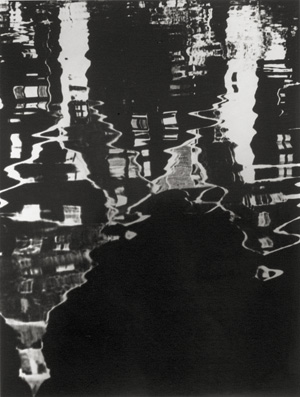
Angenendt, Erich
Spiegelung, Rathaus Besigheim
Los 4125
Ergebnis (inkl. Aufgeld) *
575€ (US$ 661)
Spiegelung, Rathaus Besigheim. Ca. 1955. Vintage gelatin silver print, mounted to board. 26,7 x 20,2. Photographer's stamp on mount verso.
In excellent condition.
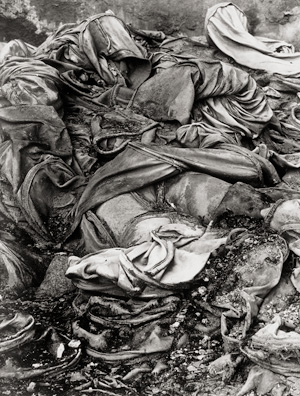
Untitled. 1990. Large-format gelatin silver print on Agfa paper, printed later. 40,3 x 30,2 cm. Signed, dedicated by the photographer in pencil as well as copyright stamp, therein editioned "e.a." on the verso.
A few light surface marks, otherwise in very good condition.
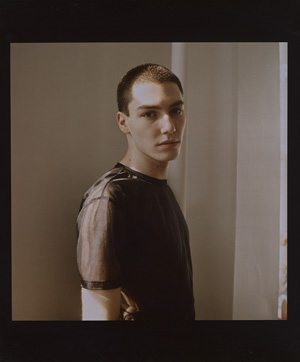
Boris, NYC. 1997. Chromogenic print, hinge-mounted to board. 61 x 50,5 cm (mount 66 x 56 cm). Signed, titled, dated and editioned "2/5" in pencil on the verso. Framed under glass in wooden frame.
David Armstrong was an American photographer associated with the Boston School of photography, known for his intimate, emotionally resonant portraiture. Emerging in the late 1970s, alongside his close friend Nan Goldin, he developed a distinctive style defined by natural light, shallow focus, and a quiet, contemplative mood. His portraits - often of friends, lovers, and fellow artists - evoke a strong sense of trust and vulnerability, capturing fleeting expressions and introspective moments. – A few very faint handling creases, otherwise in near excellent condition.
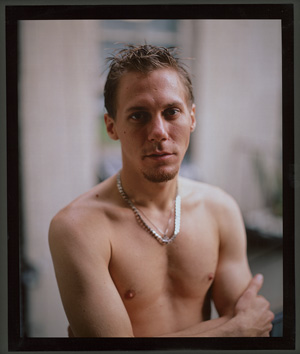
Armstrong, David
Sean at the Bowery, NYC
Los 4130 [*]
Ergebnis (inkl. Aufgeld) *
1.500€ (US$ 1,724)
Sean at the Bowery, NYC. 1997. Chromogenic print, hinge-mounted to board. 61 x 50,5 cm (mount 66 x 56 cm). Signed, titled, dated and editioned "3/5" in pencil on the verso. Framed under glass in wooden frame.
A few very faint handling creases, otherwise in near excellent condition.
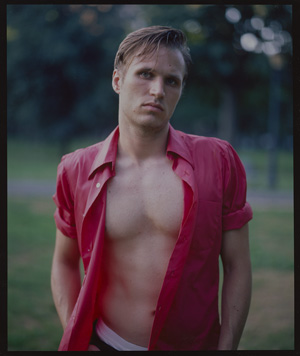
Armstrong, David
Andrew, New Haven Green
Los 4131 [*]
Ergebnis (inkl. Aufgeld) *
1.875€ (US$ 2,155)
Andrew, New Haven Green. 1997. Chromogenic print, hinge-mounted to board. 61 x 50,5 cm (mount 66 x 56 cm). Signed, titled, dated and editioned "3/5" in pencil on the verso. Framed under glass in wooden frame.
A few very faint handling creases, otherwise in near excellent condition.
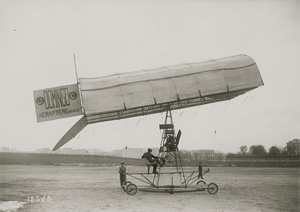
Photographers: Maurice-Louis Branger (1878-1950), Agence Rol (active 1904-1937). Early aviation and aeronautical experiments in France. Ca. 1908-1913. 13 gelatin silver press photographs. Each ca. 12,7 x 18 cm. With press-agency copyright stamps, including “Copyright - Reproduction interdite / M. Rol, 4, rue Richer, Paris IXe” and “Copyright / M. Branger, 5, rue Cambon, Paris,” as well as annotated in blue ink on the verso.
These photographs place French aviation at a moment when scientific research and public spectacle still overlapped, tracing the shift from tethered man-lifting kites to powered aircraft presented before large crowds as signs of technological progress. The images show early box-like biplanes, experimental seaplanes tested on open water, and unconventional designs such as Jérôme Donnet’s circular-wing Donnet Aéraptère, photographed during ground and taxi tests at Suresnes shortly before the First World War. Together, they document a period of intense experimentation, when multiple approaches to flight coexisted before aviation assumed a more standardized form. – Some scuff marks, handling creases, and small tears, as well as minor signs of silver mirroring and discoloration visible on some prints; otherwise all in good to very good condition.
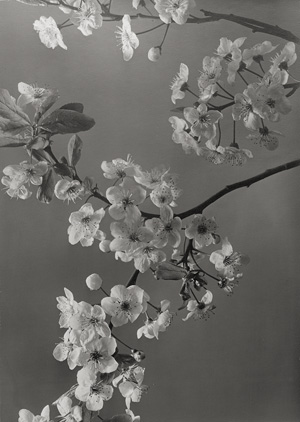
Cherry blossoms. 1940s. Vintage gelatin silver print on doubleweight ivory paper. 30 x 21,6 cm. Photographer's copyright stamp on the verso,
Minimal silver mirroring in lower and side edges, otherwise in excellent condition.
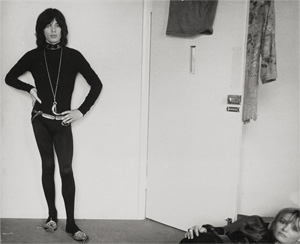
Beaton, Cecil
Mick Jagger with Anita Pallenberg iin the film "Performance"
Los 4136
Ergebnis (inkl. Aufgeld) *
688€ (US$ 790)
Mick Jagger with Anita Pallenberg in the film Performance. 1968. Vintage gelatin silver print. 23,2 x 28,3 cm. 2 agency stamps and label with typed press text on the verso.
Known for his glamorous celebrity portraits, Cecil Beaton also photographed on film sets. This image shows a very young Mick Jagger in his first screen role in Performance. Shot in 1968 but released only in 1970, the film was initially withheld by Warner Bros. due to its sexual content and graphic violence. Though it received mixed reviews at the time, it has since been reassessed as a highly influential and innovative work of the 1970s, featuring one of the most notable screen performances by a rock musician. – Corners bumped, some handling dents and creases in upper left and lower area, otherwise in good condition.
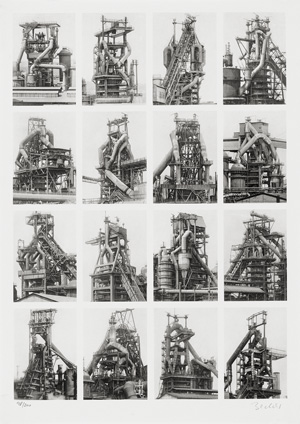
Hochöfen (Blast Furnaces). 1971. Collotype. 45 x 32 cm. Signed and numbered "98/300" by the photographers in pencil in lower margin, number notation in pencil on the verso.
Bernd and Hilla Becher, the influential German conceptual artists and photographers, collaborated throughout their careers to document industrial architecture with remarkable precision and consistency. They are best known for their extensive typologies of structures such as water towers, blast furnaces, and framework houses, often presented in grids to highlight formal similarities and regional variations. Their work, characterized by its objective style and conceptual rigor, significantly influenced the development of contemporary photography and led to the founding of the Düsseldorf School of Photography, shaping the practices of subsequent generations of photographers. – In excellent condition.
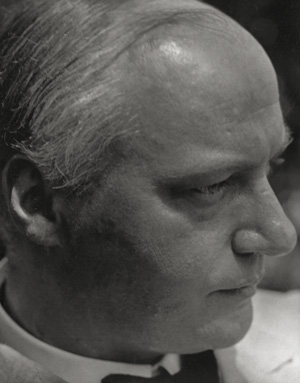
Biermann, Aenne
Portrait of Martin Engels, Gera
Los 4138
Ergebnis (inkl. Aufgeld) *
1.750€ (US$ 2,011)
Portrait of Martin Engels, Gera. Ca. 1928. Vintage ferrotyped gelatin silver print, mounted to board. 22,5 x 17,8 cm. Signed and annotated "Gera" by the photographer in pencil below the image on the mount; photographer's "d.w.b" stamp, therein numbered twice in pencil on the verso.
Aenne Biermann was a self-taught photographer whose work, though developed independently of the European avant-garde, aligns closely with the formal clarity and experimental spirit of modernism. Today, several of her images are regarded as icons of New Vision photography, and her work was included in the landmark Film und Foto exhibition in Stuttgart. Following her early death, much of her oeuvre was confiscated under National Socialism, and many prints and negatives remain lost. The present photograph, sent by Biermann to her friend Martin Engels, constitutes a rare and personal document within her oeuvre. Gertrud and Martin Engels, progressive educators and long-time neighbors of the Biermanns in Gera, were part of her close circle. Biermann frequently photographed the Engels family - particularly the children - and such images are now held in major international collections. – Some areas of light surface rubbing, a few nicks in edges, otherwise in very good condition.
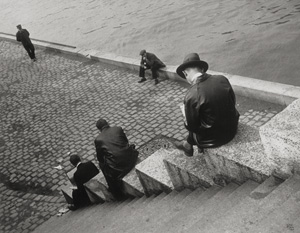
Three Men on Seine Steps. 1931. Gelatin silver print, printed later, mounted to original board. 26,5 x 34 cm. Signed and dated by the photographer in black ink in the lower right; signed, titled, and dated in ink and pencil on mount verso.
Ilse Bing's move from her birth city Frankfurt to the avant-garde and surrealist scene in Paris marked the start of the most notable period of her career. She produced images in the fields of photojournalism, architectural photography, advertising and fashion, and her work was published in magazines such as Le Monde Illustrée, Harper's Bazaar and Vogue. In 1931, Bing's work was exhibited in both France and Germany. Her rapid success as a photographer, and her position as the only professional in Paris to use an advanced Leica camera, earned her the title "Queen of the Leica", coined by the critic and photographer Emmanuel Sougez, whom she met in 1931. – Traces of previous mounting on mount verso, otherwise a rich tonal print in excellent condition.
Lit.: Larisa Dryansky and Edwynn Houk. Ilse Bing. Photography Through the Looking Glass. New York: Abrams, 2006, ill. p. 125.
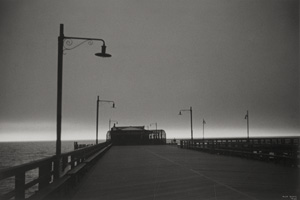
Pier, New York. 1936. Vintage gelatin silver print on Agfa-Brovira paper, mounted in corners to original board. 19 x 28 cm. Signed and dated by the photographer in white ink in lower right.
Mount with some foxing spots and traces of previous mounting on the verso; print lifting from the mount in the lower left corner, otherwise a rich tonal print in excellent condition.
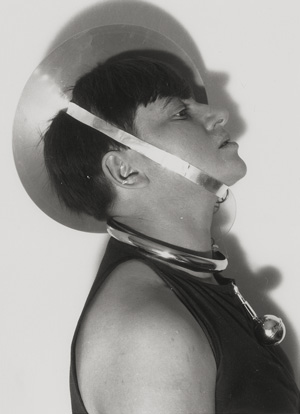
Bauhausfotos portfolio. 1927-1931. 10 gelatin silver prints, printed 1993, hinge-mounted in mats. Each ca. 23,5 x 17,5 cm. Each photograph with portfolio stamp on the verso, therein numbered “23” (of 30). Presented in original canvas clamshell box with text and colophon sheet. Sabine Hartmann and Karsten Hitz (eds.) for Bauhaus-Archiv GmbH, Berlin, 1993.
The portfolio brings together key photographs by Marianne Brandt from her Bauhaus period, reflecting her experimental engagement with reflection, material, and self-representation. Several works - including Selbstportrait in der Kugel gespiegelt, Das Atelier in der Kugel I-II, and Selbstportrait mit Schmuck zum Metallischen Fest - explore the artist’s image through mirrored surfaces and spherical distortions, dissolving the boundary between subject and object. Complementary still lifes, such as Spiegelungen (Stilleben aus Metall und Glas) and Stilleben in der Metallwerkstatt, emphasize the interplay of light, texture, and industrial materials, while Bauhausbühne I-II document performative aspects of the Bauhaus stage. The group is completed by Selbstportrait, Doppelbelichtung, in which Brandt uses photographic superimposition to further destabilize a fixed sense of identity. Together, the works exemplify the innovative spirit of Bauhaus photography, combining formal experimentation with a probing exploration of perception and modern subjectivity. – Clamshell box with a few scuff marks and light pen marks; one print with more pronounced retouching, one with a few light pressure marks, otherwise prints in excellent condition.
Lit.: Marianne Brandt. Fotografien am Bauhaus. Ostfildern-Ruit: Hatje Cantz, 2003, ill. pp. 45, 47, 49, 51, 55, 57, 71, 82, 83 and front cover.
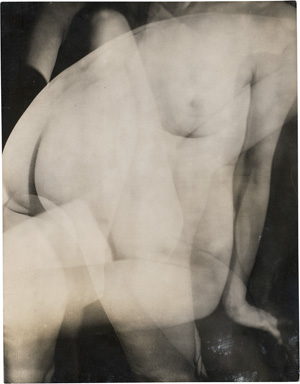
Bruguière, Francis Joseph
Experiment (multiple exposure)
Los 4145
Ergebnis (inkl. Aufgeld) *
1.625€ (US$ 1,868)
Experiment (multiple exposure). Ca. 1926. Vintage gelatin silver print on doubleweight paper. 23,8 x 18,3 cm.
Both an artist and a photographer, Francis Bruguière studied under Frank Eugene and was acquainted with Alfred Stieglitz. Between 1919-1927 he had a studio in New York while taking portraits for Harper's Bazaar, Vanity Fair and Vogue. In 1928, Bruguière moved his studio to London. In the same year he had a solo exhibition in Herbert Walden's avant-garde gallery Der Sturm in Berlin. He remained in London until 1937. – Silver mirroring along the edges in the shadow areas; some soiling and traces of previous mounting on the verso; corners bumped; small creases to the lower and upper left corners; a light spot to the upper right and a few spots to the lower right, otherwise in good condition.
Lit.: James Enyeart. Francis Bruguière: His Photographs and his Life. New York: Knopf, 1977, ill. plate 28.
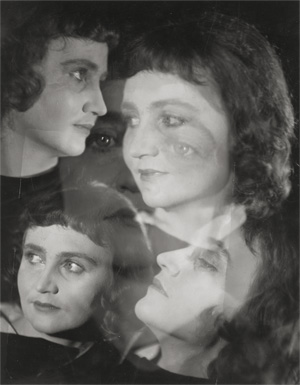
Bruguière, Francis Joseph
Portrait study, Cynthia Fuller (multiple exposure)
Los 4146
Ergebnis (inkl. Aufgeld) *
750€ (US$ 862)
Portrait study, Cynthia Fuller (multiple exposure). 1929. Vintage gelatin silver print on doubleweight paper, mounted to mat. 23,8 x 18,6 cm.
Minimal silver mirroring in corners, a few pressure marks and light scratch marks, otherwise in good condition.
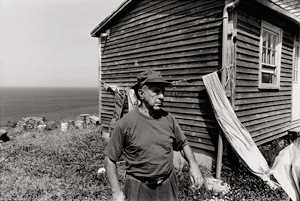
Robert Frank, Cape Breton. 1998. Gelatin silver print, printed later. 21,2 x 32 cm (sheet 27,5 x 35,5 cm). Signed, titled and dated by the photographer in pencil, as well as photographer's copyright stamp on the verso.
During his long career as a cameraman and photographer, Norbert Bunge developed close connections with a wide range of photographers. Among them was the otherwise reclusive Robert Frank, whom he met and photographed. – In excellent condition.
Lit.: Mathias Bertram, ed. Norbert Bunge: Fotografien. Leipzig: Lehmstedt 2017, ill. p. 124.
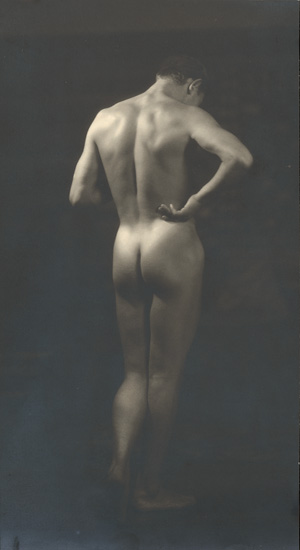
Male nude. Early 1930s. Vintage warm-toned gelatin silver print. 20 x 11 cm. Photographer's stamp on the verso.
Will Burgdorf began his career as a photographer in 1930, and by 1931, had established a studio at Lister Platz in Hanover. He specialized in portraiture and expressively posed nudes, often depicting his sitters with closed eyes, lending his images a distinctive sense of inward contemplation. With the outbreak of the Second World War, Burgdorf’s career came to an abrupt end, and he was reported missing in 1945. – Some oxidation mirroring in lower area and edge, otherwise in very good condition.
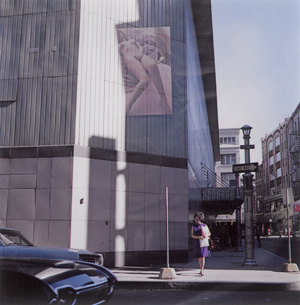
Callahan, Harry
Nude on Building, Providence
Los 4150
Ergebnis (inkl. Aufgeld) *
1.875€ (US$ 2,155)
Nude on Building, Providence. 1970. Dye transfer print, printed 1980s. 18,5 x 18,2 cm (sheet 23,7 x 20,9 cm). Signed by the photographer in pencil in lower margin.
Harry Callahan’s color photographs, produced in the later years of his career, are widely celebrated for their vivid, introspective, and often abstract qualities. Exploring a wide range of subjects - from landscapes and cityscapes to portraiture - Callahan used color to add a new dimension of depth and emotional resonance, further enriching his already distinguished body of work. – Traces of previous mounting on the verso along the upper edge; a few small spots, otherwise in very good condition.
[*]: Regelbesteuert gemäß Auktionsbedingungen. [^]: Ausgleich von Einfuhr-Umsatzsteuer.
* Alle Angaben inkl. 25% Regelaufgeld ohne MwSt. und ohne Gewähr – Irrtum vorbehalten.
Galerie Bassenge
Erdener Str. 5A
14193 Berlin
Öffnungszeiten:
Montag bis Donnerstag, 10–18 Uhr,
Freitag, 10–16 Uhr
Telefon: +49 30 8938029-0
Fax: +49 30 8918025
E-Mail: info (at) bassenge.com
Impressum
Datenschutzerklärung
© 2026 Galerie Gerda Bassenge
Galerie Bassenge
Erdener Str. 5A
14193 Berlin
Öffnungszeiten:
Montag bis Donnerstag, 10–18 Uhr,
Freitag, 10–16 Uhr
Telefon: +49 30 8938029-0
Fax: +49 30 8918025
E-Mail: info (at) bassenge.com
Impressum
Datenschutzerklärung
© 2026 Galerie Gerda Bassenge