
Aguado, Olympe
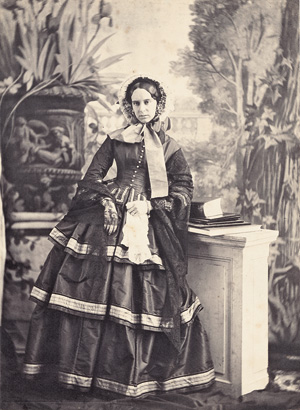
Studio portrait of a woman
Los 4001
Ergebnis (inkl. Aufgeld) *
2.500€ (US$ 2,874)
Studio portrait of a young woman. 1850s. Salted paper print, mounted to thin card. 22,5 x 16,5 cm (mount 37,5 x 30,5 cm). Annotated “par M. Aguado” in pencil in the lower margin of the mount.
Count Olympe-Clément-Auguste-Alexandre Aguado de las Marismas, was a Franco-Spanish photographer and socialite active primarily in the 1850s and 1860s, and among several early practitioners trained by Gustave Le Gray. Working from his studio on the Place Vendôme in Paris, he quickly moved beyond the daguerreotype, experimenting with paper negatives and collodion on glass, and became a founding member of the Société française de photographie in 1854. Born into a wealthy Spanish banking family, Aguado devoted considerable resources to photography, producing landscapes, portraits, and staged tableaux vivants that often playfully reflect the social conventions of the Second Empire.
– A few handling creases and some foxing to the mount; print in excellent condition with strong tones.
Lit.: Sylvain Morand, ed. Olympe Aguado (1827-1894): Photographe. Strasbourg: Musées de Strasbourg, 1997.
Aguado, Olympe
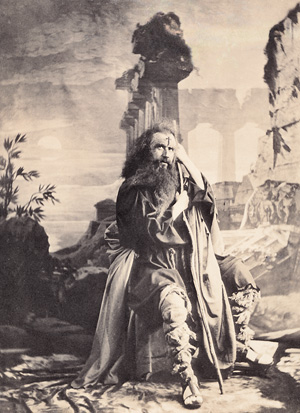
Eugène Massol in the opera "The Wandering Jew"
Los 4002
Ergebnis (inkl. Aufgeld) *
1.500€ (US$ 1,724)
Eugène Massol in the opera The Wandering Jew. 1852. Salted paper print, mounted to card. 23,7 x 17,2 cm (mount 37,5 x 29,7 cm). Annotated “par M. Aguado” in pencil in the lower margin; publisher’s blindstamp “E B” with caduceus in the lower left corner.
This photograph depicts the baritone Eugène Massol in the role of Ashvérus in the opera The Wandering Jew. – Faint crease in the upper left margin of the mount; vertical discoloration along the upper center of the mount; print in excellent condition with strong tones.
Lit.: Sylvain Morand, ed. Olympe Aguado (1827-1894): Photographe. Strasbourg: Musées de Strasbourg, 1997.
Ahrendts, Leopold
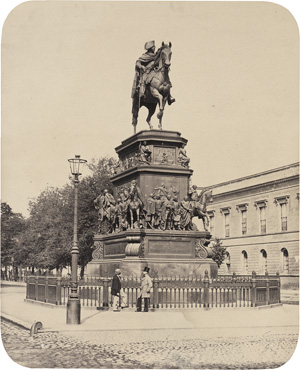
Equestrian statue of Friedrich II. / Kronprinzenpalais / Brandenburger Tor
Los 4003
Ergebnis (inkl. Aufgeld) *
1.250€ (US$ 1,437)
Equestrian statue of Friedrich II / Kronprinzenpalais / Brandenburger Tor. 1860s. 3 albumen prints with rounded corners, mounted to card. Between 21,5 x 17,5 cm and 17 x 23 cm (mounts between 29,2 x 22,3 cm and 26,3 x 34,8 cm). Annotated in black ink below the image on the mounts.
Leopold Ahrendts began his artistic career as a painter and lithographer in Dessau, eventually transitioning to photography around the mid-19th century. His work as a photographer included urban landscapes and architectural views of Berlin, reflecting a keen eye for composition and detail. His significant contributions to the field led to his participation in international photographic exhibitions and widespread recognition as an architectural photographer. – Some buckling, handling creases and/or small tears on mounts. Some fading and scattered fading spots on the prints; otherwise in very good condition.
Lit.: Hendrik Berinson, Natalia Kazmierczak, and Ira Plein, eds. Leopold Ahrendts (1825-1870) und die Frühzeit der Photographie. Berlin: Galerie Berinson, 2011, ill. pp. 17, 59 (variants).
Eberhard Mayer-Wegelin and Sigrid Schulze, eds. Berlin als Residenzstadt: Photographien von Leopold Ahrendts 1854-1870. Munich: Schirmer/Mosel, 2018, ill. pp. 111, 127.
Ahrendts, Leopold
Views of the Altes Museum, Berlin
Los 4004
Ergebnis (inkl. Aufgeld) *
750€ (US$ 862)
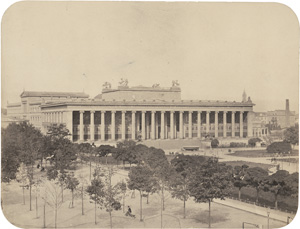
Views of the Altes Museum, Berlin. 1860s. 2 albumen prints with rounded corners, mounted to card. 17,6 x 23 cm and 22,7 x 17,5 cm (mounts 23,5 x 34 cm and 28,2 x 23 cm). Annotated in black ink below the image on the mount.
This lot comprises a general view of the Altes Museum, likely taken from the roof of the Zeughaus, as well as a view of the sculpture Kämpfende Amazone by August Kiss (1802-1865) at the entrance of the museum. – Mounts slightly soiled and/or torn. Some fading and scattered fading spots on the prints; otherwise in good condition.
Lit.: Hendrik Berinson, Natalia Kazmierczak, and Ira Plein, eds. Leopold Ahrendts (1825-1870) und die Frühzeit der Photographie. Berlin: Galerie Berinson, 2011, ill. p. 19.
Lothar de Maizière and Antonius Jammers, eds. Bevor Berlin zur Weltstadt wurde: Die Residenz in Fotografien von Leopold Ahrendts. Berlin: Verlagshaus Braun, 2001, ill. pp. 56, 58 (variants).
Eberhard Mayer-Wegelin and Sigrid Schulze, eds. Berlin als Residenzstadt: Photographien von Leopold Ahrendts 1854-1870. Munich: Schirmer/Mosel, 2018, ill. p. 90 (variant), 99.
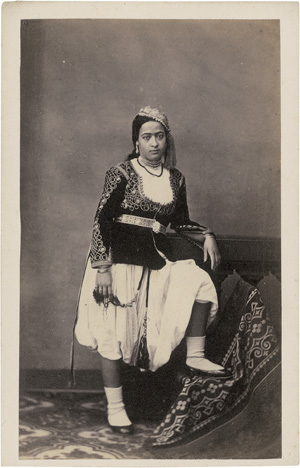
Photographers: Alary & Geiser (active 1850s-1880s), Adolphe Clavier (1821-1894 ), Charles Leinack (active 1850s-1860s), Photographie Saharienne (active 1860s), B.B. Photographie Orientale (1862-1890), Claude-Joseph Portier (1841-1910), Eugène Hilaire Richan (active 1855-1870s). Women of Algiers. 1860s-1870s. 51 albumen prints, mounted to board. Each ca. 9,2 x 5,5 cm (mounts ca. 10,5 x 6,2 cm). Most with the photographer's studio information printed on the verso.
This lot comprises a compelling group of 19th-century studio portraits depicting women from Algiers and surrounding regions, shown in elaborate traditional dress within staged interiors. The sitters - identified as Moorish, Jewish, Kabyle, Ouled Naïl, and sub-Saharan - appear alone or in small groups, their attire and poses emphasizing ethnographic “types” over individual identity. Produced for a European market, the photographs reflect the visual culture of colonial Algeria, combining ethnographic curiosity with the conventions of Orientalist studio photography. – Some scuff marks as well as light foxing and fading on several prints, otherwise all in good to very good condition.
Alinari, Fratelli
Fonte Gaia, Piazza del Campo, Siena; Pisa Cathedral; Palazzo della Signoria, Perugia
Los 4006
Ergebnis (inkl. Aufgeld) *
1.000€ (US$ 1,149)
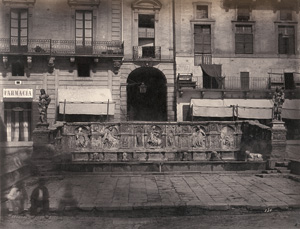
Fonte Gaia, Piazza del Campo, Siena; Pisa Cathedral; Palazzo della Signoria, Perugia. 1850s. 3 large-format, lightly albumenized salted paper prints, mounted to board. 26 x 34 cm, 34 x 26 cm, and 31,5 x 41,8 cm (mounts 46 x 61,5 cm). Each with the photographer’s “Fratelli Alinari, Fotografi Firenze Presso Luigi Bardi” embossed stamp below the image on the mount; each with a negative number in the lower right; two annotated in ink below the image on the mount.
The Fratelli Alinari photography studio, established in 1852 in Florence, is among the world’s oldest photographic companies. Initially focused on portraiture, the studio soon expanded its repertoire to capture Italy's cultural heritage, architecture, and historical landmarks. The extensive archive of daguerreotypes, albumen prints, and glass negatives produced by Fratelli Alinari during this period has played a crucial role in preserving and documenting Italy's rich artistic and cultural history. A print of the Perugia image in this group is in the Manfred Heiting Collection at the Museum of Fine Arts, Houston. – Boards with edges slightly time-stained and with foxing. Prints with some scattered spots; Perugia print with fading along the lower and left edges, Siena print with slight fading in the upper right edge, otherwise in very good condition.
Ambrotypes
Studio portrait of three children
Los 4007
Ergebnis (inkl. Aufgeld) *
375€ (US$ 431)
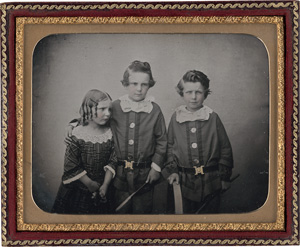
Studio portrait of three children. 1860s. Hand-colored ambrotype, housed in velvet-lined case with a gilt brass mat. 8,5 x 11,2 cm (case 11,5 x 14 cm).
This ambrotype presents a closely grouped studio portrait characteristic of mid-19th-century photography, in which gesture and coordinated dress emphasize familial bonds and the image’s sentimental function. The inclusion of small hand-held props reflects contemporary studio practice, serving both compositional needs and the practical demands of longer exposure times. Produced using the wet-collodion process on glass, ambrotypes offered a more accessible alternative to the daguerreotype and were widely favored for family portraiture from the 1850s onward. – Edges of case slightly rubbed, one clamp missing; some small specks on glass surface as well as cracking on the verso of plate, otherwise in very good condition.
Anderson, James
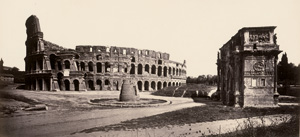
Views of the Colosseum, Rome; Arch of Constantine, Rome
Los 4008
Ergebnis (inkl. Aufgeld) *
1.000€ (US$ 1,149)
View of the Colosseum, Rome; Meta Sudans with Temple of Venus, Rome; Arch of Constantine, Rome. 1850s. 3 large-format albumen prints, mounted to card. 20 x 43 cm and 28 x 36 cm (mounts 45 x 59,5 cm). Each titled in ink below the image and 2 with partial "Spithöver" blindstamp in lower right corner on the mount.
Born Isaac Atkinson in Blencarn, Cumberland, England, James Anderson initially studied painting in Paris before relocating to Rome in 1838, where he first worked as a sculptor. Around 1849, he turned to photography and established a studio in Rome, specializing in reproductions of works of art as well as views of Italian monuments and antiquities. His work gained wide recognition, particularly for his depictions of Rome, and he exhibited extensively throughout the 1860s. After his death, the studio was taken over by his son Domenico and remained in the family until the 1940s. – Constantine print slightly faded in lower edge, both with some light surface scuffing, otherwise strong tonal prints in very good condition with a strong violet-brown tone.
Lit.: Dorothea Ritter. Rom 1846-1870: James Anderson und die Maler-Fotografen, Sammlung Siegert. Bönningheim: Braus/Wachter Verlag, 2005.
Anderson, James and Tommaso Cuccioni
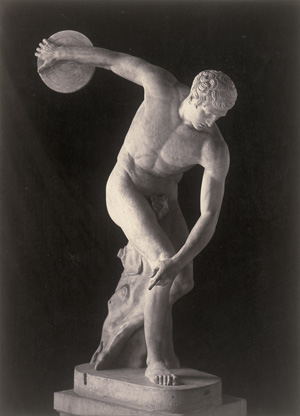
Classical sculptures from the Vatican Museums, the Lateran Museum, Villa Ludovisi, and the Capitoline Museums
Los 4009
Ergebnis (inkl. Aufgeld) *
1.250€ (US$ 1,437)
Classical sculptures from the Vatican Museums, the Lateran Museum, Villa Ludovisi, and the Capitoline Museums: Apollo Belvedere, Meleager, Laocoön, Discobolus, Nike, Niobid, Marcus Aurelius, Sophocles, and Mars. 1855-1860. 9 large-format albumen prints, mounted to card. Each ca. 38,5 x 30 cm or reverse (mounts 64 x 48,5 cm or reverse). Each annotated in black ink below the image on the mount; most with the photographer’s or publisher’s stamp embossed in the margins of the mount.
James Anderson's rendition of sculpture is exceptional, likely due to his own experience as a sculptor. His images of sculpture far surpass other art reproductions of the time and stand out as individual works. The prints are gold-toned, giving them a rich, violet brown color that exceeds the quality of images found in travel albums of the time. – Some light creases to most mounts; the Cuccioni print with some foxing, a small tear in the lower margin, and slight fading along the edges; a few surface scuff marks and some retouched spots on the others; otherwise in near excellent condition with strong violet-brown tones.
Anderson, James and Tommaso Cuccioni
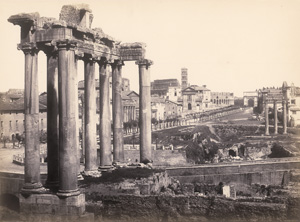
Views of the Forum Romanum, the Arches of Titus and Septimius Severus, the Campidoglio, and the Villa Medici
Los 4010
Ergebnis (inkl. Aufgeld) *
1.500€ (US$ 1,724)
Views of the Forum Romanum, the Arches of Titus and Septimius Severus, the Campidoglio, and the Villa Medici. 1855-1860. 6 large-format albumen prints, mounted to card. Each between 39,5 x 30,5 cm and 33 x 46,5 cm (mounts 64 x 49 cm or reverse). All but one annotated in black ink below the image on the mount; most with the photographer’s or publisher’s stamp embossed in the margins of the mount.
Tommaso Cuccioni was active in Rome from ca. 1830 as a lithographer and print publisher, with a studio on the centrally located Via dei Condotti, a popular destination for affluent English tourists. Embracing photography in 1852, he began producing large-format views of Roman landmarks, offering a new and highly effective form of visual souvenir. Few of these early prints survive and such large-formats are rare. – Some light foxing and time-staining to the mounts, with minor handling creases and slightly uneven margins; prints with some fading, occasional scuff marks, and light foxing to a few, otherwise strong tonal prints in near excellent condition.
Lit.: Dorothea Ritter. Rom 1846-1870: James Anderson und die Maler-Fotografen, Sammlung Siegert. Bönningheim: Braus/Wachter Verlag, 2005, ill. pp. 140-141.
Anderson, James and Tommaso Cuccioni
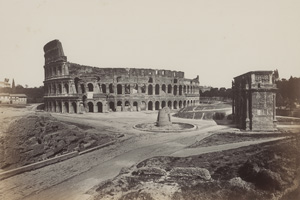
View of the Colosseum; Arch of Constantine; Temple of Hercules Victor; Arch of Drusus
Los 4011
Nachverkaufspreis
1.000€ (US$ 1,149)
Views of the Colosseum, the Arch of Constantine, the Arch of Drusus, the Temple of Vesta, the Temple of Vespasian, and the Piazza di Monte Cavallo. 1857-early 1860s. 6 large-format albumen prints, mounted to card. Each between 30 x 41 cm and 36 x 53,5 cm or reverse (mounts 49 x 64 cm or reverse). All but one annotated in black ink below the image on the mount; most with the photographer’s or publisher’s stamp embossed in the margins of the mount.
Colosseum print with some fading in edges in lower area, all with a few surface scuff marks, some retouched spots, some foxing in sky area, otherwise in very good condition with strong violet-brown tones.
Lit.: Dorothea Ritter. Rom 1846-1870: James Anderson und die Maler-Fotografen, Sammlung Siegert. Bönningheim: Braus/Wachter Verlag, 2005, ill. p. 47 (Arch of Drusus, attributed to James Anderson).
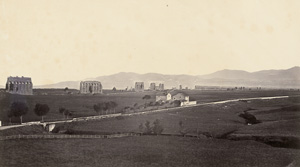
Anderson, James and Unknown
Panoramic view of Roman Campagna to the Alban Hills, etc.
Los 4012
Nachverkaufspreis
500€ (US$ 575)
Panoramic view of Roman Campagna to the Alban Hills; Views of Tivoli and San Benedetto convent, Subiaco. Late 1850s. 1 Large-format albumen panorama and 2 albumen prints, mounted to card. 23 x 41 cm and 17 x 24 cm (mounts 45 x 59,5 cm). Each annotated in ink below the image on the mount.
Mounts soiled, with foxing and time-stained in edges, some small tears, Campagna print with some foxing in sky area, a few light scuff marks, otherwise in good condition.
Lit.: Dorothea Ritter. Rom 1846-1870: James Anderson und die Maler-Fotografen, Sammlung Siegert. Bönningheim: Braus/Wachter Verlag, 2005, compare ill. p. 87 (similar image of Campagna).
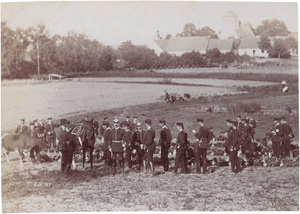
Anschütz, Ottomar
Imperial Military Maneuvers at Müncheberg / State visit of Umberto I to Berlin
Los 4013
Nachverkaufspreis
1.200€ (US$ 1,379)
Album documenting the Imperial Military Maneuvers at Müncheberg and the state visit of Umberto I to Berlin with Kaiser Wilhelm II. 1888-1889. 118 albumen prints, mounted to album pages. Each ca. 10,2 x 14,4 cm (mounts 22 x 32,5 cm). Each with the photographer’s blind stamp in the lower right corner. Presented in half-leather album.
This album brings together views of the Imperial Maneuvers at Müncheberg (1888) and the state visit of King Umberto I of Italy to Berlin. The military photographs depict infantry, cavalry, and artillery in formation, maneuvers, and live-fire exercises. In contrast, the Berlin scenes record ceremonial receptions with elaborate decorations and large crowds. Together, the images provide a concise visual record of late 19th-century military display and imperial spectacle. – Edges of album slightly rubbed; some age staining and foxing to mounts; some foxing and fading to prints; otherwise in good to very good condition.
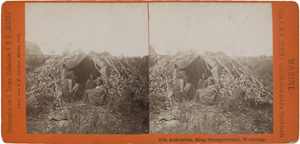
Photographer: Gustav Adolph Riemer (1842-1899). Aboriginal habitation. 1876. Stereoscopic albumen print, mounted to card. Each 7,8 x 7,8 cm (mount ca. 8,5 x 17,8 cm). Printed caption along the recto margin: “Photographie von G. Riemer, Zahlmeister S. M. S. ‘Hertha’. Verl. von J. F. Stiehm, Berlin 1884 / 342. Australien, King Georges Sound / Marine Reise S. M. S. ‘Hertha’ nach Ost-Asien und den Südsee-Inseln.” Numbered “56” in pencil on the verso.
Gustav Adolph Riemer was a German naval officer who served as a purser in the Prussian and later Imperial German Navy. He developed photography as a largely self-taught practice alongside his military career. Between 1874-1877 he took part in the world voyage of SMS Hertha, during which he produced an extensive body of photographs across East Asia, Micronesia, Australia, and the South Seas - many of them among the earliest visual records of these regions and their inhabitants. – Edges of card slightly rubbed, some minor surface irregularities and faint traces of foxing, otherwise in very good condition.
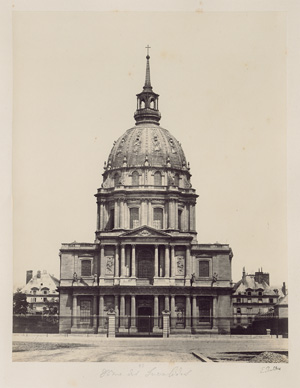
Views of Paris. 1850s. 7 albumen prints, mounted to card. Each ca. 27 x 21 cm or reverse (mounts ca. 43,5 x 33,5 cm or reverse). Each with the photographer’s “E. Baldus” stamp below the image on the mount.
Édouard Baldus was a key practitioner of early architectural photography in France known for his meticulously detailed views that combine documentary precision with carefully structured compositions. This lot comprises views of the Sainte-Chapelle, La Trinité, Saint-Étienne-du-Mont, Assemblée nationale (Corps législatif), Saint-Augustin, Dôme des Invalides, and the Louvre seen from the Rue de Rivoli. – A few prints with isolated light foxing spots in the sky area, light fading and minor scuff marks, otherwise, all prints with strong tones and in very good condition.
Baldus, Édouard
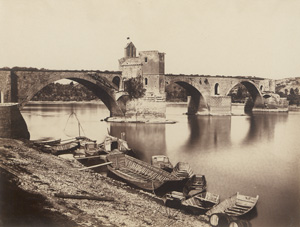
Pont Saint-Bénézet, Avignon
Los 4016
Ergebnis (inkl. Aufgeld) *
1.500€ (US$ 1,724)
Pont Saint-Bénézet, Avignon. Ca. 1861. Albumen print, mounted to card. 21,2 x 28 cm (mount ca. 28,7 x 35 cm). Titled “Arles (Pont de St Benézé)” (sic); annotated “Avignon” in pencil and stamped “E. Baldus” in black ink below the image on the mount.
Some scuff marks, buckling, and slight signs of silver mirroring in the shadow areas; otherwise in very good condition.
Béchard, Émile
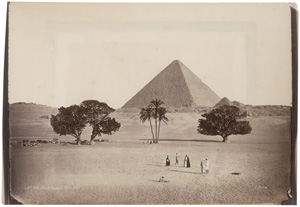
Grande Pyramide vue de l'Est
Los 4017
Ergebnis (inkl. Aufgeld) *
375€ (US$ 431)
Grande Pyramide vue de l'Est. 1870s. Albumen print. 28,8 x 42 cm. With the photographer's signature in the negative in lower right corner, as well as numbered and titled in the negative in lower left corner.
Émile Béchard produced some of the most evocative photographs of Egypt in the late 19th century. Unlike the large, highly commercial studios of Pascal Sébah, Félix Bonfils, Hippolyte Arnoux, and the Zangaki Brothers, Béchard’s practice was comparatively short-lived resulting in a more limited and consequently scarcer body of work. His photographs are distinguished by a restrained compositional elegance and quiet attention to light, scale, and atmosphere, lending his views of monuments and landscapes a contemplative quality that sets them apart from the more standardized tourist views of the period. – Some small tears and light handling creases; lower margin slightly uneven; otherwise a strong print with a rich brown tone in very good condition.
Béchard, Émile
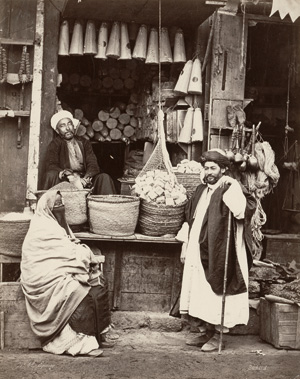
Market and street scenes in Cairo, Thèbes and Port d' Assouan
Los 4018
Nachverkaufspreis
600€ (US$ 690)
Market and street scenes in Cairo, Thèbes and Port d'Assouan. Mid-1870s. 5 albumen prints, mounted to card. Circa 27 x 21,5 cm and reverse. Each with photographer's name in lower right corner, as well as numbered and titled in lower right/left in the negative, collector's stamp "P. Reinhart-Sulzer, Winterthur" in lower right corner on the mount.
The images in this group include an Arabian café, a market spice seller, women washing laundry, Thèbes and Port d'Assouan.
– Card slightly buckled and with slight traces of use, prints with some surface scuff marks, otherwise strong prints with a rich brown tone and in very good condition.
Lit.: Ken Jacobson. Odalisques and Arabesques: Orientalist Photography 1839-1925. London: Quaritch, 2007, see pp. 210-212.
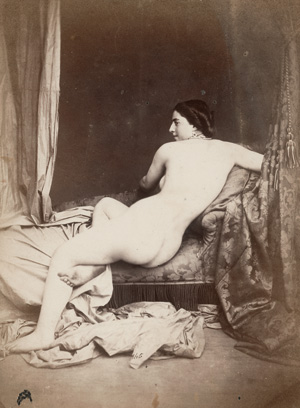
Reclining Nude. Circa 1855. Albumen print, mounted to board. 19,9 x 14,7 cm (mount 21,3 x 16 cm). With the number “146” etched into the negative in the lower margin.
Auguste Belloc, initially trained as a painter of miniatures and watercolors, turned to photography in the early 1850s, where he distinguished himself in daguerreotype practice and contributed to early experiments in color stereoscopy. He later became known for his carefully staged nude studies, which combine academic tradition with photographic precision. His work is now held in major public collections, including the Museum of Modern Art, the Metropolitan Museum of Art, the Musée d’Orsay, and the Museum of Fine Arts Boston. – Some surface irregularities, a few scuff marks, otherwise in good condition.
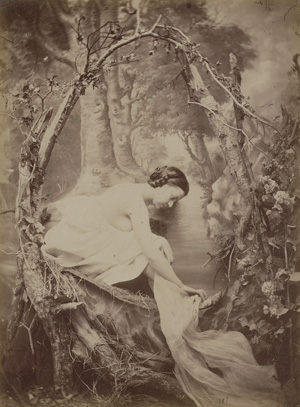
Female nude. 1850s. Albumen print. 20,2 x 14,8 cm. With number "187" etched into the negative in the lower margin.
Some scuff marks and light fading; otherwise in near excellent condition.
Bisson frères
View of the Mer de Glace glacier, Mont Blanc massif
Los 4021
Ergebnis (inkl. Aufgeld) *
1.250€ (US$ 1,437)
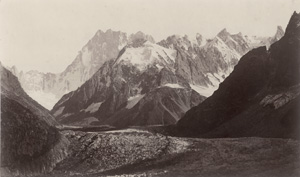
View of the Mer de Glace glacier, Mont Blanc massif. 1860. Large-format albumen print, mounted to card. 23,4 x 39,5 cm (mount 40,6 x 55,5 cm). With the photographers' studio stamp in red ink below the image on the mount.
This photograph belongs to the celebrated Alpine campaign undertaken by Bisson Frères in the late 1850s and early 1860s, among the earliest sustained efforts to photograph the high Alps at extreme altitude. Depicting the Mer de Glace glacier framed by the jagged peaks of the Mont Blanc massif, the image emphasizes the vast scale and geological drama of the glacial landscape. Characteristic of the Bissons’ work, it combines topographical precision with a Romantic sensibility, playing a key role in establishing mountain photography as both scientific record and aesthetic expression. – Some handling creases and foxing on the mount; some scuff marks; otherwise a strong print in very good condition.

Panorama von München. 1858. 11 albumen prints, mounted to linen-backed cards as a leporello. Each ca. 34 x 40 cm (overall ca. 34 x 440 cm). The middle 3 prints with “Panorama der K. Haupt- und Residenz-Stadt München. Aufgenommen in der Vogelperspective vom Sct. Petersthurme aus, zur Zeit des 700 jährigen Jubilaeums 1858” printed below the image on the mount. Loose in a full-leather folder with embossed decorative ornament and gilt-stamped title “Panorama von München” on the front cover.
This panorama of Munich, composed of eleven large-format albumen prints joined to form a 360-degree view of the city, is among the most technically ambitious photographic achievements of German 19th-century photography. Taken in 1858 from the St. Petersturm, the photographs depict the city in panoramic detail, providing a broad view of Munich. Extending over four meters when fully assembled, the panorama’s scale and the precision of its alignment represent a notable technical achievement of the period.
Only one other example of this panorama is known, preserved at the Stadtmuseum Munich. Its rarity and scale - combined with its technical sophistication - underscore the panorama's significance as a landmark of 19th-century German photographic history. – Mounts with some foxing and smudge marks. Most prints faded, some with small spots, rubbing and some soiling, two prints with stronger tones, otherwise in very good condition.
Böttger, Georg
Early views of Munich: General view with Maximilianstrasse / Siegesthor
Los 4023
Nachverkaufspreis
500€ (US$ 575)
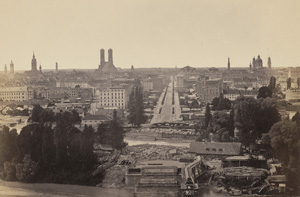
Early views of Munich: General view with Maximilianstrasse / Siegesthor. 1850s. 2 albumen prints, mounted to board. 15 x 22,5 cm and 20,3 x 16 cm. Each with photographer's name and title printed below/above image on the mount.
Georg Böttger's attractive views of German cities such as Munich, Regensburg and Nuremberg as well as German monuments are among the rare examples of early German 19th century photography. – General view with minimal fading in side edges, Siegesthor print with a few foxing spots in sky area, both with a few light scuff marks, otherwise in very good condition and with strong contrasts.
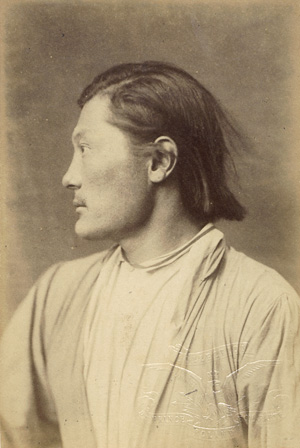
Kalmouks (from the series “Collection Anthropologique du Prince Roland Bonaparte”). 1883. 19 albumen prints, mounted to board. Each between ca. 14,5 x 9,8 and 11,5 x 17,5 cm or reverse (mounts ca. 24 x 18 cm or reverse). Each mount with number stamp and numbered in black ink in the upper left corner; “Collection Prince Roland Bonaparte” blindstamp embossed in the lower right corner of the mount, and the series title stamped below the image on the mount. Presented in original blue portfolio with decorative framing and gilt-embossed title, together with a loose table of contents.
Roland Bonaparte assembled the Collection Anthropologique du Prince Roland Bonaparte in the late 1880s as part of a large-scale project to systematically photograph ethnic groups from around the world. Produced in collaboration with scientific institutions such as the Société d’Anthropologie de Paris, the series follows contemporary anthropometric conventions, presenting subjects in standardized frontal and profile poses against neutral backgrounds, often with stamped identifiers. Although depicting non-European populations, many photographs were taken in Europe in the context of ethnographic exhibitions rather than in the subjects’ places of origin. The present group focuses on members of the Kalmyk (Oirat Mongol) population of southern Russia, emphasizing physiognomy, dress, and bodily typologies in line with the classificatory aims of late 19th-century anthropology. – Edges of the portfolio slightly rubbed, with minor soiling; mounts with foxing and toning; some prints with light surface scuffing and fading; overall in good to very good condition.
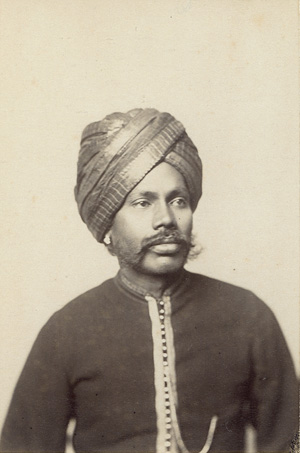
Hindous (from the series “Collection Anthropologique du Prince Roland Bonaparte”). 1883. 9 albumen prints, mounted to board. Each between ca. 14,8 x 9,8 and 20 x 14,4 cm (mounts ca. 31,5 x 40,8 cm). Each mount with number stamp and numbered in black ink in the upper right corner; the series title stamped below the image on the mount. Presented in original green portfolio with decorative framing and gilt-embossed title, together with a loose table of contents.
This series records named individuals identified as Hindu domestic servants, with each sitter listed by age and occupation in the accompanying table of contents. – Edges of the portfolio slightly rubbed, with some scuff marks and soiling; mounts with foxing; some prints with foxing, surface scuffing, and fading; overall in good condition.
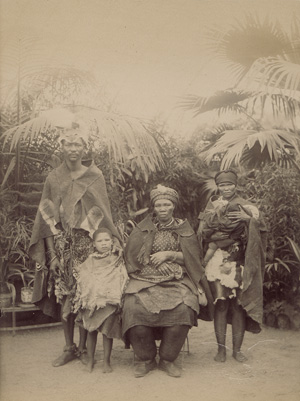
Hottentots (from the series “Collection Anthropologique du Prince Roland Bonaparte”). 1883. 30 albumen prints, mounted to board. Each between ca. 19,5 x 9,5 and 23 x 17,5 cm or reverse (mounts ca. 31,5 x 41 cm or reverse). Each mount with number stamp in black ink in the upper left corner; “Collection Prince Roland Bonaparte” blindstamp embossed in the lower margin of the mount, and the series title stamped below the image on the mount. Presented in original turquoise portfolio with decorative framing and gilt-embossed title.
The photographs in this series depict men and women labeled “Hottentots,” a now-obsolete and derogatory term historically applied to Khoikhoi and related Khoisan-speaking peoples of southern Africa. Presented in standardized frontal, profile, and rear views, the images follow contemporary anthropometric conventions and reflect the racialized classificatory frameworks through which human bodies were recorded and interpreted in late 19th-century European anthropology. – Edges of the portfolio rubbed, with some scuff marks; mounts with minor foxing along the edges; some prints with surface scuffing and fading; overall in good to very good condition.
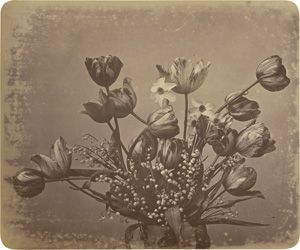
Flower study. Ca. 1855. Varnished salted paper print, mounted to card. 37 x 44,5 cm (mount 45 x 54,5 cm).
Originally trained as a textile designer, Adolphe Braun turned to photography in 1853, initially producing detailed studies of flowers for his publication Fleurs photographiées, conceived as source material for wallpaper and fabric designs. The project was an immediate success, earning Braun a medal at the 1855 Exposition Universelle in Paris, and an album of the photographs was presented to Empress Eugénie. By the early 1860s, Braun had expanded his practice to include topographical views throughout Europe and, soon after, large-scale photographic reproductions of works of art, establishing his firm as one of the most important and prolific photographic publishing enterprises of the 19th century. – Lower left and right corners of the mount torn; some handling creases, some fading along the edges of the print and a few small ink stains; otherwise in good condition.
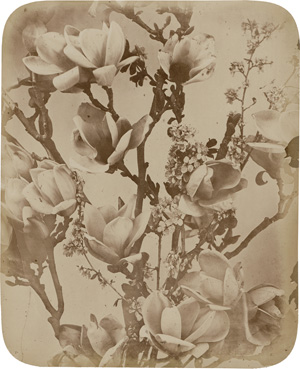
Magnolia. Ca. 1855. Varnished salted paper print, mounted to card. 28 x 22,8 cm (mount 38,4 x 29,4 cm). Framed under glass in wooden frame.
Some handling creases; lower left and right corners of the mount torn; some fading along the edges of the print and a few small ink stains; otherwise in good condition.
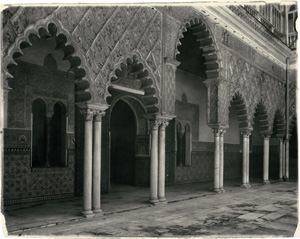
Braun et Cie.
View of the Alcázar, Sevilla
Los 4029
Ergebnis (inkl. Aufgeld) *
1.375€ (US$ 1,580)
View of the Alcázar, Sevilla. Circa 1890. Mammoth-plate carbon print. 38 x 48 cm.
Following the death of Adolphe Braun in 1877, the firm of Braun et Cie developed into one of Europe’s leading art-photography publishers, working closely with major institutions to document paintings, sculpture, and architecture. Its photographs were produced in standardized formats for use in museum catalogues, educational albums, and scholarly study, significantly broadening access to works of art. Renowned for the exceptional quality and stability of its carbon prints, the firm also issued stereoscopic and panoramic views, reflecting a highly systematic and technically advanced approach to photographic production and distribution. – Margins slightly uneven; some very light handling creases; otherwise a strong print in near excellent condition.
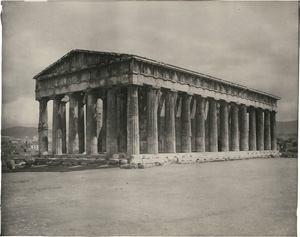
View of the Parthenon. Circa 1890. Mammoth-plate carbon print. 38 x 48 cm.
Margins torn or slightly uneven; some very light handling creases; otherwise a strong print in near excellent condition.
[*]: Regelbesteuert gemäß Auktionsbedingungen. [^]: Ausgleich von Einfuhr-Umsatzsteuer.
* Alle Angaben inkl. 25% Regelaufgeld ohne MwSt. und ohne Gewähr – Irrtum vorbehalten.
Galerie Bassenge
Erdener Str. 5A
14193 Berlin
Öffnungszeiten:
Montag bis Donnerstag, 10–18 Uhr,
Freitag, 10–16 Uhr
Telefon: +49 30 8938029-0
Fax: +49 30 8918025
E-Mail: info (at) bassenge.com
Impressum
Datenschutzerklärung
© 2026 Galerie Gerda Bassenge
Galerie Bassenge
Erdener Str. 5A
14193 Berlin
Öffnungszeiten:
Montag bis Donnerstag, 10–18 Uhr,
Freitag, 10–16 Uhr
Telefon: +49 30 8938029-0
Fax: +49 30 8918025
E-Mail: info (at) bassenge.com
Impressum
Datenschutzerklärung
© 2026 Galerie Gerda Bassenge