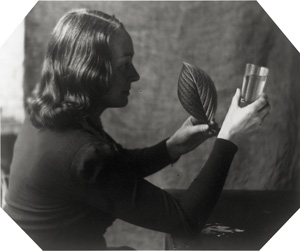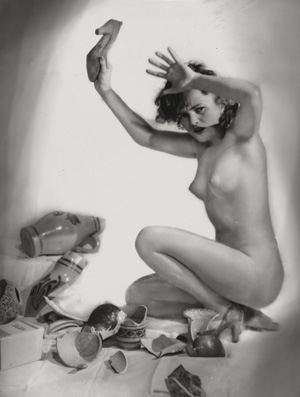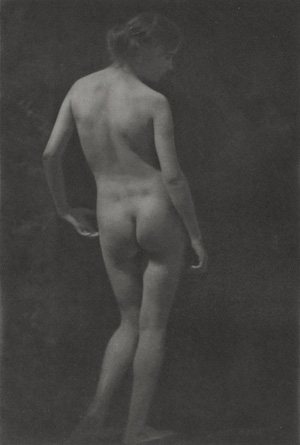
Der Akt. Zwanzig photographische Aufnahmen weiblicher Körper nach der Natur. 20 l. with photos as hand-pulled photogravures on Japan. 41 x 30,5 cm. Original cream-colored boards with mounted photogravure. Dachau, Einhorn-Verlag, 1918.
802 Photo Books, p. 111; Heidtmann 11127; Koetzle 215. First edition of Germaine Krull’s first publication, issued when she was only 21, shortly after opening her studio in Munich in 1917. Forced to leave the city in 1920 due to her political activism, she went on to work internationally, including in the Soviet Union, Amsterdam, Paris, Brazil, Africa, and Bangkok. One of the most influential women photographers of the interwar period, she is represented here alongside works by József Pécsi (4 photographs) and Wanda von Debschitz-Kunowski (9 photographs), with 7 photographs by Krull herself. The photogravures (hand-pressed copper engravings) and the 2 text leaves are printed on thin Japan paper and mounted to cardboard sheets.
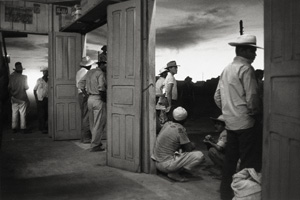
Brasilia im Bau. 1958. Gelatin silver print, printed later. 38,5 x 57,6 cm (sheet 50 x 60 cm). Signed, titled, and dated by the photographer in ink, and with 2 photographer’s stamps on the verso.
Robert Lebeck was among the most influential German photojournalists of the postwar period, whose work spans several decades and subjects ranging from politics and culture to everyday life. Known for his acute sense of timing and narrative clarity, he captured both pivotal historical moments and intimate portraits of leading figures. His photographs combine documentary precision with a strong visual instinct, establishing him as a key figure in European photojournalism.
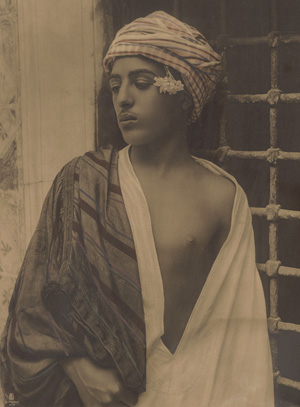
Portrait of an Arabian youth. Ca. 1910. Hand-colored photogravure. 38,5 x 29 cm. Photographer’s logo and number “6009” in the negative in the lower left corner. Framed under glass in wooden frame.
Lehnert & Landrock were among the most accomplished photographic studios working in North Africa in the early 20th century, celebrated for their refined studio portraits and atmospheric views of Tunisia and Egypt. Their work is characterized by technical precision, careful staging, and a painterly sensitivity to light, costume, and setting. Produced primarily for a European audience, these images reflect the period’s fascination with North African culture, and have come to define the studio’s lasting appeal within the tradition of Orientalist photography.
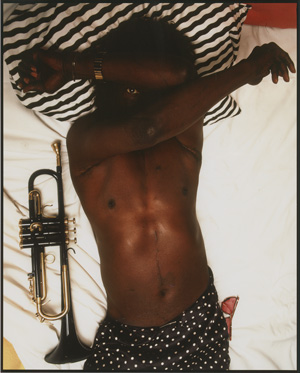
Miles Davis, New York. 1989. Cibachrome print. 36,9 x 29,8 cm (sheet 50,6 x 40,6 cm). Signed, titled, dated, and annotated “a.p. 6” by the photographer in black marker in the lower margin. From an edition of 40.
The American photographer Annie Leibovitz is one of the most influential portraitists of our time. Her breakthrough came when she joined Rolling Stone magazine as a photographer in 1973, eventually serving as its chief photographer until 1981. In the following years, Leibovitz, known for her media-shy demeanor, rose to international acclaim for her iconic portraits of numerous music legends. Alongside staged portraits such as Queen Elizabeth II, and notable nudes, including those of Demi Moore, Whoopi Goldberg, and Marina Ambramovic, Leibovitz expanded her repertoire to include reportage and advertising photography.
Literatur: Annie Leibovitz. Photographien 1970-1990. Munich: Schirmer/Mosel, 1991, ill. p. 190.
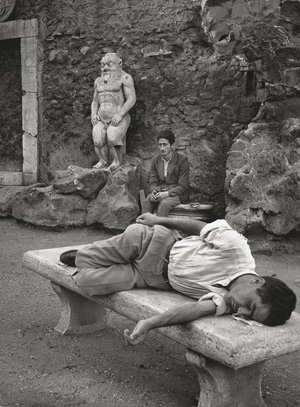
Die Verzauberten - an der Porta Magica. 1949. Vintage ferrotyped gelatin silver print on doubleweight Agfa-Brovira paper. 29,5 x 21,8 cm. Photographer's/copyright stamps and annotated in pencil on the verso.
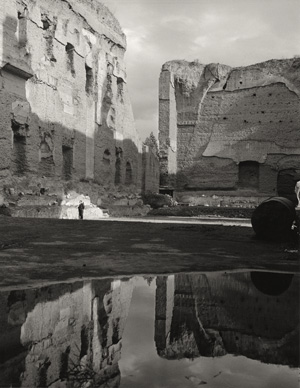
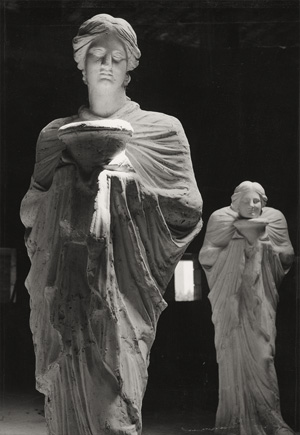
The German photographer Herbert List was a major figure in 20th-century photography, known for his refined visual language that combined classical aesthetics with the modernist sensibilities of his time. Deeply influenced by his background in art history and his exposure to Surrealism and the Bauhaus movement, List created images that often imbued everyday subjects with a dreamlike or metaphysical quality. His work spans still lifes, architectural studies, and portraits - many of which reflect a quiet, contemplative mood, displaying a fascination with form, light and shadow. A print of this image is in the collection of the Münchner Stadtmuseum.
Literatur: Max Scheler, ed. Herbert List: Italien. Munich: Schirmer/Mosel, 1995, plate 28 (variant).
Max Scheler and Matthias Harder, eds. Herbert List: The Monograph. Munich: Schirmer/Mosel, 2000, ill. p. 273 (variant).
Caracalla Baths, Rome. 1950s. Vintage ferrotyped gelatin silver print on doubleweight Agfa-Brovira paper. 30 x 23,5 cm. Photographer's/copyright stamp on the verso.
List, Herbert
Ancient Greek sculpture, Capitilone Museum, Rome
Los 4220
Schätzung
1.000€ (US$ 1,136)
Ancient Greek sculpture; Capitoline Museum, Rome. 1950s. Vintage ferrotyped gelatin silver print on doubleweight Agfa-Brovira paper. 29,2 x 20,2 cm. Photographer's estate stamp, therein number in pencil on the verso.
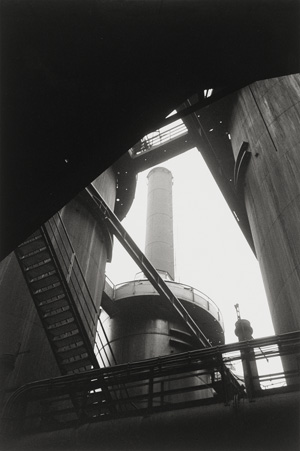
Ruhrgebiet. 1959. Gelatin silver print, printed 1986. 30 x 20 cm (sheet 40,2 x 30,5 cm). Photographer's blind stamp in lower margin; signed and titled by the photographer in pencil, as well as photographer's/copyright stamp and reproduction limitation stamp on the verso.
The German photographer Ulrich Mack was known for his work in photojournalism, portraiture, and landscape photography, gaining recognition in the 1960s through magazines such as twen, Quick, and Stern. His practice ranges from reportage and incisive portraits to contemplative landscape series and long-term documentary projects, characterized by a strong sense of composition and clarity.
Magritte, René
Königin Semiramis, Brüssel (Georgette Magritte); Belohnte Tugend, Brüssel
Los 4222
Schätzung
500€ (US$ 568)
Königin Semiramis, Brüssel, 1947 (Georgette Magritte); Belohnte Tugend, Brüssel, 1934. 2 gelatin silver prints, printed 1984. Each ca. 20 x 24 cm (sheet 30,5 x 40,3 cm). Each with “Georgette Magritte Nachlaß” Griffelkunst stamp on the verso.
René Magritte’s photography, produced mainly between the late 1920s and 1950s, extends his Surrealist practice through staged, playful scenes that echo the logic of his paintings. Rather than functioning as documentary records, these images explore themes of illusion, identity, and visual paradox, often serving as experiments and source material within his broader artistic work.
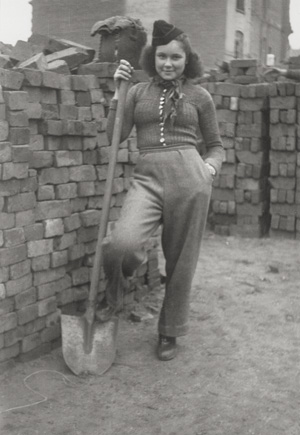
"Trümmerfrauen", Leipzig. 1949. 3 gelatin silver prints, printed 1997, 1 mounted to card. Each circa 23 x 16 cm. 1 signed, annotated and editioned in pencil on mount; 2 with printed archive/exhibition paper label affixed to the verso.
Karl Heinz May was a German photographer active in the postwar period, known for his documentary and reportorial images of everyday life. His work is characterized by a direct, observational approach, capturing social realities with clarity and an understated sense of composition.
Man Ray
Le violon d’Ingres (1924), Group photo of the DADA group (ca. 1922), Self-Portrait (1932), Erotique voilée (1933), Juliet (1945)
Los 4224
Schätzung
600€ (US$ 682)
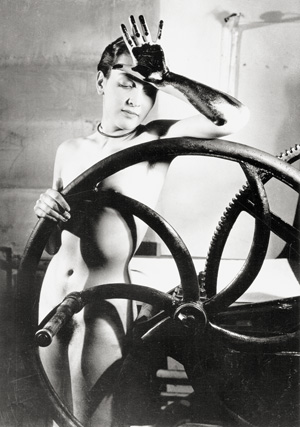
Le violon d’Ingres (1924), Group photo of the DADA group (ca. 1922), Self-Portrait (1932), Erotique voilée (1933), Juliet (1945) . 5 gelatin silver prints, printed 1991. Each circa 23,8 x 18 cm (sheets 30,2 x 24,2 cm). Each with “Griffelkunst” and “ADAGP Man Ray Trust” copyright stamps on the verso.
Man Ray was a central figure of Dada and Surrealism, whose photography pushed the medium toward experimentation and abstraction. Through techniques such as solarization and his cameraless “rayographs,” he explored chance, transformation, and the interplay between object and image, redefining photography as a creative and conceptual practice. The present lot comprises later prints of some of his most important photographs.
Gebrochene Versprechen. Circa 1930. Vintage gelatin silver print, hinge-mounted to mat. 21,2 x 16,2 cm (mount 49,8 x 40). Photographer's "Foto Wlassics Wien" copyright stamp on the verso. Framed under glass in wooden frame.
Studio Manassé was a prominent Viennese photographic studio active during the 1920s and early 1930s, founded by Olga Spolarits and Adolf Manassé. Renowned for its fashion photography, portraits, and stylized nude studies, the studio developed a highly polished visual language characterized by sharp lighting, theatrical staging, and an Art Deco-influenced modernity. Its work exemplifies the close connection between avant-garde aesthetics and commercial photography in interwar Vienna.
Manen, Hans van
Improvisation II Rob van Woerkom; Guilherme Botelmo Gr. Plié
Los 4226
Schätzung
800€ (US$ 909)
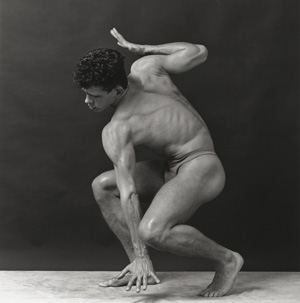
Improvisation II, Rob van Woerkom / Gr. Plié, Guilherme Botelho. 1985/1984. 2 vintage gelatin silver prints, flush-mounted to board. Each 37 x 37 cm (mounts 42,8 x 38,7 cm). Each signed, titled, and editioned “5/10” and “3/10” in pencil on the mount verso.
Hans van Manen is internationally recognized as one of the leading figures of contemporary ballet. Alongside his distinguished career as a dancer and choreographer, he has also developed a notable practice in photography, with his work published in book form and exhibited internationally.
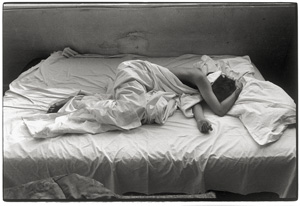
Barbara in unserem Bett, Berlin. 1959. Gelatin silver print, printed 2005. 35 x 52 cm (sheet 50,7 x 60,5 cm). Signed, titled and dated by the photographer in pencil on the verso.
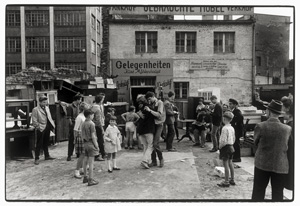
The American-German photographer Will McBride is celebrated for his candid and empathetic documentary work. From the start of his career, he focused on unvarnished depictions of youth, sexuality, and identity, offering a glimpse into the cultural and societal shifts of the postwar era. With a compassionate eye and deep trust in his subjects, McBride created photographs that remain striking for their honesty, intimacy, and emotional depth.
McBride, Will
Evi und Lapper tanzen beim Kremserfahrt vorm Trödelhändler Kurt Mühlenhaupt
Los 4228
Schätzung
900€ (US$ 1,023)
Evi und Lapper tanzen beim Kremserfahrt vorm Trödelhändler Kurt Mühlenhaupt. 1959. Gelatin silver print, printed 1990s. 22,5 x 33 cm (sheet 26,5 x 40,3 cm). Signed, titled and dated by the photographer in pencil as well as photographer's stamp on the verso.
[*]: Regelbesteuert gemäß Auktionsbedingungen. [^]: Ausgleich von Einfuhr-Umsatzsteuer.
* Alle Angaben inkl. 25% Regelaufgeld ohne MwSt. und ohne Gewähr – Irrtum vorbehalten.
Galerie Bassenge
Erdener Str. 5A
14193 Berlin
Öffnungszeiten:
Montag bis Donnerstag, 10–18 Uhr,
Freitag, 10–16 Uhr
Telefon: +49 30 8938029-0
Fax: +49 30 8918025
E-Mail: info (at) bassenge.com
Impressum
Datenschutzerklärung
© 2026 Galerie Gerda Bassenge
Galerie Bassenge
Erdener Str. 5A
14193 Berlin
Öffnungszeiten:
Montag bis Donnerstag, 10–18 Uhr,
Freitag, 10–16 Uhr
Telefon: +49 30 8938029-0
Fax: +49 30 8918025
E-Mail: info (at) bassenge.com
Impressum
Datenschutzerklärung
© 2026 Galerie Gerda Bassenge