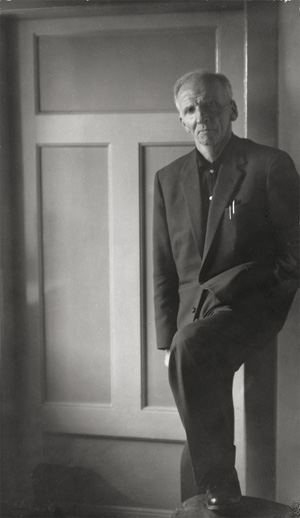
Portrait of Albert Renger-Patzsch. 1963. Vintage gelatin silver print. 24,5 x 14,2 cm. Signed by the photographer in pencil in lower left corner; annotated in pencil on the verso.
Lotte Jacobi is renowned for her intimate and engaging portraits, utilizing dramatic lighting and composition to capture the true essence of her subjects. This intriguing portrait of the German photographer Albert Renger-Patzsch shows a masterful approach to lighting and composition. Jacobi's fusion of artistic vision and technical prowess has established her as a significant and celebrated figure in the history of photography.
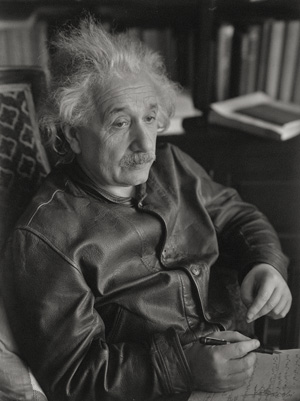
Albert Einstein, Princeton, New Jersey. 1938. Gelatin silver print, printed 1940s-50s. 25 x 20,1 cm. Signed by the photographer in pencil in the lower right.
Literatur: Marion Beckers and Elisabeth Moortgat. Atelier Lotte Jacobi: Berlin, New York. Berlin: Nicolai Verlag, 1997, ill. p. 157.
Jacoby, Max
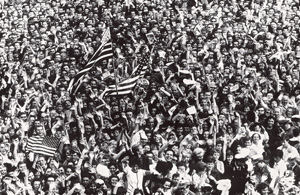
Crowds listening to John F. Kennedy speaking in front of Rathaus Schöneberg
Los 4201
Schätzung
1.000€ (US$ 1,136)
Jubelnde Menschen beim Berlin-Besuch des US-Präsidenten John F. Kennedy. 1963. Gelatin silver print, printed later. 19,5 x 30 cm. Photographer's stamp and annotated in pencil on the verso.
In 1937, Jewish photographer Max Jacoby fled Germany for Argentina, where he started working as a camera assistant to Georges Friedmann. Alongside other émigré photographers, he co-founded the group “La Carpeta de los Diez.” Returning to Berlin in 1957, he worked as a freelance photographer, portraying workers, artists, beggars, and politicians, and documenting political events and everyday life in the divided city. His photographs of John F. Kennedy’s 1963 visit to Berlin rank among the most poignant images of the occasion; Jacoby himself titled this image “The People’s Heart.”
Literatur: Angelika Gause, ed. Der Fotograf Max Jacoby : Bilder der 60er und 70er Jahre, Koblenz: Görres, 2003.
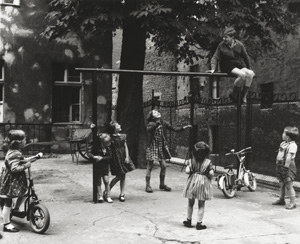
Children playing in back courtyard, Berlin. 1960s. Gelatin silver print, printed later. 24 x 29,2 cm. Photographer's stamp and annotated in pencil on the verso.
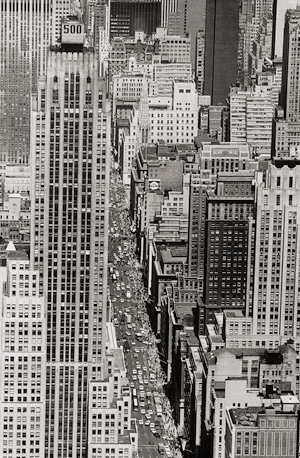
New York. 1974. Vintage large-format gelatin silver print on Agfa paper. 39,7 x 26,5 cm. Signed, titled and dated by the photographer in pencil and photographer's/copyright stamp on the verso.
Kaiser Wilhelm II in Morocco
Souvenir album of Kaiser Wilhelm II's Mediterranean trip March/April 1905
Los 4204 [*]
Schätzung
900€ (US$ 1,023)
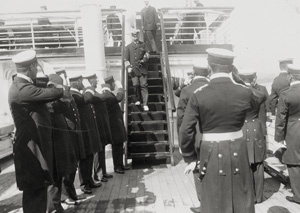
Souvenir album of Kaiser Wilhelm II’s Mediterranean trip. 1905-1906. Ca. 112 vintage gelatin silver prints, mounted to album boards. 103 prints ca. 13 x 18 cm and 9 prints ca. 17 x 24 cm. Each annotated in ink below the image on the mount. Bound in a contemporary half-leather album with gilt-stamped title “Meine Kaiserreise 1905” on the front cover.
This album documents the imperial entourage around Wilhelm II during his Mediterranean journey aboard the SMS Hamburg and other accompanying ships such as the Hohenzollern. The journey, which took place in 1905-1906, included stops in Portugal, Morocco, Gibraltar, Italy, and Greece. Particularly noteworthy is the imperial visit to Tangier, where Wilhelm II went ashore to meet Sultan Abd el-Aziz and rode in on horseback. This event led to a serious international crisis between the European powers - especially between France and the German Empire - later known as the “First Moroccan Crisis.”
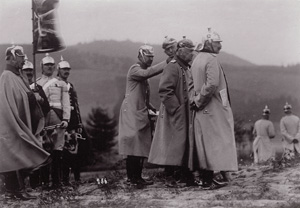
Photographer: Eugen Jacobi (active 1883-1916) and Oskar Tellgmann (1857-1936). Kaisermanöver 1913. 4 vintage collodion prints and 3 vintage gelatin silver prints, 4 mounted in mat. Each circa 15,5 x 22 cm. Each with number in the negative in lower portion and 1 with photographer's blindstamp in lower right corner; 2 with photographer's stamp (Jacobi) and all annotated in pencil on the verso.
The photographs offered here are interesting examples of early journalistic photography with several unposed regimental scenes in the midst of the Imperial Maneuver of 1913. This was the last Kaisermanöver to take place due to the onset of WWI in 1914.
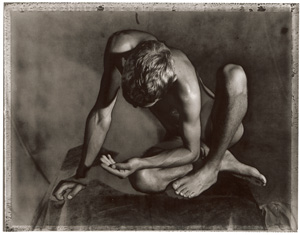
Doug II. 1981. Archival pigment print. 24 x 36 cm (sheet 28,5 x 43 cm). Signed, titled and dated by the photographer in pencil on the verso.
Dan Kane's commitment to analog photography is an underlying current in his body of work. His exploration of the male human form as a terrain of shapes and contours is present throughout his work. Living in Berlin since 1983, Kane found many of his models there. The present image was taken in Ithaca, New York, a few years before he moved to Berlin. A print of this image is in the collection of the South Dakota Art Museum.
Literatur: Over a Hundred Thousand Images Later: Dan Kane, a Retrospective (exhibition catalogue). Brookings: South Dakota Art Museum, 2025, ill. p. 58.
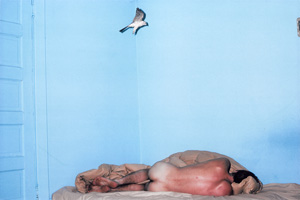
Claudio. 2013. Solarized selenium toned gelatin silver print. 16,5 x 21,4 cm (sheet 20 x 25,1 cm). Signed, titled, dated, editioned "2/5" and copyrighted by the photographer in pencil on the verso.
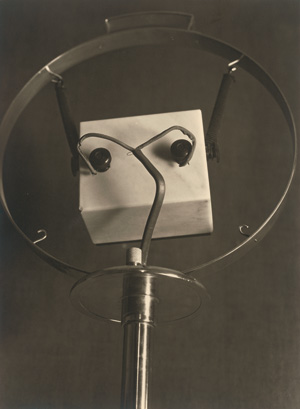
Microphone. 1932. Vintage gelatin silver print, hinge-mounted in upper edge to mat. 24,8 x 16,8 cm. Photographer's blindstamp in lower right; photographer's stamp and annotated in pencil on the verso.
Willy Kessels attended the École des Beaux-Arts in Ghent before moving to Brussels, where he worked as a sculptor and architectural draftsman in the 1920s. He began his photographic career in 1929, embracing the medium as a modern form of visual expression. The high point of his production falls in the 1920s-1930s, and his photomontages, aerial views, dynamic angles, and use of light exemplify the modern movement in Belgian photography at the time. His refined nude studies also form a significant part of his oeuvre.
Kesting, Edmund
Kameramann (Konstantin Kestting with camera)
Los 4209
Schätzung
600€ (US$ 682)
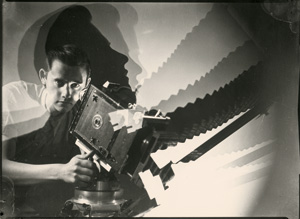
Kameramann (Konstantin Kesting with camera). 1948. Gelatin silver print, printed later. 21,8 x 29,7 cm. Photographer's stamp, signed by Gerda Kesting and annotated in pencil on the verso.
The German photographer, painter, and professor Edmund Kesting is associated with Expressionism and New Vision photography, his work bridging avant-garde experimentation and formal abstraction. From the 1920s onward, he employed techniques such as multiple exposure, photograms, and solarization to produce dynamic portraits, nudes, and abstract compositions. After 1945, he continued this experimental approach with camera-less processes and what he termed “chemical painting.”
Literatur: Edmund Kesting. Ein Maler sieht durch's Objektiv. Halle: Fotokino, 1958, ill. plate 62.
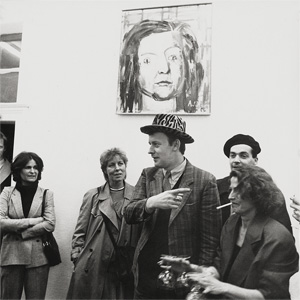
Photographer: Rainer Fichel (1946-2010). Martin Kippenberger at an exhibition opening. 1984. Vintage gelatin silver print on Agfa paper. 25,3 x 25,2 cm. Photographer’s stamp, annotated, and signed by the photographer in pencil on the verso.
Martin Kippenberger studied at the Hamburg Academy of Fine Arts from 1972 to 1976, where he was strongly influenced by the work of Sigmar Polke. In 1978 he moved to Berlin, where he co-founded “Kippenberger’s Büro” with Gisela Capitain to support emerging artists, while also serving as business director of the influential venue SO36. Throughout the 1980s, Kippenberger gained increasing recognition through exhibitions in Germany and abroad, culminating in his participation in the Venice Biennale in 1988 and documenta X. Associated with the “Neue Wilde” movement, his work is marked by irreverence, wit, and a critical engagement with artistic and social conventions; he died prematurely in 1997 as a consequence of his excess-driven lifestyle.
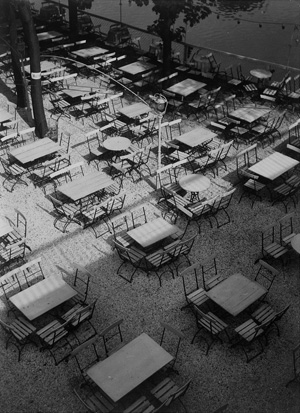
Biergarten. 1929-32. Vintage ferrotyped gelatin silver print on ivory paper, hinge-mounted along upper edge to mount. 24,3 x 18 cm. Photographer’s “Foto H. Koch Halle/S” stamp on the verso.
Heinrich Koch studied mural painting at the Bauhaus in Weimar and Dessau between 1922-1928, before working as an interior designer in Halle an der Saale until 1929. From 1930, he studied photography at Burg Giebichenstein under Hans Finsler, becoming his assistant and, in 1932, his successor. The photography class was closed in 1933 by the National Socialists, forcing Koch to emigrate to Prague, where he tragically died in a car accident in 1934.
Literatur: T. O. Immisch and Gunnar Lüsch, eds. Heinrich Koch: Photographien (1929-1934). Halle: Mitteldeutscher Verlag, 2002.
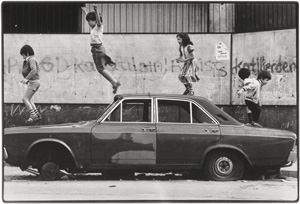
Kreuzberg, Berlin. 1980. Vintage gelatin silver print on Agfa paper. 28 x 40,2 cm. Signed, titled and dated by the photographer in pencil on the verso.
In 1972, Wolfgang Krolow moved to Berlin, where he studied visual communication at the Berlin University of the Arts, specializing in photography and graphic design. From an early stage he devoted himself to socially critical photography. He photographically captured everyday cultural and social life in Berlin as well as the political conflicts during the height of the squatter movement and later during the fall of the Berlin Wall.
Translated with DeepL.com (free version)
Literatur: Sigrid Heger, Andeas Homann and Rainer Wendling, eds. Kreuzberg die Welt: Fotografien von Wolfgang Krolow. Berlin: Assoziation-A, 2025, ill. pp. 118-119.
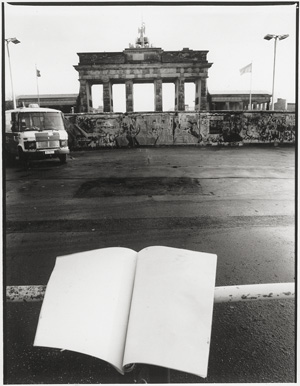
Brandenburg Gate. 1980s. Vintage gelatin silver print. 23,8 x 18 cm. Photographer's stamp on the verso.
[*]: Regelbesteuert gemäß Auktionsbedingungen. [^]: Ausgleich von Einfuhr-Umsatzsteuer.
* Alle Angaben inkl. 25% Regelaufgeld ohne MwSt. und ohne Gewähr – Irrtum vorbehalten.
Galerie Bassenge
Erdener Str. 5A
14193 Berlin
Öffnungszeiten:
Montag bis Donnerstag, 10–18 Uhr,
Freitag, 10–16 Uhr
Telefon: +49 30 8938029-0
Fax: +49 30 8918025
E-Mail: info (at) bassenge.com
Impressum
Datenschutzerklärung
© 2026 Galerie Gerda Bassenge
Galerie Bassenge
Erdener Str. 5A
14193 Berlin
Öffnungszeiten:
Montag bis Donnerstag, 10–18 Uhr,
Freitag, 10–16 Uhr
Telefon: +49 30 8938029-0
Fax: +49 30 8918025
E-Mail: info (at) bassenge.com
Impressum
Datenschutzerklärung
© 2026 Galerie Gerda Bassenge