
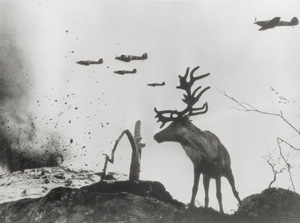
Chaldej, Jewgeni
Yascha the Reindeer, September 1941
Los 4154
Ergebnis (inkl. Aufgeld) *
625€ (US$ 718)
Yascha the Reindeer, September 1941. Gelatin silver print, printed later. 29,8 x 39,5 cm. Signed by the photographer in pencil on the verso.
Slightly buckled, corners slightly bumped, light handling dent in lower left, otherwise in very good condition.
Lit.: Ernst Volland and Heinz Krimmer, eds. Jewgeni Chaldej: Der bedeutende Augenblick. Leipzig: Neuer Europa Verlag 2008, ill. pp. 48-49.
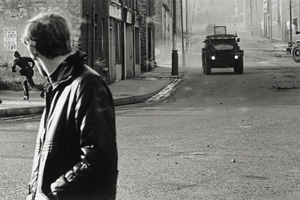
Christoph, Henning
Bloody Sunday, Corner of William Street and Rosville Street, Londonderry, January 30, 1972
Los 4155
Ergebnis (inkl. Aufgeld) *
625€ (US$ 718)
Bloody Sunday, Corner of William Street and Rosville Street, Londonderry, January 30, 1972. Gelatin silver print on Agfa paper, printed 2000. 31 x 46,3 cm (sheet 39,8 x 49,8 cm). Title label below image in margin; signed, dedicated and dated by the photographer in pencil on the verso.
Henning Christoph, born near Leipzig in 1944, emigrated to the United States with his family in 1950. He studied journalism and anthropology at the University of Maryland and worked as a photographer for Gannett Newspapers in New York before returning to Germany in 1967 to study under Otto Steinert at the Folkwang School in Essen. Since 1969, he has worked as a freelance photojournalist for international publications including Life, Time, Newsweek, The New York Times, Le Figaro, Geo, and Stern. His socially engaged reportages address subjects ranging from the relationship between people and technology to marginalized communities, migrant workers, and religious life; he has received numerous honors, including six World Press Photo awards. – A few small nicks in edges, otherwise in very good condition.
Lit.: Henning Christoph and Shawn Christoph. Irland - Irrland: Reportagen aus dem nordirischen Bürgerkrieg. Trier: Spee 1978.
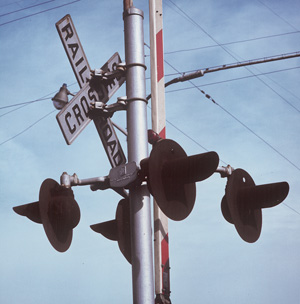
Railroad Crossing. 1984. Cibachrome print, printed 1985, mounted in photo corners in the original mat. 19,7 x 19,7 cm (sheet 25,4 x 20,3 cm). Signed, titled, dated, and editioned “4/25” by the photographer in ink on the verso; signed, dated, titled, and numbered by the photographer in pencil on the mat cover.
Robert Cottingham is known for his paintings and prints depicting the urban American landscape, with a particular focus on building façades, neon signage, movie marquees, railroad heralds, and storefronts. Although often associated with Photorealism, Cottingham has consistently rejected the label, positioning himself instead within a broader tradition of American realism, alongside artists such as Stuart Davis, Charles Demuth, Edward Hopper, and Charles Sheeler. Beginning in the late 1960s, he incorporated photography into his working process as a tool for observation and composition, while maintaining a primary interest in the subject matter itself - often described as Americana. – A few surface scuff marks in black margins, otherwise in very good condition.
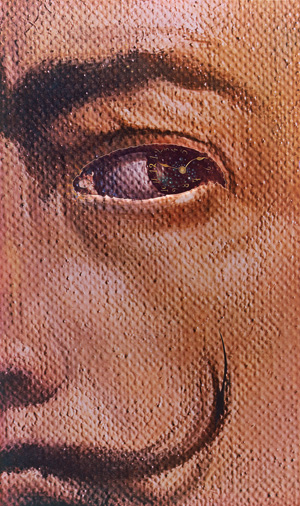
Dalí, Salvador and Robert Descharnes
Surrealist photographic collages
Los 4157
Nachverkaufspreis
800€ (US$ 920)
Surrealist photographic collages. 1962-1975. 4 dye transfer collages with applied elements, printed before 1989. 40 x 26,8 cm (sheets 59,8 x 45 cm) and 40,2 x 26,6 cm (sheets 60,8 x 51,2 cm). Signed and numbered “45/90” by the photographer in blue felt-tip pen in the lower margin and signed by Salvador Dalí in blue felt-tip pen in the lower right corner.
These collages were created in collaboration between the Spanish Surrealist Salvador Dalí and his secretary and close associate Robert Descharnes (1926-2014). Beyond managing Dalí’s intellectual property, Descharnes played a key role in documenting and interpreting the artist’s work, notably through publications such as The World of Salvador Dalí (1975), which features one of these collages on its cover. The group includes images of Gala Dalí, a tribute to Guillaume Apollinaire, and Dalí’s Venus de Cullero. – Some buckling, handling creases and traces from previous mounting in margins, moisture stains on verso of one print, some discoloration from mat frame along margins of each print, otherwise in good condition.
Lit.: Robert Descharnes, Gilles Neret. Salvador Dali 1904-1989: Das Malerische Werk. Cologne: Taschen, 1993, ill. p. 731.
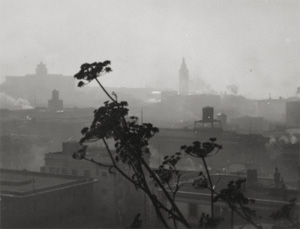
Dassonville, William E.
San Francisco skyline
Los 4158
Ergebnis (inkl. Aufgeld) *
625€ (US$ 718)
San Francisco skyline with Eucalyptus trees (# 318). Ca. 1925. Vintage gelatin silver print on Charcoal Black paper, matted. 8,8 x 11,4 cm (sheet 17 x 20,4 cm). Annotated “318” in ink in the lower margin; annotated in pencil on the verso.
William Dassonville, a photographer and trained chemist, was known for producing his own photographic papers and emulsions in pursuit of specific aesthetic effects. A one-time neighbor of Ansel Adams, he developed the distinctive “Charcoal Black” paper, valued for its rich tonal depth and used by Adams until 1933. – Very small black fiber in right portion of sky area; margins with minimal toning in edges, otherwise a fine tonal print in very good condition.
Lit.: Peter E. Palmquist. William E. Dassonville: California Photographer (1879-1957). Nevada City: Carl Mautz Publishing, 1999, ill. p. 65 (similar image).
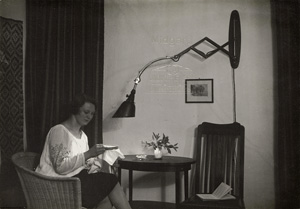
Design/Midgard Lenklampen
Presentation album of Midgard Lenklampen
Los 4159
Nachverkaufspreis
600€ (US$ 690)
Presentation album of Midgard Lenklampen. 1920s. 25 vintage gelatin silver prints, mounted to album pages. Various sizes between ca. 12 x 17 cm and 8 x 11 cm and larger (mounts 18 x 25,5 cm). Photographs with “Midgard” and “IWA” blind stamps, some with numbers in ink on the image; company labels affixed above or below each photograph and annotations in ink below the images on the mounts. Bound with string.
Attractive album presenting the various models of Midgard adjustable wall lamps, along with suggested applications and interior settings. Characterized by their functional clarity and articulated joints, the designs closely reflect the principles of Bauhaus modernism. – Mounts with slight traces of use, one phorto missing, some photos with light silver mirroring, otherwise in very good condition.
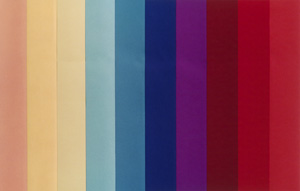
Demand, Thomas
Untitled (Detail of studio stage background for the show "Was bin ich?")
Los 4160
Ergebnis (inkl. Aufgeld) *
1.500€ (US$ 1,724)
Untitled (Detail of Studio Stage Background for the Show “Was bin ich?”). 1997. Chromogenic print on Fujicolor Crystal Archive paper, printed 2001. 39 x 60 cm. Signed and editioned “AP IV” by the photographer in felt-tip pen on the verso.
Thomas Demand is known for constructing life-sized models from paper and cardboard, which he then photographs. These meticulously crafted replicas of everyday interiors produce images that appear uncannily real while subtly undermining their own authenticity. His work engages with themes of representation, memory, and perception, questioning the reliability of images in an increasingly mediated world. The present print is one of ten produced but never distributed, intended for the unrealized portfolio westwärts on the occasion of an exhibition at the Kunstmuseum Bonn. The project, which was to include works by DAAD scholarship holders Franz Ackermann, Karin Sander, Anke Doberauer, and Heiner Schilling, was abandoned when Schilling did not contribute. Untitled (Detail of Studio), 1997, is based on a photograph of a 1970s television set used for the German game show Was bin ich?, hosted by Robert Lembcke. – A few surface scuff marks and a couple of small handling creases, otherwise in near excellent condition.
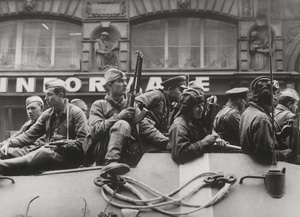
Prague, 21.8.1968. Gelatin silver print, printed 1980s. 27,7 x 37,5 cm. Signed, titled and dated by the photographer in pencil on the verso.
František Dostál was a Czech journalist and documentary photographer based in Prague. He studied at the School of Mechanical Engineering from 1953-1957 and took up photography as an amateur in 1960. His work was first published in 1964 in the weekly magazine Květy, marking the beginning of a long and active photographic career. Dostál participated regularly in photographic salons, and his images were widely published in magazines and newspapers. Over the course of his career, he authored more than 15 books and exhibited internationally, gaining recognition for his keen observational approach to everyday life. – In excellent condition.
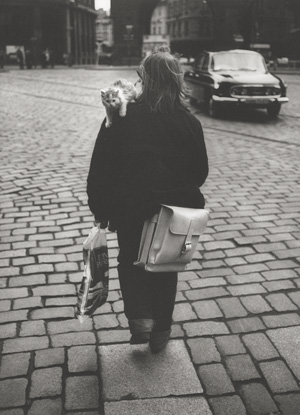
Prague. 1978. Vintage gelatin silver print. 37 x 27 cm. Signed by the photographer in ballpoint pen on the verso.
Small nick in upper edge, otherwise in very good condition.
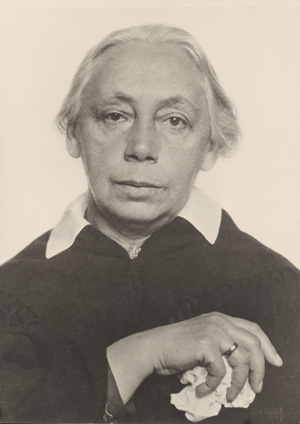
Erfurth, Hugo
Portrait of the artist Käthe Kollwitz
Los 4163
Ergebnis (inkl. Aufgeld) *
750€ (US$ 862)
Portrait of the artist Käthe Kollwitz (1867-1945). 1925. Cropped reproduction gelatin silver print, printed 1960s. 29,5 x 21 cm. Photographer's blindstamp on original print visible in lower right.
A print of this image is in the collection of the Städel Museum, Frankfurt and the Museum für Kunst & Gewerbe, Hamburg. – In excellent condition.
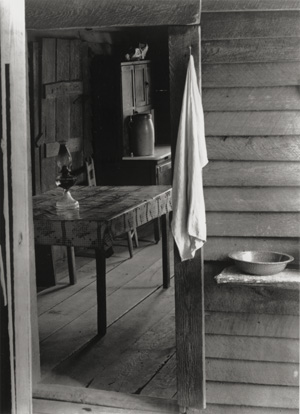
Evans, Walker
Farmer's Kitchen, Hale County, Alabama
Los 4164
Ergebnis (inkl. Aufgeld) *
1.063€ (US$ 1,221)
Farmer's Kitchen, Hale County, Alabama. 1936. Gelatin silver print, printed later from the original negative by Brian Graham. 40 x 28,8 cm (sheet 42,2 x 31,1 cm). Annotated by another hand in pencil as well as "Walker Evans - Gelatin silver print from the original negative" stamp on the verso.
Walker Evans’ work for the Farm Security Administration (FSA) was instrumental in shaping the visual record of rural America during the Great Depression. His photographs captured the stark realities faced by individuals and communities, portraying economic hardship and social dislocation with clarity and empathy. Working alongside other FSA photographers, Evans helped create an enduring documentary archive that not only heightened public awareness but also established documentary photography as a powerful medium for social insight and historical record. – Light crease in lower portion, otherwise in very good condition.
Lit.: John T. Hill. Walker Evans: Lyric Documentary. Göttingen: Steidl, 2006, ill. p. 182.
John T. Hill and Gilles Mora. Walker Evans: Der unstillbare Blick. Munich: Schirmer/Mosel, 1993, ill. p. 206.
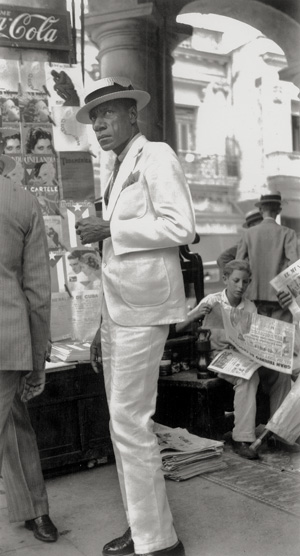
Evans, Walker
Citizen in Downtown Havanna
Los 4165
Ergebnis (inkl. Aufgeld) *
1.250€ (US$ 1,437)
Citizen in Downtown Havana. 1933. Gelatin silver print, printed 1988 from the original negative by Brian Graham. 28 x 15,2 cm (sheet 30 x 23,6 cm). Annotated in pencil by another hand, as well as with “Walker Evans – Gelatin silver print from the original negative” stamp and authentication label on the verso.
In excellent condition.
Lit.: John T. Hill and Gilles Mora. Walker Evans: Der unstillbare Blick. Munich: Schirmer/Mosel, 1993, ill. p. 85.
Maria Morris Hambourg et al. Walker Evans. New York: Metropolitan Museum of Art, 2000, ill. pl. 38.
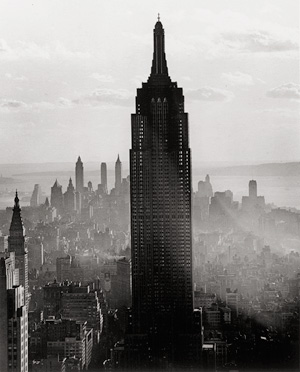
Feininger, Andreas
Empire State Building, New York
Los 4166
Nachverkaufspreis
1.900€ (US$ 2,184)
Empire State Building, New York. 1940. Gelatin silver print, printed later, mounted in mat. 29,5 x 23,7 cm (sheet 35,5 x 27,5 cm). Signed by the photographer in ink in lower right margin.
After leaving school at age 16 in 1922, Andreas Feininger enrolled at the Bauhaus, before he shifted his focus to architecture, studying first at the Staatliche Bauschule Weimar, and later at the Bauschule Zerbst. While in Zerbst, he developed a growing interest in photography, guided in part by Bauhaus teacher and neighbor László Moholy-Nagy. In 1936, Feininger abandoned architecture to pursue photography full-time, relocating to Sweden, and later immigrating to the United States in 1939. He went on to work as a staff photographer for Life magazine from 1943-1962, and became widely known for his photographic manuals, including The Complete Photographer. – One minor pin-sized indentation mark in upper tower area, otherwise a fine tonal print in excellent condition.
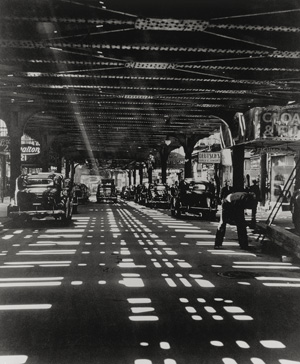
Feininger, Andreas
New York und Chicago in den Vierziger Jahren
Los 4167
Ergebnis (inkl. Aufgeld) *
750€ (US$ 862)
New York und Chicago in den Vierziger Jahren. 1940-41. 6 gelatin silver prints, printed later from the original negatives. Each ca. 24,5 x 19 cm (sheet 30 x 24 cm). Each with Griffelkunst edition stamp on the verso. Presented in original half-canvas folder with illustrated text brochure.
In excellent condition.
Lit.: Andreas Feininger. New York in the Forties. New York: Dover Publications, 1978.
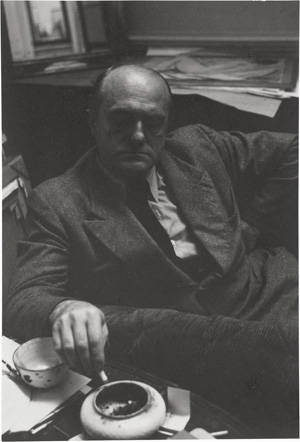
Fietz, Helga
The artist Max Beckmann (1884-1950) in his studio, Amsterdam
Los 4168
Ergebnis (inkl. Aufgeld) *
3.000€ (US$ 3,448)
The artist Max Beckmann (1884-1950) in his studio, Amsterdam. 1938. Vintage gelatin silver print on Gravura paper, mounted along the upper edge to original cream-colored card. 11,5 x 7,7 cm. Photographer’s stamp on the verso.
Best known for her iconic portraits of Max Beckmann, Helga Fietz also photographed numerous other artists throughout her career. In addition to portraiture, she developed a particular affinity for the horses of Iceland, a subject she returned to often and which featured prominently in several published volumes of her work. – A strong print in excellent condition.
Lit.: Carla Schulz-Hoffmann and Judith C. Weiss, eds. Max Beckmann: Retrospektive. Munich: Städtische Galerie im Lenbachhaus, 1984.
[*]: Regelbesteuert gemäß Auktionsbedingungen. [^]: Ausgleich von Einfuhr-Umsatzsteuer.
* Alle Angaben inkl. 25% Regelaufgeld ohne MwSt. und ohne Gewähr – Irrtum vorbehalten.
Galerie Bassenge
Erdener Str. 5A
14193 Berlin
Öffnungszeiten:
Montag bis Donnerstag, 10–18 Uhr,
Freitag, 10–16 Uhr
Telefon: +49 30 8938029-0
Fax: +49 30 8918025
E-Mail: info (at) bassenge.com
Impressum
Datenschutzerklärung
© 2026 Galerie Gerda Bassenge
Galerie Bassenge
Erdener Str. 5A
14193 Berlin
Öffnungszeiten:
Montag bis Donnerstag, 10–18 Uhr,
Freitag, 10–16 Uhr
Telefon: +49 30 8938029-0
Fax: +49 30 8918025
E-Mail: info (at) bassenge.com
Impressum
Datenschutzerklärung
© 2026 Galerie Gerda Bassenge