
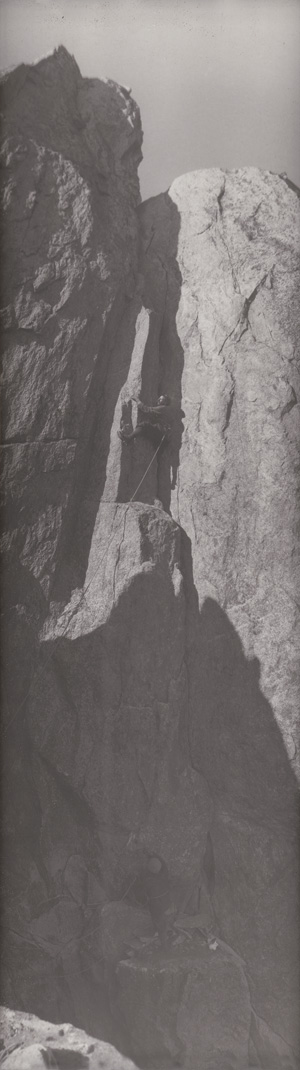
Tairraz, Georges
Mountaineers at the summit of Aiguille du Grepon (Rateau de Chèvres), near Mont Blanc Massif
Los 4289
Nachverkaufspreis
1.200€ (US$ 1,379)
Mountaineers at the summit of Aiguille du Grépon (Rateau de Chèvres), near the Mont Blanc massif. Ca. 1910. 2 vintage gelatin silver prints. Each ca. 69 x 21 cm. 1 signed by the photographer in ink in the lower right corner. Each framed under glass in contemporary wooden frame.
The Tairraz family of Chamonix brought forth several generations of Alpine photographers. In 1857 Joseph Tairraz began taking daguerrotypes and produced the first photographs at the summit of Mont Blanc in 1860. He provided tourists and mountaineers with souvenir portraits and mountain views. His son Georges, who was an apprentice to Pierre Petit in Paris, took over the studio circa 1882, which was then called "Tairraz Alpine Photographic Studio". The studio continued throughout the 20th century. – Both with slight soiling inside frame, one print with a few spots of insect damage, otherwise in very good condition.
Lit.: Georges Tairraz. Le Massif du Mont-Blanc: Photographies de Georges Tairraz. Paris: Arthaud, 1947.
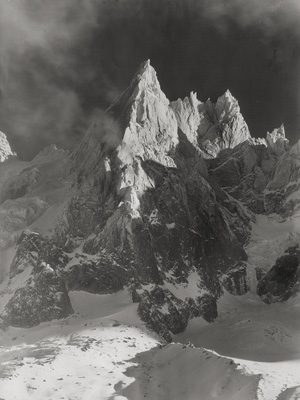
Tairraz II, Georges
Mont Blanc massif (Aiguille Verte/Les Drus)
Los 4290
Nachverkaufspreis
500€ (US$ 575)
Mont Blanc massif (Aiguille Verte/Les Drus). 1960s. Vintage gelatin silver print. 39,5 x 29,5 cm. Photographer's stamp on the verso.
Some silver mirroring in upper and side edges, a few light handling dents, slightly buckled, otherwise in very good condition.
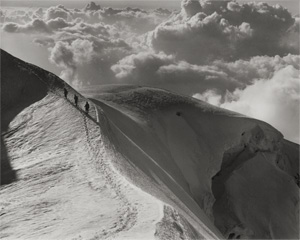
Tairraz II, Georges
Mountaineers at the summit of Mont Blanc
Los 4291
Ergebnis (inkl. Aufgeld) *
625€ (US$ 718)
Mountaineers at the summit of Mont Blanc. 1960s. Vintage gelatin silver print. 23,8 x 29,8 cm. Photographer's stamp on the verso.
Minimal silver mirroring in edges, one light handling dent in right area, otherwise a fine, tonal print in very good condition.
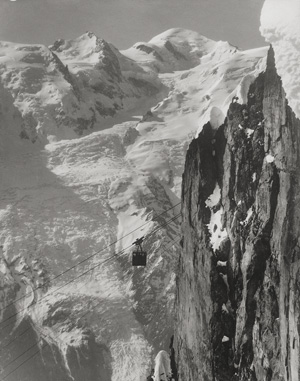
Tairraz II, Georges
Aiguille du Midi gondola with Mont Blanc in the background
Los 4292
Ergebnis (inkl. Aufgeld) *
625€ (US$ 718)
Aiguille du Midi gondola with Mont Blanc in the background. 1960s. Vintage gelatin silver print. 29,7 x 23,5 cm. Photographer's stamp on the verso.
Minimal silver mirroring in edges, otherwise a fine, tonal print in very good condition.
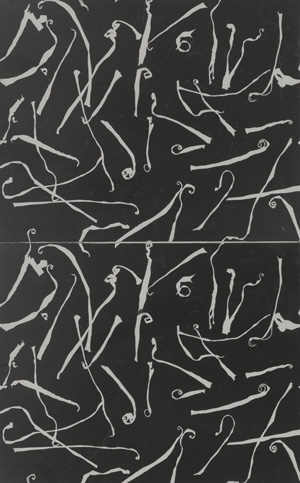
Design for wallpaper. 1930-31. Unique collage consisting of 2 vintage ferrotyped gelatin silver prints with added hand-painting, mounted to board. 32 x 20 cm. Photographer’s estate stamp on mount verso.
Between 1929-1931, Elsa Thiemann's formative years at the Bauhaus in Dessau were marked by influential teachers like Josef Albers, Joost Schmidt, and, notably, Walter Peterhans, who guided her in photography. Her artistic development was strongly shaped by the New Objectivity movement and an emphasis on advertising photography in her Bauhaus education, instilling in her a deep appreciation for structure and innovative composition. In 1930 she met her future husband, the painter Hans Thiemann. After completing her studies, she returned to Berlin in 1931, where she worked as a freelance press photographer until 1960, when she moved to Hamburg following her husband’s appointment as professor at the Hochschule für Bildende Künste. – Some retouched spots, a few light surface scuff marks, photos lifting off of mount in some areas, otherwise in good condition.
Provenance: From the estate of the photographer
Lit.: Annemarie Jaeggi and Margot Schmidt (eds.). Elsa Thiemann: Fotografin. Bauhaus und Berlin. Berlin: Kupfergraben 2004, see pp. 18-27.
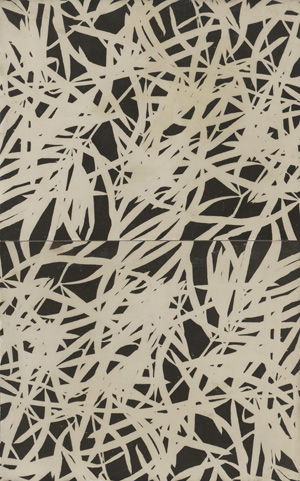
Design for wallpaper. 1930-31. 2 unique collages, one consisting of 2 and one of 4 vintage gelatin silver prints; one collage with individual prints mounted to board and joined with paper tape, the other taped together along the edges with paper tape. Circa 32 x 20 cm. Each with the photographer’s estate stamp on mount verso.
Paper tape slightly torn in parts at joints, one collage slightly soiled and with crease in upper right, the other with light handling marks, corners slightly bumped, otherwise in very good condition.
Provenance: From the estate of the photographer
Lit.: Annemarie Jaeggi and Margot Schmidt, eds. Elsa Thiemann: Fotografin. Bauhaus und Berlin. Berlin: Kupfergraben, 2004, ill. pp. 18–27.
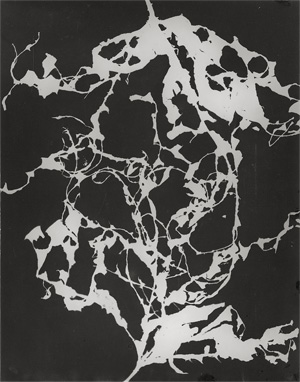
Structural study. 1930s. Vintage gelatin silver print on chamois Agfa-Brovira paper. 29,5 x 23,2 cm. Photographer's estate stamp on the verso.
Some retouched spots, remnants of previous mounting on verso, right edge cut slightly uneven, otherwise in very good condition.
Provenance: From the estate of the photographer
Tobias, Herbert
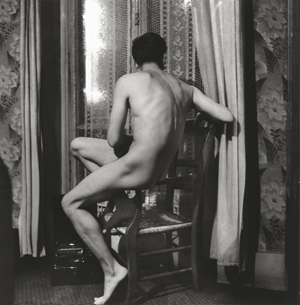
Dick in front of the Window, Hotel Naumur
Los 4296
Ergebnis (inkl. Aufgeld) *
1.375€ (US$ 1,580)
Dick in front of the Window, Hotel Naumur, Rue Delambre, Paris Montparnasse. 1952. Gelatin silver print, printed later. 34,4 x 34,4 cm (sheet 50 x 40 cm). Signed, titled and dated by the photographer in pencil in lower margin.
Herbert Tobias is known for his psychologically charged portraiture, shaped by influences from dance, Surrealism, and theatrical staging. Emerging in postwar Berlin, he photographed figures from artistic and queer subcultures, often exploring themes of identity, performance, and gender through stylized, collaborative portraits. – A few spots in margins, otherwise a rich dark print in very good condition.
Lit.: Herbert Tobias. Photographien. Berlin: Fröhlich & Kaufmann, 1985, ill. p. 51.
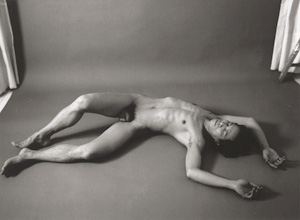
Arthur Umboh. 1980. Portfolio of 16 gelatin silver prints. Each 40 × 30,5 cm. Each signed, titled, and dated by the photographer in pencil below the image in the margin; “Herbert Tobias succession binoche” stamp on the verso. Presented in a golden folder. Dedication in felt-tip on the inside flap: “Für Pali with love, Weihnachten 1980 von Tobias.”
Portfolio with nudes and a few portraits of Arthur Umboh in various poses. – Folder with rubbed edges and general signs of use. Some scuff marks on individual prints, slight buckling along the edges, otherwise stong prints with a fine tonal quality.
Lit.: Bernhard Albers, ed. Herbert Tobias: Fotografien aus der Sammlung Pali Meller Marcovicz. Aachen: Rimbaud, 1996, several ill. (unpaginated).
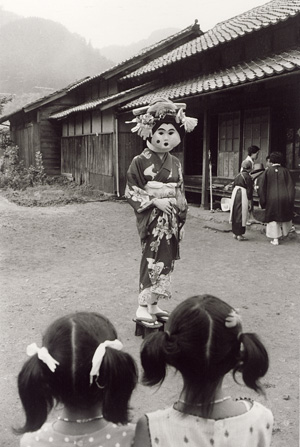
Untitled. 1960. Gelatin silver print on RC paper, printed later. 21 x 14 cm (sheet 25,2 x 20 cm). Signed by the photographer in ink and dated "1960" on the verso.
The Japanese photographer Shoji Ueda developed a distinctive and poetic photographic language. Working in his native Tottori, he repeatedly used the local sand dunes as a stage, transforming their stark terrain into subtly surreal, almost otherworldly landscapes. His spare, meticulously composed images - often featuring solitary figures or everyday objects set against the vast expanse - evoke a quiet, contemplative atmosphere, emphasizing the delicate interplay between human presence and the natural environment. – A few light handling dents, otherwise in good condition.
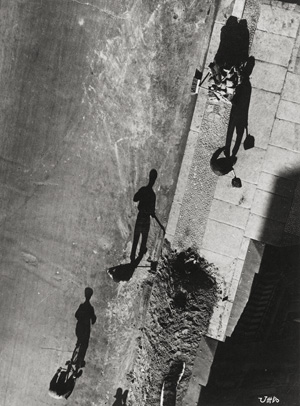
Schattenwunder. 1928. Gelatin silver print, printed ca. 1975. 28 x 20,5 cm (sheet 35,2 x 27,8 cm). Signed by the photographer in white ink in the lower right corner; portfolio/copyright stamp, therein numbered "32/50" in ink on the verso. From the UMBO Portfolio: 10 Photographien 1927-1930, Galerie Rudolf Kicken, Cologne, 1980.
Otto Umbehr, known as UMBO, was a key figure in early 20th-century avant-garde and modernist photography. The photograph offered here ranks among his most iconic series of street scenes taken from an aerial perspective. Only a few vintage prints of these works are known to exist, and in the mid- to late 1970s UMBO produced a small edition both with Galerie Rudolf Kicken and later with the Kestner Gesellschaft. – Buckled in edges, otherwise in excellent condition.
Lit.: Herbert Molderings. Umbo: Otto Umbehr 1902-1980. Düsseldorf: Richter 1995, ill. plate 53.
Villers, André
Pablo Picasso in Madoura, Vallauris
Los 4300 [*]
Nachverkaufspreis
1.500€ (US$ 1,724)
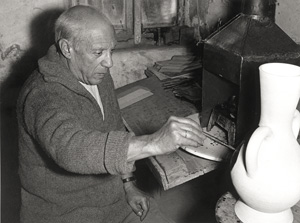
Pablo Picasso in Madoura, Vallauris. 1954. Gelatin silver print, printed later. 30,2 x 40,2 cm. Signed by the photographer in ink in lower margin; signed titled and dated by the photographer on the verso.
André Villers made this portrait of Pablo Picasso in 1954 at the Madoura workshop in Vallauris, where Picasso was deeply engaged in ceramics. Reflecting their close relationship, the image favors an informal, intimate approach over conventional studio portraiture. Villers’ use of natural light and an unforced composition situates Picasso within his working environment, capturing a moment of creative maturity with a sense of immediacy and quiet presence. – Corners slightly bumped, otherwise a strong print in very good condition.
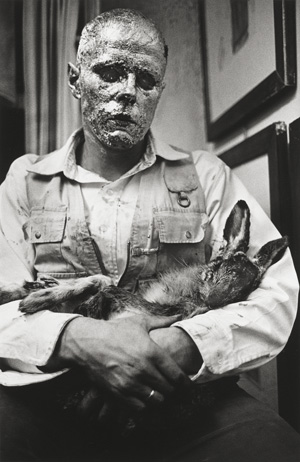
Joseph Beuys. 1965. Gelatin silver print, printed 2015. 47,7 x 31 cm (sheet 51,2 x 40,5 cm). Signed, titled and dated in black ink in lower margin; annotated, dated and editioned "1/3" by the photographer in ink on the verso.
This photograph by Walter Vogel shows Joseph Beuys during his performance "Wie man dem toten Hasen die Bilder erklärt" (How to Explain Pictures to a Dead Hare) at the Galerie Schmela in Düsseldorf, 1965. – A few light handling dents condition.
Lit.: Walter Vogel. Werkverzeichnis 1950-2010. Düsseldorf, 2009, ill. p. 26.
Voigt, Adolf & Hans Giebler
Surface of the Moon
Los 4302
Ergebnis (inkl. Aufgeld) *
1.375€ (US$ 1,580)
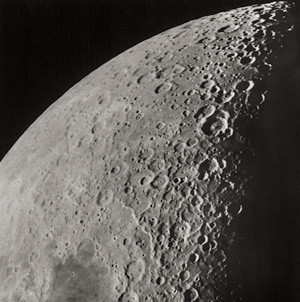
Surface of the Moon. 1964-1968. 30 vintage gelatin silver prints. Each 21 x 21 cm. Each with detailed information on the photograph’s date, moon phase, and location printed on label on the verso.
The collaborative lunar photography project by Adolf Voigt and Hans Giebler represents a significant contribution to astronomical imaging during the height of the space race. Using the 12-inch Bamberg-Refractor telescope at the Wilhelm Foerster Observatory, they captured detailed images of the moon’s surface with a custom-built camera, meticulously documenting its various phases.Their systematic approach, of recording the moon across a full lunation and annotating each image with detailed observational data, resulted in a comprehensive visual record that later formed the basis of the Berliner Mondatlas. The combination of scientific rigor with photographic clarity, render these images not only as important tools for observation, but also reflect the broader cultural fascination with lunar exploration in the years leading up to the Apollo missions. – Some very light surface scuff marks, pressure marks and finger prints; a few corners slightly bumped, otherwise in near excellent condition.
Volland, Ernst
WB 1 (from the series 'Eingebrannte Bilder')
Los 4303
Ergebnis (inkl. Aufgeld) *
1.125€ (US$ 1,293)
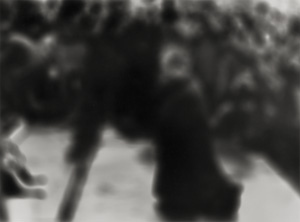
WB 1 (from the series "Eingebrannte Bilder"). 1999. Gelatin silver print. 30 x 40 cm. Signed and dated by the photographer in pencil on the verso.
Since the 1990s, Ernst Volland has focused on the artistic reinterpretation of historical photographs and iconic images from contemporary history. His series "Eingebrannte Bilder" (Branded Images), developed over several years and exhibited at the German Historical Museum in Berlin, transforms familiar photographs embedded in Germany’s collective memory. By deliberately blurring and distorting these images, Volland challenges viewers to confront their visual assumptions, turning once recognizable scenes into enigmatic visual puzzles. – Edges slightly curled, otherwise in very good condition.
[*]: Regelbesteuert gemäß Auktionsbedingungen. [^]: Ausgleich von Einfuhr-Umsatzsteuer.
* Alle Angaben inkl. 25% Regelaufgeld ohne MwSt. und ohne Gewähr – Irrtum vorbehalten.
Galerie Bassenge
Erdener Str. 5A
14193 Berlin
Öffnungszeiten:
Montag bis Donnerstag, 10–18 Uhr,
Freitag, 10–16 Uhr
Telefon: +49 30 8938029-0
Fax: +49 30 8918025
E-Mail: info (at) bassenge.com
Impressum
Datenschutzerklärung
© 2026 Galerie Gerda Bassenge
Galerie Bassenge
Erdener Str. 5A
14193 Berlin
Öffnungszeiten:
Montag bis Donnerstag, 10–18 Uhr,
Freitag, 10–16 Uhr
Telefon: +49 30 8938029-0
Fax: +49 30 8918025
E-Mail: info (at) bassenge.com
Impressum
Datenschutzerklärung
© 2026 Galerie Gerda Bassenge