
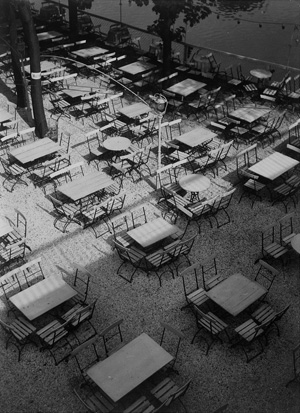
Biergarten. 1929-32. Vintage ferrotyped gelatin silver print on ivory paper, hinge-mounted along upper edge to mount. 24,3 x 18 cm. Photographer’s “Foto H. Koch Halle/S” stamp on the verso.
Heinrich Koch studied mural painting at the Bauhaus in Weimar and Dessau between 1922-1928, before working as an interior designer in Halle an der Saale until 1929. From 1930, he studied photography at Burg Giebichenstein under Hans Finsler, becoming his assistant and, in 1932, his successor. The photography class was closed in 1933 by the National Socialists, forcing Koch to emigrate to Prague, where he tragically died in a car accident in 1934. – Corners bumped, otherwise a fine tonal print in very good condition.
Lit.: T. O. Immisch and Gunnar Lüsch, eds. Heinrich Koch: Photographien (1929-1934). Halle: Mitteldeutscher Verlag, 2002.
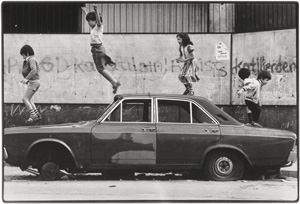
Kreuzberg, Berlin. 1980. Vintage gelatin silver print on Agfa paper. 28 x 40,2 cm. Signed, titled and dated by the photographer in pencil on the verso.
In 1972, Wolfgang Krolow moved to Berlin, where he studied visual communication at the Berlin University of the Arts, specializing in photography and graphic design. From an early stage he devoted himself to socially critical photography. He photographically captured everyday cultural and social life in Berlin as well as the political conflicts during the height of the squatter movement and later during the fall of the Berlin Wall.
Translated with DeepL.com (free version) – Some handling creases throughout, otherwise in very good condition.
Lit.: Sigrid Heger, Andeas Homann and Rainer Wendling, eds. Kreuzberg die Welt: Fotografien von Wolfgang Krolow. Berlin: Assoziation-A, 2025, ill. pp. 118-119.
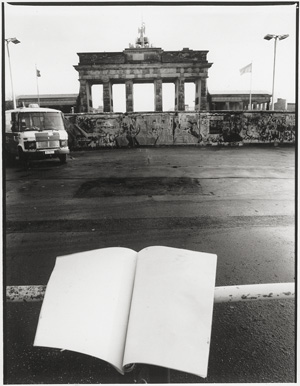
Brandenburg Gate. 1980s. Vintage gelatin silver print. 23,8 x 18 cm. Photographer's stamp on the verso.
Corner slightly bumped, some minimal scuff marks, otherwise a strong print in near excellent condition.
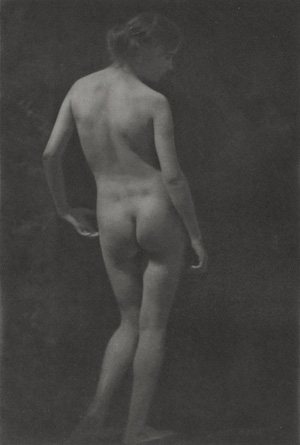
Der Akt. Zwanzig photographische Aufnahmen weiblicher Körper nach der Natur. 20 l. with photos as hand-pulled photogravures on Japan. 41 x 30,5 cm. Original cream-colored boards with mounted photogravure. Dachau, Einhorn-Verlag, 1918.
802 Photo Books, p. 111; Heidtmann 11127; Koetzle 215. First edition of Germaine Krull’s first publication, issued when she was only 21, shortly after opening her studio in Munich in 1917. Forced to leave the city in 1920 due to her political activism, she went on to work internationally, including in the Soviet Union, Amsterdam, Paris, Brazil, Africa, and Bangkok. One of the most influential women photographers of the interwar period, she is represented here alongside works by József Pécsi (4 photographs) and Wanda von Debschitz-Kunowski (9 photographs), with 7 photographs by Krull herself. The photogravures (hand-pressed copper engravings) and the 2 text leaves are printed on thin Japan paper and mounted to cardboard sheets. – Cover slightly rubbed, some photogravures with small tears in upper edges/corners, a few with light stains from glue in upper corners, otherwise good copy.
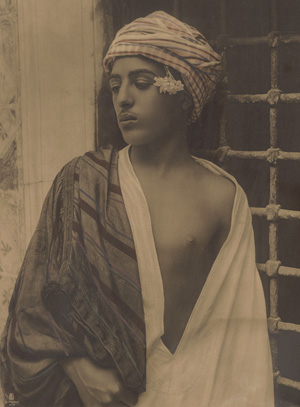
Lehnert & Landrock
Portrait of an Arabian youth
Los 4216
Ergebnis (inkl. Aufgeld) *
1.500€ (US$ 1,724)
Portrait of an Arabian youth. Ca. 1910. Hand-colored photogravure. 38,5 x 29 cm. Photographer’s logo and number “6009” in the negative in the lower left corner. Framed under glass in wooden frame.
Lehnert & Landrock were among the most accomplished photographic studios working in North Africa in the early 20th century, celebrated for their refined studio portraits and atmospheric views of Tunisia and Egypt. Their work is characterized by technical precision, careful staging, and a painterly sensitivity to light, costume, and setting. Produced primarily for a European audience, these images reflect the period’s fascination with North African culture, and have come to define the studio’s lasting appeal within the tradition of Orientalist photography. – Light scattered white spots in the lower right corner; otherwise a strong print in near excellent condition.
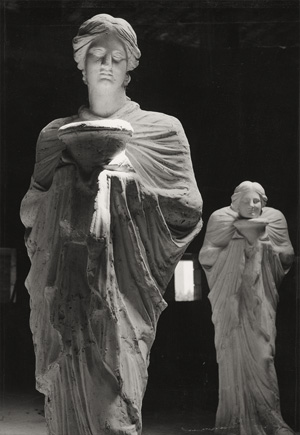
List, Herbert
Ancient Greek sculpture, Capitilone Museum, Rome
Los 4220
Ergebnis (inkl. Aufgeld) *
1.375€ (US$ 1,580)
Ancient Greek sculpture; Capitoline Museum, Rome. 1950s. Vintage ferrotyped gelatin silver print on doubleweight Agfa-Brovira paper. 29,2 x 20,2 cm. Photographer's estate stamp, therein number in pencil on the verso.
Edges slightly curled, a few retouched spots, some surface scratch marks, more visible at an angle, otherwise in very good condition.
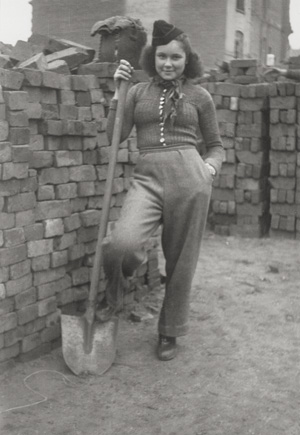
Trümmerfrauen, Leipzig. 1949. 3 gelatin silver prints, printed 1997, 1 mounted to card. Each circa 23 x 16 cm. 1 signed, annotated and editioned in pencil on mount; 2 with printed archive/exhibition paper label affixed to the verso.
Karl Heinz May was a German photographer active in the postwar period, known for his documentary and reportorial images of everyday life. His work is characterized by a direct, observational approach, capturing social realities with clarity and an understated sense of composition. – In very good condition.
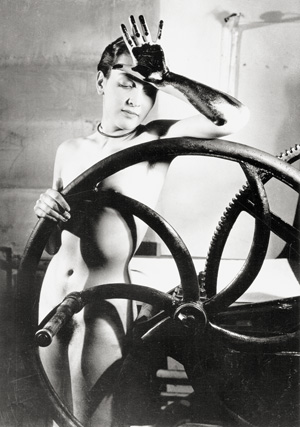
Man Ray
Le violon d’Ingres (1924), Group photo of the DADA group (ca. 1922), Self-Portrait (1932), Erotique voilée (1933), Juliet (1945)
Los 4224
Ergebnis (inkl. Aufgeld) *
1.188€ (US$ 1,365)
Le violon d’Ingres (1924), Group photo of the DADA group (ca. 1922), Self-Portrait (1932), Erotique voilée (1933), Juliet (1945) . 5 gelatin silver prints, printed 1991. Each circa 23,8 x 18 cm (sheets 30,2 x 24,2 cm). Each with “Griffelkunst” and “ADAGP Man Ray Trust” copyright stamps on the verso.
Man Ray was a central figure of Dada and Surrealism, whose photography pushed the medium toward experimentation and abstraction. Through techniques such as solarization and his cameraless “rayographs,” he explored chance, transformation, and the interplay between object and image, redefining photography as a creative and conceptual practice. The present lot comprises later prints of some of his most important photographs. – Some light handling creases and minimal buckling along the edges of some prints, otherwise all in good to very good condition.
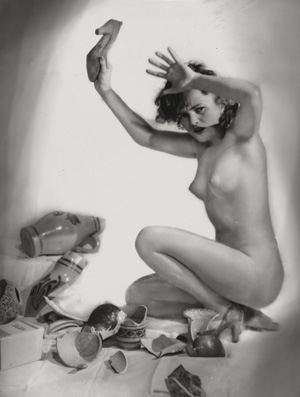
Gebrochene Versprechen. Circa 1930. Vintage gelatin silver print, hinge-mounted to mat. 21,2 x 16,2 cm (mount 49,8 x 40). Photographer's "Foto Wlassics Wien" copyright stamp on the verso. Framed under glass in wooden frame.
Studio Manassé was a prominent Viennese photographic studio active during the 1920s and early 1930s, founded by Olga Spolarits and Adolf Manassé. Renowned for its fashion photography, portraits, and stylized nude studies, the studio developed a highly polished visual language characterized by sharp lighting, theatrical staging, and an Art Deco-influenced modernity. Its work exemplifies the close connection between avant-garde aesthetics and commercial photography in interwar Vienna. – Some scuff marks and faint surface irregularities, particularly along the edges; corners bumped and edges slightly rubbed; otherwise in good condition.
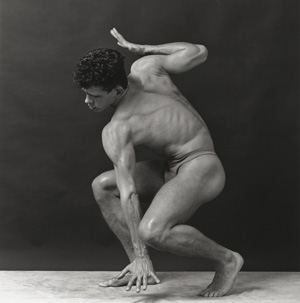
Manen, Hans van
Improvisation II Rob van Woerkom; Guilherme Botelmo Gr. Plié
Los 4226
Ergebnis (inkl. Aufgeld) *
1.125€ (US$ 1,293)
Improvisation II, Rob van Woerkom / Gr. Plié, Guilherme Botelho. 1985/1984. 2 vintage gelatin silver prints, flush-mounted to board. Each 37 x 37 cm (mounts 42,8 x 38,7 cm). Each signed, titled, and editioned “5/10” and “3/10” in pencil on the mount verso.
Hans van Manen is internationally recognized as one of the leading figures of contemporary ballet. Alongside his distinguished career as a dancer and choreographer, he has also developed a notable practice in photography, with his work published in book form and exhibited internationally. – Upper right corner of both prints slightly bumped, otherwise fine large exhibition prints in excellent condition.
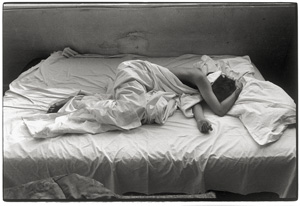
McBride, Will
Barbara in unserem Bett, Berlin
Los 4227
Ergebnis (inkl. Aufgeld) *
1.375€ (US$ 1,580)
Barbara in unserem Bett, Berlin. 1959. Gelatin silver print, printed 2005. 35 x 52 cm (sheet 50,7 x 60,5 cm). Signed, titled and dated by the photographer in pencil on the verso.
The American-German photographer Will McBride is celebrated for his candid and empathetic documentary work. From the start of his career, he focused on unvarnished depictions of youth, sexuality, and identity, offering a glimpse into the cultural and societal shifts of the postwar era. With a compassionate eye and deep trust in his subjects, McBride created photographs that remain striking for their honesty, intimacy, and emotional depth. – A few retouched lines in upper right, otherwise in very good condition.
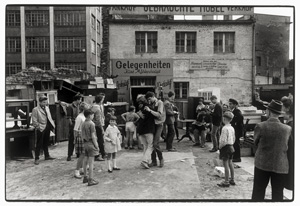
McBride, Will
Evi und Lapper tanzen beim Kremserfahrt vorm Trödelhändler Kurt Mühlenhaupt
Los 4228
Ergebnis (inkl. Aufgeld) *
1.000€ (US$ 1,149)
Evi und Lapper tanzen beim Kremserfahrt vorm Trödelhändler Kurt Mühlenhaupt. 1959. Gelatin silver print, printed 1990s. 22,5 x 33 cm (sheet 26,5 x 40,3 cm). Signed, titled and dated by the photographer in pencil as well as photographer's stamp on the verso.
A few handling creases/dents, otherwise in good condition.
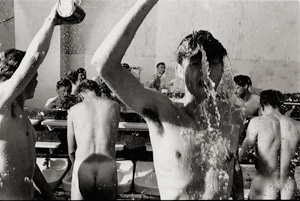
McBride, Will
Schüler schmeißen Wasser beim Waschen, Schloß Schule Salem
Los 4229
Ergebnis (inkl. Aufgeld) *
2.750€ (US$ 3,161)
Schüler schmeißen Wasser beim Waschen, Schloß Schule Salem. 1963. Gelatin silver print, printed 1990. 36 x 53,5 cm (sheet 50,5 x 60,5 cm). Signed, annotated, dated and numbered "4/12" by the photographer in pencil and collection stamp on the verso.
In near excellent condition.
Provenance: Directly from the photographer to the present owner.
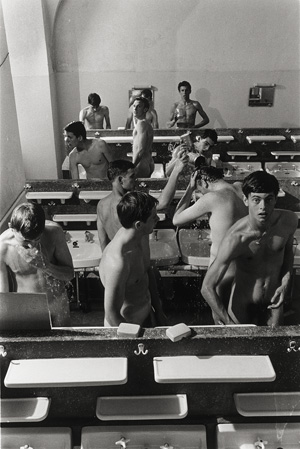
McBride, Will
Schüler waschen sich, Schule Schloss Salem
Los 4230
Ergebnis (inkl. Aufgeld) *
3.250€ (US$ 3,736)
Schüler waschen sich, Schule Schloss Salem. 1963. Gelatin silver print, printed 1990. 53,5 x 36 cm (sheet 60,5 x 50,5 cm). Signed, titled, dated and editioned "1/12" by the photographer in pencil and collector's stamp on the verso.
Slightly buckled in right edge, light crease mark and pressure mark in right margin, otherwise in near excellent condition.
Provenance: Directly from the photographer to the present owner
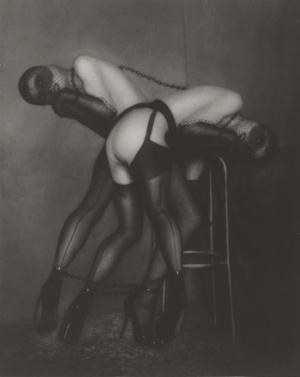
Pantomime céleste. 1968. Vintage gelatin silver print, mounted to board. 13,5 x 11,7 cm (mount 36 x 31,5 cm). Titled in pencil on the verso, "Hanel Koeck Collection" stamp. Framed under glass in wooden frame.
Pierre Molinier developed a highly personal body of work centered on staged self-portraits and photomontages, using his own body as both subject and material. Closely aligned with Surrealism, his practice explores fetishism, gender ambiguity, and erotic desire through fragmentation, repetition, and theatrical mise-en-scène. Working largely outside institutional frameworks, Molinier blurred the boundary between artist and model, anticipating later developments in body art and performance-based photography. – Corners minimally bumped, otherwise in excellent condition.
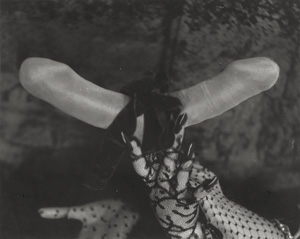
Godemiche fétiche. 1970. Vintage gelatin silver print, mounted to board. 8,8 x 11,2 cm (mount 30,6 x 32,2 cm). Titled in pencil on the verso, "Hanel Koeck Collection" stamp. Framed under glass in wooden frame.
Corners minimally bumped, otherwise in excellent condition.
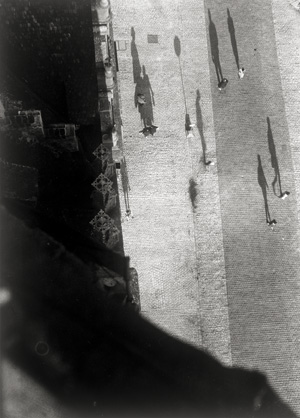
Moholy-Nagy, László
Rothenburg ob der Taube
Los 4235
Ergebnis (inkl. Aufgeld) *
2.250€ (US$ 2,586)
Rothenburg ob der Taube. 1930/31. Gelatin silver print, printed 1990s. 24,2 x 17,5 cm (sheet 39,2 x 29,5 cm). "Laszlo Moholy-Nagy - griffelkunst" stamp on the verso.
László Moholy-Nagy moved from Budapest to Berlin in 1920 with his wife, the artist Lucia Moholy. In 1923 he joined the Bauhaus in Weimar, where he initially co-taught the foundation course before becoming head of the metal workshop. Photography soon became central to his practice. Introduced to the medium by Lucia Moholy, he embraced experimental techniques to articulate the dynamism of modern urban life and developed the concept of a “New Vision,” aligned with broader modernist ideas of perception in the postwar era. – In very good condition.
Lit.: Jeanine Fiedler, ed. Moholy Album: Perspektivwechsel auf den Fotostrecken der Moderne. László Moholy-Nagys schwarzweißfotografische Arbeiten 1924-1937. Göttingen: Steidl, 2018, ill. p. 141.
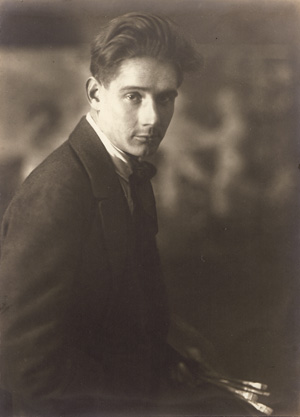
Morgner, Wilhelm
Portrait of the artist Wilhelm Morgner
Los 4236
Ergebnis (inkl. Aufgeld) *
625€ (US$ 718)
Photographer unknown. Portrait of the artist Wilhelm Morgner. Circa 1910. Vintage sepia-toned gelatin silver print. 22 x 16 cm.
In 1908, on the advice of Otto Modersohn, Wilhelm Morgner moved to Worpswede, where he studied with Georg Tappert, who introduced him to modern art and encouraged plein air painting; the two remained in close contact. After returning to Soest in 1909, Morgner established a studio and began exhibiting, and in 1910 he traveled to Berlin for further study with Tappert. His growing reputation led to publications in Der Sturm and Die Aktion, and participation in major exhibitions, including the Neue Secession in Berlin, the Blauer Reiter in Munich, and the Sonderbund in Cologne. Drafted in 1913, he was sent to the Western Front at the outbreak of the First World War and was killed near Langemark in Flanders in 1917 at the age of 26. – Minimal silver mirroring in edges, more visible at an angle, traces of previous mounting on the verso, otherwise in very good condition.
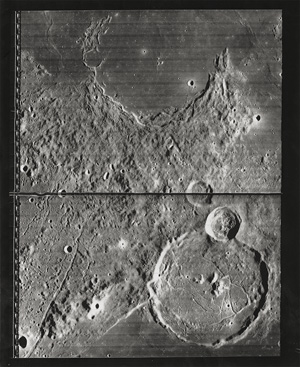
NASA
Lunar surface taken by Lunar Orbiter IV
Los 4238
Ergebnis (inkl. Aufgeld) *
625€ (US$ 718)
Lunar surface taken by Lunar Orbiter IV. 1967. Vintage ferrotyped gelatin silver print. 61 x 51 cm. "NASA-LRC" and "IV-143H2" in lower margin.
Handling dents/creases throughout, edges curled, some pinholes, otherwise in good condition.
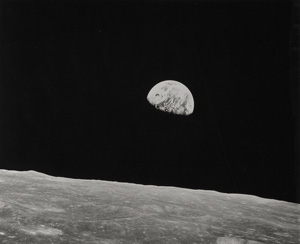
Photographer: William Anders (1933-2024). Earthrise from Apollo 8. December 24, 1968. Vintage gelatin silver print. 20,3 x 25,2 cm. NASA press text printed on the verso.
This celebrated image shows a black and white version of planet Earth rising above the bleached lunar horizon. The crew had completed three lunar orbits before emerging from the far side and witnessing this sight, surely one of the most astounding ever photographed. Anders stated "I was immediately almost overcome by the thought that here we came all this way to the Moon, and yet the most significant thing we're seeing is our own home planet, the Earth." – One longer, diagonal surface scratch in right area, a few other surface scratches, more visible in raking light, otherwise in very good condition.
Lit.: Ron Schick and Julia Van Haaften. The View from Space: American Astronaut Photography 1962-1972. New York: Clarkson Potter, 1988, ill. p. 98 (in color).
[*]: Regelbesteuert gemäß Auktionsbedingungen. [^]: Ausgleich von Einfuhr-Umsatzsteuer.
* Alle Angaben inkl. 25% Regelaufgeld ohne MwSt. und ohne Gewähr – Irrtum vorbehalten.
Galerie Bassenge
Erdener Str. 5A
14193 Berlin
Öffnungszeiten:
Montag bis Donnerstag, 10–18 Uhr,
Freitag, 10–16 Uhr
Telefon: +49 30 8938029-0
Fax: +49 30 8918025
E-Mail: info (at) bassenge.com
Impressum
Datenschutzerklärung
© 2026 Galerie Gerda Bassenge
Galerie Bassenge
Erdener Str. 5A
14193 Berlin
Öffnungszeiten:
Montag bis Donnerstag, 10–18 Uhr,
Freitag, 10–16 Uhr
Telefon: +49 30 8938029-0
Fax: +49 30 8918025
E-Mail: info (at) bassenge.com
Impressum
Datenschutzerklärung
© 2026 Galerie Gerda Bassenge