
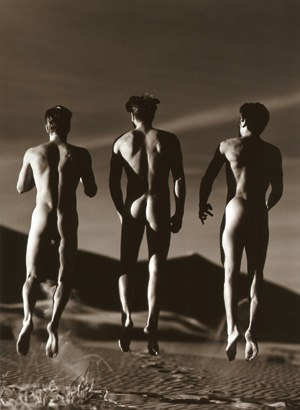
Three Boys Jumping. 1991. Vintage sepia-toned gelatin silver print. 48,2 x 35,5 cm (sheet 50,2 x 40,8 cm). Photographer's stamp, therein signed, editioned "1/25" and dated as well as number notation in pencil on the verso.
Greg Gorman is best known for his striking black-and-white portrait photography, capturing celebrities, artists, and cultural figures with a refined sense of drama and intimacy. His work is characterized by meticulous lighting, strong contrasts, and a timeless elegance that reveals both the glamour and vulnerability of his subjects. Beyond Hollywood portraiture, Gorman has also explored the male nude with a bold and sensual aesthetic, establishing his reputation in both commercial and fine art photography. – Handling crease in the right margin; a crease to the lower right corner in the margin; handling dents near the left edge within the image, otherwise a fine tonal print in very good condition.
Greene, Milton H.
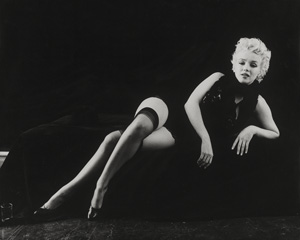
Marilyn Monroe (from the "Black Sitting")
Los 4183
Ergebnis (inkl. Aufgeld) *
1.375€ (US$ 1,580)
Marilyn Monroe (from the "Black Sitting"). 1956. Large-format gelatin silver print, printed 1978. 40,3 x 50,5 cm. Photographer's "Authentic Original Photograph by: Milton H. Greene" stamp, therein signed and dated by the photographer in ink on the verso.
Slight buckling in edges, edges slightly curled, a few minimal nicks in edges, upper left corner bumped, otherwise in very good condition.
Lit.: Joshua Greene, ed. Milton's Marilyn. Munich: Schirmer/Mosel, 1998, ill. p. 158 ff. (images from the same sitting).
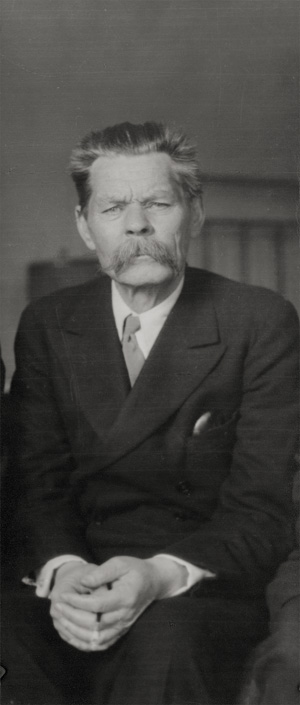
Portrait of Maxim Gorky. 1928/29. Vintage gelatin silver print. 27,7 x 11,8 cm. Signed and annotated by the photographer in ink and annotated by another hand in pencil on the verso.
Maxim Gorky (born Alexei Maximovich Peshkov) was a central figure in Russian and Soviet literature and a committed advocate of socialist ideals. Nominated five times for the Nobel Prize in Literature, he rose to prominence through works shaped by his early years of hardship and extensive travels across the Russian Empire, during which he held a wide range of jobs. These formative experiences informed his literary voice and subject matter. Gorky maintained close ties with leading contemporaries such as Leo Tolstoy and Anton Chekhov, both of whom he later reflected upon in his memoirs. – Silver mirroring and slight buckling in edges, indentation mark and small retouched spot in lower portion, otherwise in very good condition.
Guillaume, Paul
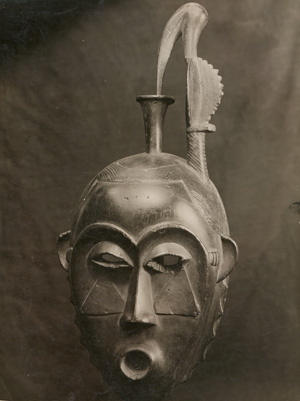
African Mask, Ivory Coast
Los 4186
Ergebnis (inkl. Aufgeld) *
2.375€ (US$ 2,730)
African Mask, Ivory Coast. 1929. Vintage gelatin silver print on chamois paper. 28,6 x 21,5 cm. Annotated in French and with layout notes in pencil on the verso.
Paul Guillaume was among a generation of dealers who embraced Cubism shortly before the First World War. He opened his first gallery in February 1914 at 6, rue de Miromesnil in Paris, promoting artists such as Giorgio de Chirico, André Derain, Jacques Lipchitz, Henri Matisse, Amedeo Modigliani, Francis Picabia, and Chaïm Soutine. After the exile of Daniel-Henry Kahnweiler during the war, he emerged as a key figure in the Cubist market. He later moved to 59, rue La Boétie and developed a strong interest in African sculpture, which he both collected and promoted, organizing exhibitions, lending works internationally, and publishing on the subject. Photographers such as Man Ray documented pieces from his collection. The present photograph, depicting an African mask formerly in Guillaume’s collection, was likely used for publication in La Sculpture nègre primitive by Paul Guillaume and Thomas Munro (Paris: G. Crès et Cie., 1929, pl. 6; photographer not credited). – Some handling dents, small tear and ink mark in right edge, some light silver mirroring, otherwise in good condition.
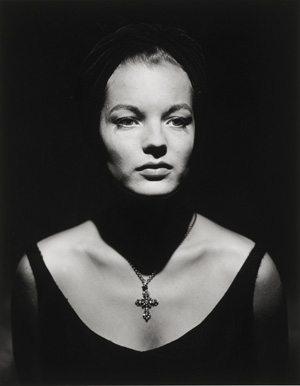
Romy mit Kreuz, Hamburg. 1962. Gelatin silver print, printed 1980s. 39 x 30,2 cm (sheet 50,3 x 40 cm). Signed, titled and dated by the photographer in pencil on the verso.
Spanning several decades, the career of F.C. Gundlach is a testament to his exceptional sense of composition, mastery of light, and an unwavering commitment to elegance. His work reflects the essence of post-war Germany, including its evolving fashion and culture, effectively bridging the realms of photography and art. Gundlach's iconic fashion images and portraits of celebrities have left an enduring mark on the industry, establishing him as a respected and influential figure in the realm of photography. – Two light creases in upper area, more in margin, otherwise in very good condition.
Lit.: Published in: Film und Frau, no. 11, 1962, ill. p. 10 (“Die andere Romy Schneider”).
Klaus Honnef and Hans-Michael Koetzle, eds. F.C. Gundlach: Das fotografische Werk. Göttingen: Steidl, 2008, ill. p. 270.
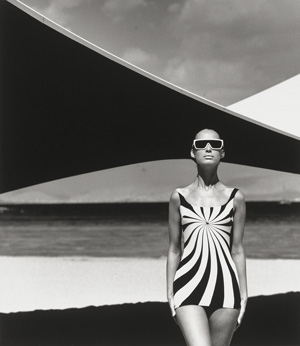
Gundlach, F.C.
Op-Art Design, Athen, Brigitte Bauer
Los 4188
Ergebnis (inkl. Aufgeld) *
4.250€ (US$ 4,885)
Op-Art Design, Athen, Brigitte Bauer. 1966. Gelatin silver print. 35,4 x 30,7 cm (sheet 50,5 x 40,5 cm). Signed, titled and dated in pencil on the verso.
In excellent condition.
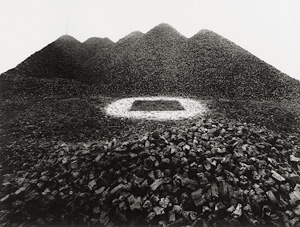
Störung. 1971. Archival pigment print, printed later. 30 x 39,5 cm (sheet 40 x 50 cm). Signed, titled, dated and editioned "I/V" by the photographer in pencil in lower margin.
Throughout his career, Robert Häusser consistently showed an extraordinary talent for capturing the quintessence of his subjects, whether they were people, landscapes, or still lifes. His photography is marked by a pervasive sense of timelessness, achieved through a particular dedication to detail and a keen eye for composition. – A fine tonal print in excellent condition.
Lit.: Robert Häusser. Photographische Bilder: Werkübersicht der Jahre 1941-1987 (exhibition catalog). Stuttgart 1988, ill. p. 99.
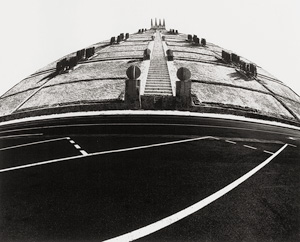
Unwirkliche Landschaft. 1980. Archival pigment print, printed later. 30 x 37 cm (sheet 40 x 50 cm). Signed, titled, dated and editioned "II/V" by the photographer in pencil in lower margin.
A fine tonal print in excellent condition.
Lit.: Robert Häusser. Photographische Bilder: Werkübersicht der Jahre 1941-1987 (exhibition catalog). Stuttgart 1988, ill. p. 91.
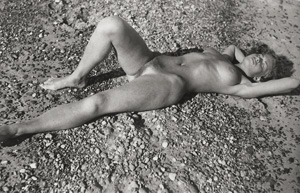
Hausmann, Raoul
Female nude on rocky beach
Los 4191
Ergebnis (inkl. Aufgeld) *
4.750€ (US$ 5,460)
Female nude on rocky beach. 1930/31. Vintage gelatin silver print, tipped to original card and hinge-mounted to mat. 15,3 x 23,8 cm (mount 25 x 27,5 cm). Signed by the photographer in pencil below the image on mount recto.
Raoul Hausmann’s nude photographs from the late 1920s-early 1930s, mark a shift from his Dada practice toward a more lyrical and experimental engagement with the human body. Often set in natural coastal landscapes, his figures are integrated into their surroundings, emphasizing movement, light, and texture rather than idealized form. Through unconventional cropping and a sense of immediacy, these works reflect the broader currents of New Vision photography while retaining a distinctly personal and exploratory character. – Mount soiled, print lifting off mount in upper right corner, otherwise in very good condition.
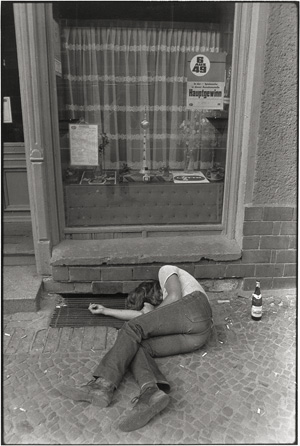
Berlin, Eberswalder Str. 1982. Vintage gelatin silver print. 29,4 x 19,8 cm. Signed, titled, and dated by the photographer in pencil in the lower margin.
Harald Hauswald’s photographic practice is defined by a direct and unembellished documentary approach, through which he recorded everyday life in the GDR from the late 1970s onward. Moving through East Berlin as both participant and observer, he captured scenes of daily routine, youth culture, and urban decay, revealing the tensions between official ideology and lived reality. – In excellent condition.
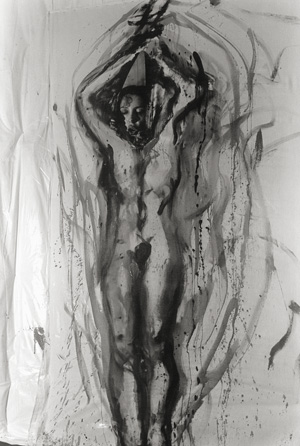
Photographer: Hans W. Mende (b. 1948). Aktion mit Evelyn Steiger, February 1981. 4 vintage gelatin silver prints, printed 1986. Each circa 39,8 x 29,8 cm. Each signed, annotated and dated by the artist on the verso.
Barbara Heinisch is a transdisciplinary German process painter whose work combines painting and performance, often in collaboration with artists from dance and music. Trained at the Kunstakademie Düsseldorf under Joseph Beuys and later at the Hochschule der Künste Berlin as a master student of Karl Horst Hödicke, she developed a practice merging expressive figuration with gestural traces of movement. From the mid-1970s, she began staging performative painting actions, marking a decisive shift in her work, including early “self-discovery” actions (1975), Blindportrait (1976), and her first fully developed transdisciplinary process paintings in 1977. – Minimal edge wear, some with bumped corners, otherwise in very good condition.
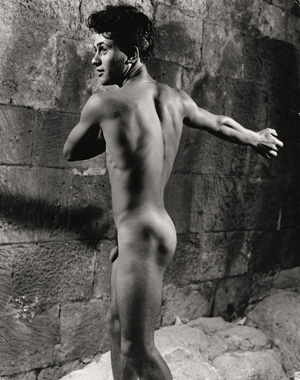
Helbig, Konrad
Young male nude with outstretched arm
Los 4195
Ergebnis (inkl. Aufgeld) *
2.750€ (US$ 3,161)
Young male nude with outstretched arm. 1950s. Vintage ferrrotyped gelatin silver print on Leonar paper. 30,2 x 24 cm. Photographer's copyright/studio label on the verso.
After returning from Soviet captivity in 1947, the German photographer and art historian Konrad Helbig devoted his work to the study and photographic documentation of Mediterranean cultures. While best known for his architectural and travel photography, he also produced intimate studies of young male nudes, often in Sicily. These photographs, situated within the tradition of Wilhelm von Gloeden and Guglielmo Plüschow, were revealed only after his death. – Some handling creases, especially in upper right, slightly buckled, otherwise in good condition.
Lit.: Wolfgang von Wangenheim, ed. Konrad Helbig: Ragazzi. Heidelberg: Braus, 2000.
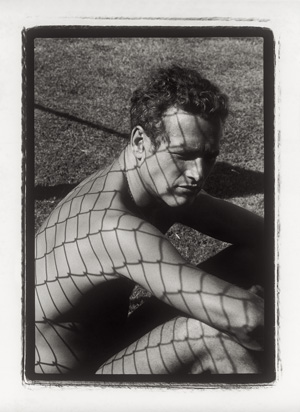
Paul Newman. 1961. Gelatin silver print, printed later. 42 x 30 cm (sheet 50,8 x 40,7 cm). Signed, dated, and editioned “3/10” in pencil on the verso; with gallery label attached to the frame verso. Framed under glass in wooden frame.
Dennis Hopper is celebrated not only as an actor and filmmaker but also as a sharp-eyed chronicler of American counterculture. His portraits capture friends, artists, and cultural icons amid fleeting moments with cinematic intensity. Hopper’s photographs distill the spirit of a turbulent era through raw composition, quiet spontaneity, and a deep connection to his subjects. – Some light buckling along the edges of the print, as well as slight toning of the photographic paper; otherwise in very good condition.
Provenance: Acquired by the present owner from Galerie Thaddäus Ropac
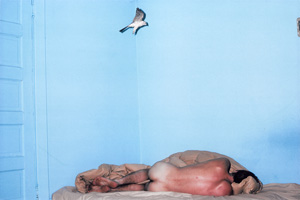
Doug II. 1981. Archival pigment print. 24 x 36 cm (sheet 28,5 x 43 cm). Signed, titled and dated by the photographer in pencil on the verso.
Dan Kane's commitment to analog photography is an underlying current in his body of work. His exploration of the male human form as a terrain of shapes and contours is present throughout his work. Living in Berlin since 1983, Kane found many of his models there. The present image was taken in Ithaca, New York, a few years before he moved to Berlin. A print of this image is in the collection of the South Dakota Art Museum. – In excellent condition.
Lit.: Over a Hundred Thousand Images Later: Dan Kane, a Retrospective (exhibition catalogue). Brookings: South Dakota Art Museum, 2025, ill. p. 58.
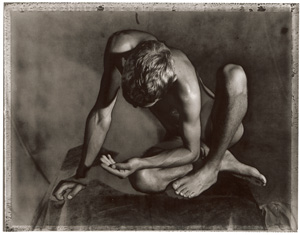
Claudio. 2013. Solarized selenium toned gelatin silver print. 16,5 x 21,4 cm (sheet 20 x 25,1 cm). Signed, titled, dated, editioned "2/5" and copyrighted by the photographer in pencil on the verso.
A few nicks in edges/margins, otherwise a fine tonal print in near excellent condition.
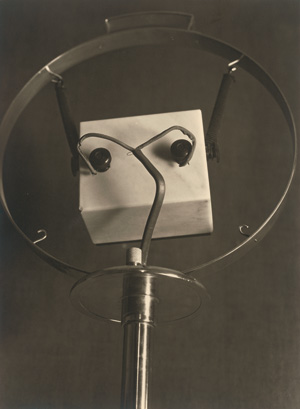
Microphone. 1932. Vintage gelatin silver print, hinge-mounted in upper edge to mat. 24,8 x 16,8 cm. Photographer's blindstamp in lower right; photographer's stamp and annotated in pencil on the verso.
Willy Kessels attended the École des Beaux-Arts in Ghent before moving to Brussels, where he worked as a sculptor and architectural draftsman in the 1920s. He began his photographic career in 1929, embracing the medium as a modern form of visual expression. The high point of his production falls in the 1920s-1930s, and his photomontages, aerial views, dynamic angles, and use of light exemplify the modern movement in Belgian photography at the time. His refined nude studies also form a significant part of his oeuvre. – Light scuff mark in upper right, otherwise a rich tonal print in near excellent condition.
[*]: Regelbesteuert gemäß Auktionsbedingungen. [^]: Ausgleich von Einfuhr-Umsatzsteuer.
* Alle Angaben inkl. 25% Regelaufgeld ohne MwSt. und ohne Gewähr – Irrtum vorbehalten.
Galerie Bassenge
Erdener Str. 5A
14193 Berlin
Öffnungszeiten:
Montag bis Donnerstag, 10–18 Uhr,
Freitag, 10–16 Uhr
Telefon: +49 30 8938029-0
Fax: +49 30 8918025
E-Mail: info (at) bassenge.com
Impressum
Datenschutzerklärung
© 2026 Galerie Gerda Bassenge
Galerie Bassenge
Erdener Str. 5A
14193 Berlin
Öffnungszeiten:
Montag bis Donnerstag, 10–18 Uhr,
Freitag, 10–16 Uhr
Telefon: +49 30 8938029-0
Fax: +49 30 8918025
E-Mail: info (at) bassenge.com
Impressum
Datenschutzerklärung
© 2026 Galerie Gerda Bassenge