
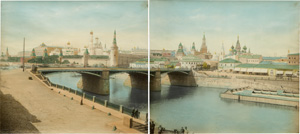
Photographer: Joseph Daziaro (1831-1892), attributed to. Large panoramic view of Moscow. 1880s. Hand-colored, two-part panoramic albumen print. 39 x 87 cm.
Active as a publisher and photographer in Moscow and St. Petersburg, the Italian-born Joseph (Giuseppe) Daziaro was among the leading producers of photographic views in mid-19th-century Russia. Originally a lithographic publishing house, the firm expanded into photography in the 1850s-60s, issuing albums and views aimed at travelers and collectors. The present two-part panorama offers a sweeping view across central Moscow from an elevated vantage point, encompassing landmarks such as the Kremlin walls, the Cathedral of Christ the Savior, and numerous church domes. – Finely hand-colored panoramic view consisting of two large-format prints in very good condition.
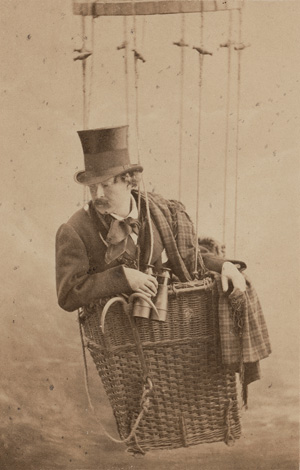
Portraits by and of Nadar. 1855-1863. 4 albumen prints on carte-de-visite mounts with decorative borders. Each ca. 8,5 x 5,5 cm (mounts 10,2 x 6,2 cm). Photographer’s initials embossed on the mount in the lower left corner; with the photographer’s “35 Boulevard des Capucines” studio information printed in red ink on the verso.
This group comprises four carte-de-visite portraits issued by the studio of Nadar. Two photographs show self-portraits of Nadar seated in a suspended balloon basket, a playful studio staging alluding to his fascination with aeronautics and his pioneering experiments in aerial photography. Another photograph is a studio portrait of Alexandre Dumas in a composed half-length pose, while the fourth depicts George Sand, reproduced after a daguerreotype by Pierre-Ambroise Richebourg. – Some scuff marks and small surface irregularities, otherwise all in good to very good condition.
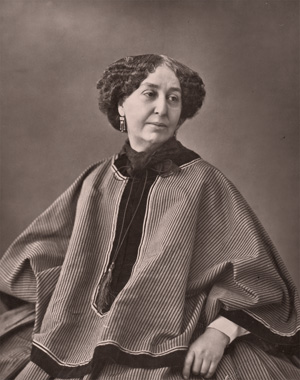
Portrait of George Sand. 1864. Woodburytype, printed before 1876, mounted to card with decorative border. 23,7 x 19 cm (mount 34,5 x 26,3 cm). "Galerie Contemporaine, 126, boulevard de Magenta", "Phot. Goubil et Ce" and "Cliché Nadar, rue d'Anjou-St-Honoré, 51" copyright stamp in lower margin of the mount.
Nadar’s mid-19th-century portraits of George Sand convey the writer’s commanding intellect and unconventional persona with remarkable sensitivity. Rendered with quiet assurance, she appears with a distinctive, androgynous elegance that reflects both her literary authority and her defiance of social norms. Through restrained composition and subtle lighting, Nadar focuses on her steady gaze and introspective expression, achieving the psychological depth that defines his finest work. – Some light scuff marks and minimal retouched hairline cracks in the lower right corner; otherwise in excellent condition. With: With a portrait of Émile Zola by Étienne Carjat (1828-1906) from the same series.
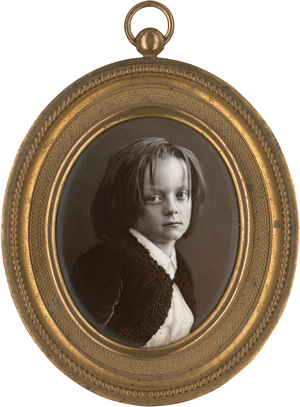
Portrait of Paul Nadar. 1868. Photographic miniature on enamel (Procédé Deroche), in a brass frame. 5,5 x 4,5 cm (frame 8 x 7 cm). Signed “Nadar,” dated “1868,” and annotated “procédé Deroche” in ink on the verso.
Portraits of his son Paul occupy a special place within Nadar’s oeuvre, combining the technical refinement of his studio practice with a rare sense of intimacy. Here, the young sitter - who would later succeed his father - appears with a softness and immediacy that departs from more formal portrait conventions, revealing Nadar’s sensitivity to expression and character. Executed using the procédé Deroche, developed around 1860, the image is transferred onto enamel, resulting in a highly durable and finely detailed miniature. Such works were relatively uncommon and often intended as cherished keepsakes, making the present portrait both a demonstration of Nadar’s technical versatility and a personal memento of his only son. – Brass frame with light scuff marks and age staining; slight matte halo and minor surface dulling along the perimeter; a few small specks on the ceramic coating; slight scuffing and light scratches to the coating; otherwise in very good condition.
Provenance: From the collection of Gérard Lévy; Millon, Paris, 20 December 2016, lot 19.
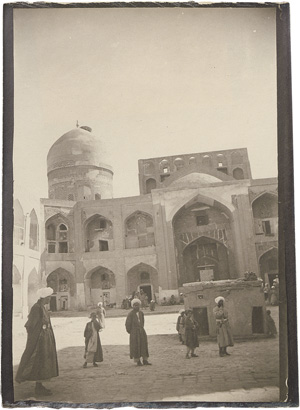
Views of Turkestan. 1890. 55 gelatin silver prints. Each ca. 16,2 x 12,4 cm or reverse. Some annotated in pencil on the verso; a few numbered in the negative in the lower margin.
These photographs form part of Paul Nadar’s work from his 1890 journey through Turkestan, undertaken in connection with the Tashkent Exhibition and the promotion of the Trans-Caspian railway, completed by the Russian Army between 1886-1888. Traveling across Samarkand, the Caucasus, and Central Asia, he produced an extensive visual record of the region, reportedly comprising around 1,800 images that include landscapes, architectural monuments, portraits, and scenes of daily life. The expedition also served to demonstrate the capabilities of new photographic technologies, particularly the newly developed Kodak Eastman Film and the Nadar Détective box camera, which allowed him to capture spontaneous, unposed moments. Upon his return to Paris, Nadar actively promoted this work through lectures, publications, and exhibitions, including presentations at the Société de Géographie as well as displays at several World’s Fairs until 1896, contributing to contemporary European perceptions of Central Asia. – Edges of prints slightly uneven; some handling creases, fingerprints, and silver oxidation along the edges of a few prints, otherwise all in good to very good condition.
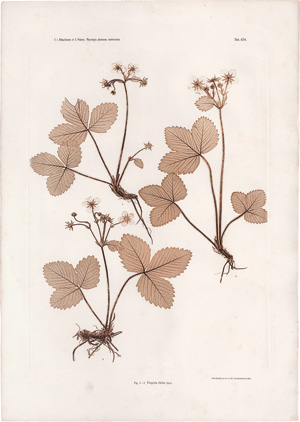
Photographers: Constantin von Ettingshausen (1826-1897) and Alois Pokorny (1836-1886). Plant studies. 1855-56. 10 nature prints (Naturselbstdrucke) on heavy paper. Each ca. 58 x 41 cm. From the publication Physiotypia plantarum austriacarum: Der Naturselbstdruck in seiner Anwendung auf die Gefässpflanzen des österreichischen Kaiserstaates, mit besonderer Berücksichtigung der Nervation in den Flächenorganen der Pflanzen. Vienna: K.K. Hof- und Staatsdruckerei, 1855-56.
Constantin von Ettingshausen and Alois Pokorny, two leading Austrian botanists of the nineteenth century, employed the technique of nature printing (Naturselbstdruck) to document the flora of the Austro-Hungarian Empire with exceptional precision. In this process, actual plant specimens were pressed into soft lead plates to create printing matrices, allowing even the finest details, such as venation and surface texture, to be transferred with remarkable fidelity. Ettingshausen and Pokorny’s work represents one of the most accomplished applications of nature printing in the nineteenth century, bridging the disciplines of botany, printmaking, and early reproductive technology. – Some with minimal foxing, light signs of handling, slight edge wear, otherwise strong impressions in very good condition.
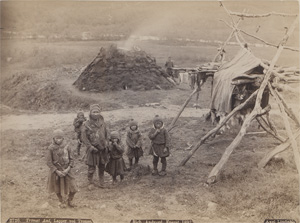
Photographers: Axel Lindahl (1841-1906), James Valentine (1815-1880), Knud Knudsen (1832-1915), and unknown. Travel album with views of Norway and Spitzbergen. 1880s-1890s. 33 albumen prints, collodion paper prints and collotypes, mounted to album boards. Most ca. 17 x 23 cm, some smaller. Most with the photographer’s name or initials, title, and number in the lower edge of the negative. Bound in a half-leather album with gilt-stamped title "Reise nach Spitzbergen" on the front cover.
This attractive album contains views of Norway showing cities, harbor scenes, dramatic landscapes with waterfalls and valleys. The views show Tromsö, Romsdal (glacier), Naes, Varden in Molde, Hardangerfjord, Botnan (Rogaland), Lower Leerfos waterfall, Tokedalen, Telemark, Dalen and others. Also includes three family portraits of Sami people and their dwellings. – Album edges rubbed, a few scratches, some prints faded in edges, several with surface scuff marks, otherwise most in good to very condition and with strong contrasts.
Ottoman Empire
Ethnic Groups of the Ottoman Empire
Los 4098
Ergebnis (inkl. Aufgeld) *
813€ (US$ 934)
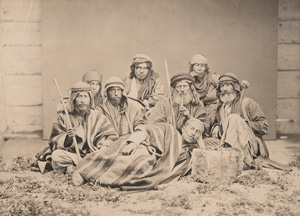
Photographers: Félix Bonfils (1821-1885), Tancrède Dumas (1830-1905), and others. Ethnic groups of the Ottoman Empire. 1870s. 8 albumen prints, mounted to board. Each between ca. 13,8 x 10 cm and 22 x 16,4 cm or reverse (mounts ca. 40,5 x 30,5 cm or reverse). Most numbered and titled in the negative along the lower edge.
This group of photographs presents a series of ethnographic studio portraits depicting men and women from across the late Ottoman empire, including western Anatolia, Greater Syria, and Palestine. Shown in traditional dress, the sitters range from Zeybek fighters and Bedouin figures to Levantine villagers and veiled women, with costumes, weapons, and domestic attributes carefully staged to convey regional identity. – Some scuff marks, some fading, otherwise in very good condition.
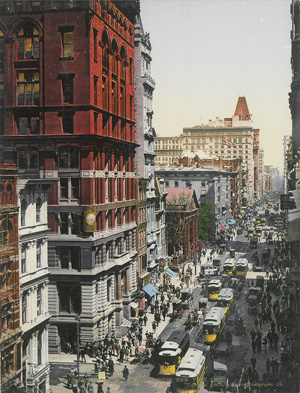
Views of the United States. 1890s-early 1900s. 78 photochromes, mounted to gilt-edged album pages. Each 17,5 x 22,7 cm or reverse (mounts 27,5 x 35 cm). Numbered, titled, and with copyright information in the lower margin. Bound in a full leather album with a gilt-embossed decorative border.
This album of photochromes presents views of San Francisco and the Bay Area, numerous sites in Yellowstone National Park, and scenes from Chicago, Niagara Falls, and New York. It also includes a portrait of Native Americans and views of railway transportation, offering a broad visual survey of the United States at the turn of the twentieth century. – Corners of album slightly rubbed; edges of album pages slightly worn; some scuff marks and minor surface irregularities on prints, otherwise all in near excellent condition.
Raoult, Ivan Petrovic
Peoples of Georgia and the Caucasus Region
Los 4103
Ergebnis (inkl. Aufgeld) *
4.500€ (US$ 5,172)
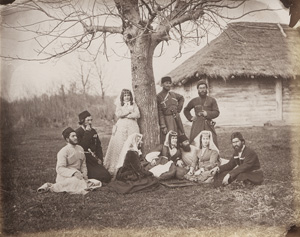
Peoples of Georgia and the Caucasus Region. Circa 1878. 14 albumen prints. Each ca. 24 x 20 cm or reverse. Each numbered, titled, and dated by another hand in pencil on the verso.
Jean Raoult (Ivan Petrovich Raoult), a French-born photographer active in the Russian Empire, operated a studio in Odessa from the 1860s to the 1880s and produced extensive ethnographic studies across its diverse regions. In the late 1870s he published the album Collection de types des Peuples de Russie, Roumanie et Bulgarie, comprising over 200 images, and later assembled albums on the landscapes, peoples, and antiquities of the Caucasus, Crimea, and the Volga region. His practice combined artistic, scientific, and documentary aims, encompassing military campaigns during the Russo-Turkish War (1877-78) and expeditions with Prof. N. P. Kondakov (1879-82) through the Caucasus, Georgia, Armenia, Mount Athos, and Palestine in search of early Christian antiquities.
Working largely in staged outdoor settings, Raoult emphasized costume, weaponry, and posture to construct typological images aligned with contemporary ethnographic and imperial frameworks. The present group reflects this approach, depicting Georgian and Caucasian subjects in compositions ranging from formal portraits of armed men to more informal scenes of villagers, musicians, laborers, and women in traditional dress. Awarded prizes at the Paris Geographic Exhibition (1875) and the Exposition Universelle (1878), his photographs remain a vivid record of the Russian Empire’s cultural diversity in the late 19th century. – Some handling creases and fading, especially around the edges of the prints; one print with a torn corner, otherwise all strong-toned prints in very good condition.
Raoult, Ivan Petrovic
Peoples of Ukraine
Los 4104
Ergebnis (inkl. Aufgeld) *
4.500€ (US$ 5,172)
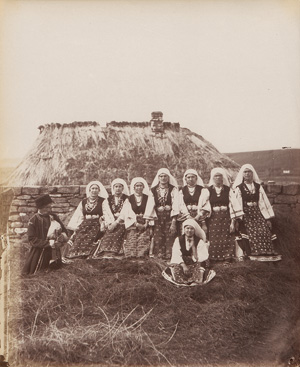
Peoples of Ukraine. Circa 1878. 24 albumen prints. Each between 20,5 x 15,5 cm and 24 x 20 cm or reverse. Each numbered, titled, and dated by another hand in pencil on the verso.
The photographs depict a range of rural populations from the Ukrainian territories of the Russian Empire, including peasants, Cossack-type figures, and village elders, as well as individuals of Tatar origin from the southern steppe regions. The group reveals a variety of regional “types,” from Central and Eastern populations in heavy sheepskin coats and fur hats to figures in steppe-influenced attire, including striped robes and turban-like headwear, suggestive of Black Sea or Crimean Tatar traditions. Differences in costume - particularly embroidered garments and women’s dress - further point to Central and Western Ukrainian traditions, highlighting the ethnic and cultural diversity of both Slavic and Turkic communities in the late 19th century. – Some handling creases and fading, especially around the edges of the prints; small tears along the edges of some prints; one print with a torn corner, otherwise all strong-toned prints in good to very good condition.
Raoult, Ivan Petrovic
Rural Communities of the Central Russian Empire
Los 4105
Ergebnis (inkl. Aufgeld) *
6.875€ (US$ 7,902)
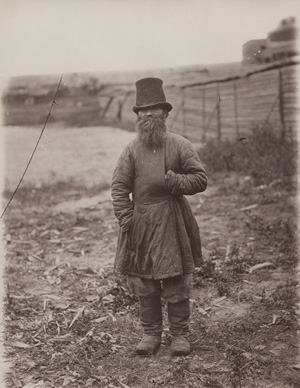
Rural Communities of the Central Russian Empire. Circa 1878. 17 albumen prints. Each between ca. 22 x 17 cm and 24,5 x 20 cm or reverse. Each numbered, titled, and dated by another hand in pencil on the verso.
The photographs depict rural communities across central and southwestern provinces of the Russian Empire, including Tula, Orel, Kursk, Tambov, Simbirsk, and Poltava. While some images present posed ethnographic “types,” others situate their subjects within everyday village life, showing men and women resting, gathering, or engaged in seasonal agricultural labor. Traditional costume and vernacular architecture, particularly log-built houses and thatched roofs, firmly locate the scenes within late 19th-century East Slavic peasant culture. – Some handling creases and fading, especially around the edges of the prints; one print with a small tear in lower left corner, one print with an ink stain, otherwise all strong-toned prints in very good condition.
Raoult, Ivan Petrovic
Armed forces of the Russian Empire
Los 4106
Ergebnis (inkl. Aufgeld) *
4.500€ (US$ 5,172)
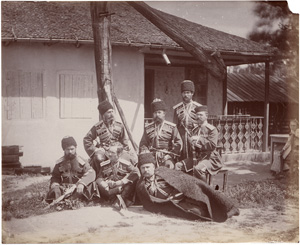
Armed forces of the Russian Empire. Circa 1878. 24 albumen prints. Each circa 24 x 20 cm or reverse. Each numbered, titled, and dated by another hand in pencil on the verso.
The photographs depict military and paramilitary figures from the Russian Empire’s southern frontier, including Caucasian Cossack officers and rank-and-file soldiers, as well as locally recruited mountaineers and irregular auxiliaries of Circassian type. Together, they reflect the diversity of imperial forces in the Caucasus, combining formal Cossack units with indigenous warrior traditions integrated into Russian service. – Some handling creases and fading, especially around the edges of the prints; one print with a torn corner, otherwise all strong-toned prints in very good condition.
Redmayne, John Thomas
Micro-photographs from the Diatomaceae
Los 4107
Ergebnis (inkl. Aufgeld) *
3.125€ (US$ 3,592)
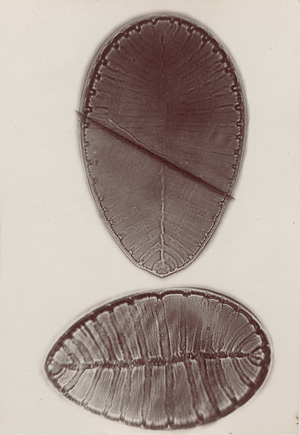
Micro-photographs from the Diatomaceae. 20,5 x 16 cm. 59 l. and 65 albumen prints (59 mounted on plates), circa 12,5 x 10 cm. Original green gilt stamped cloth, marbled endpapers. Bolton, n.d., ca. 1876.
First and only edition of a privately printed album of microphotographs illustrating various genera of microalgae, inscribed by the author to a microscope manufacturer; exceedingly rare. John T. Redmayne, a surgeon and physician, developed a specialized interest in microscopy, focusing on the collection and photographic documentation of diatoms. Among the more accomplished microphotographers of his time, he was also a founding member of the Bolton Microscopical Society, which supported his work. Published at his own expense in 1876, the album was not commercially distributed but circulated selectively as gifts or in exchange for scientific materials. This copy is inscribed to Thomas Armstrong of Armstrong & Brother Microscopes, Manchester, and includes an additional photograph of Trichina spiralis, signed by Armstrong and the photographer “J. G. Johnson,” as well as six further microphotographs preserved in a small envelope mounted to a text leaf, four depicting insects. Only one institutional copy is recorded (University of Victoria, B.C.), underscoring the publication’s rarity. – Spine and edges of book rubbed, inner front cracked, marginal foxing on leaves, some soiling on leaves, especially at front and back of book, leaves warped, a few prints with fading and foxing, otherwise many strong prints with a dark violet-brown tone and in good condition.
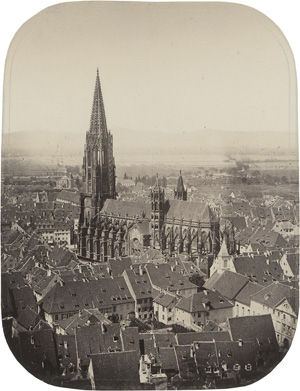
Photographers: Carl Heinrich Jacobi (1824-1897) and Gottfried Theodor Hase (active ca. 1818-1888). Early views along the Rhine River. 1850s-1860s. 4 rounded albumen prints, mounted to card with ruled borders. Each between 12 x 16 cm and 15,5 x 20,5 cm or reverse (mounts ca. 23 x 30 cm). All with printed photographer credit and place name below the image on the mount; some annotated in black ink on mount verso.
Carl Heinrich Jacobi worked as a photographer and publisher in Bad Kreuznach and the Middle Rhine region, producing composed topographical views of towns, river landscapes, and spa resorts. His work belongs to the tradition of commercially distributed Rhine photography, issued in albums and portfolios for tourism and the growing market for photographic souvenirs. Gottfried Theodor Hase, trained as a painter before turning to photography, is regarded as Freiburg im Breisgau’s first professional photographer. From the early 1860s onward, he documented the city’s medieval architecture and urban fabric with a clear, descriptive approach. – Some light fading and foxing of mounts, otherwise all in good to very good condition.
Robertson, James
Views of Constantinople
Los 4110
Ergebnis (inkl. Aufgeld) *
3.750€ (US$ 4,310)
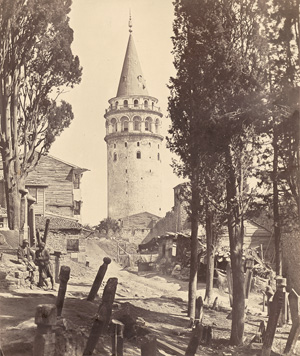
Views of Constantinople. 1850s-1860s. 3 albumenized salted paper prints and 1 salted paper print, mounted to card. Each ca. 24,2 x 28,2 cm (mounts 50 x 65 cm). Each annotated in pencil in the lower margin of the mount; one photograph numbered and titled in the negative in the lower left corner; one photograph with the photographer’s signature in the lower margin, partially cut off.
A Scottish engraver by training, Robertson served as chief engraver to the Imperial Ottoman Mint before turning to photography in the early 1850s. His photographs combine a precise architectural sensibility with a documentary interest in the urban fabric and daily life of the Ottoman capital. They are among the earliest systematic photographic records of the city. The views in this lot include the Galata Tower, the Fountain of Sultan Ahmed III, sections of the Theodosian walls, and the tomb of Sultan Suleiman. – Some handling creases, soiling, and tears along the margins of the mounts; mounts slightly time-stained with minor surface marks; all prints with some degree of fading and occasional light surface soiling, one print with signs of retouching; otherwise strong tonal prints, in good to very good condition.
Robertson, James
Interior of the Redan / View of an Abandoned Russian Battery / View of Sebastopol
Los 4111
Ergebnis (inkl. Aufgeld) *
1.500€ (US$ 1,724)
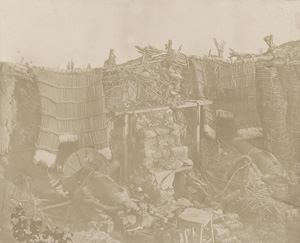
Interior of the Redan / View of an Abandoned Russian Battery / View of Sebastopol. 1855-1856. 3 salted paper prints, mounted to boards. Each ca. 23,5 x 29 cm (mounts 46 x 57 cm). With handwritten captions in pencil on the lower margin.
Taken by James Robertson during the Crimean War, these photographs depict key scenes from the Siege of Sevastopol, including the interior of the Redan, an abandoned Russian battery, and a general view of the city. Captured in the immediate aftermath of battle, they reveal shattered fortifications, debris-strewn terrain, and the desolate remnants of military infrastructure. As early examples of war photography, these images serve not only as historical documents of a pivotal conflict, but also as powerful visual testaments to photography’s role in recording the realities of modern warfare. – Slightly faded, with a few minimal ink stains and light spotting; otherwise all in near excellent condition.
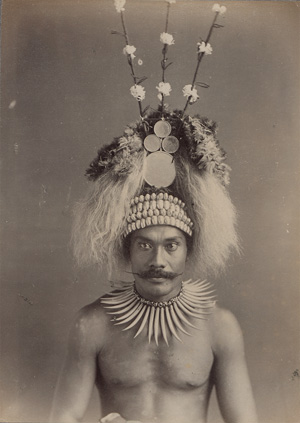
Photographer: Thomas Andrew (1855-1939). Views from Samoa. Late 1890s-early 1900s. 38 albumen prints, mounted to board. Each between ca. 20 x 14,5 cm and 18 x 24 cm (mounts ca. 29 x 37,5 cm). Some prints dated, numbered, and signed in the negative in the lower margin.
The photographs offer a broad survey of Samoan life, combining posed studio portraits with outdoor scenes and staged genre subjects. Men and women appear in ceremonial dress - feathered headdresses, shell and tooth necklaces, and woven ornaments - alongside images of village interiors, ritual performances, dance scenes, and communal activities such as processions and feasts. Produced by Thomas Andrew, who lived and worked in Samoa from 1891 to 1939, the group reflects his sustained engagement with local society and forms part of a larger body of work documenting the islands’ landscapes, people, and cultural life during the colonial period. – Some minor scuff marks and fading on a few prints; otherwise all in very good condition.
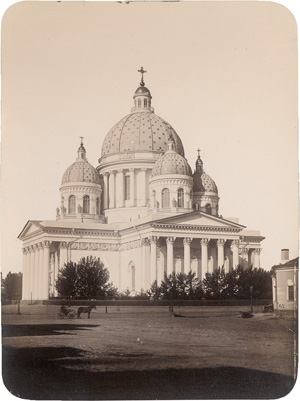
Photographer: E. Huard (active 1850-1866). Views of St. Petersburg. 1860s. 11 albumen prints, mounted to board. Each ca. 17 x 23 cm or reverse (mounts ca. 31 x 42 cm or reverse). Some signed and numbered in the negative.
Taken by the prolific yet lesser-known photographer E. Huard, this lot offers an extensive photographic survey of Saint Petersburg in the early 1860s, encompassing many of its principal imperial landmarks, including Saint Isaac’s Cathedral, the Winter Palace, Smolny Monastery, the Monument to Nicholas I, the Bronze Horseman, and the Alexander Column. Additional views show Konnogvardeysky Boulevard, the Nikolaevsky Bridge, and Nevsky Prospekt, depicted both as a bustling urban artery animated by horse-drawn traffic and crowds and as the setting for a grand military parade with cavalry, infantry, and spectators lining the avenue. – Some scuff marks. some light fading, otherwise strong tonal prints in near excellent condition.
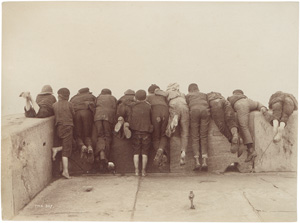
Excitement. 1888. Albumen print, mounted to card. 14,7 x 20 cm (mount 29,8 x 21,5 cm). Signed and numbered in the negative in lower left corner. With another albumen print of the port of Whitby mounted to the verso.
This photograph is among the most characteristic works by Frank Meadow Sutcliffe, made in Whitby in the 1880s. Closely associated with the British pictorial movement, Sutcliffe developed a practice of staging scenes drawn from everyday coastal life, often using local children to create compositions that appear spontaneous yet are carefully constructed. The work exemplifies the late 19th-century shift toward photography as a more expressive and narrative medium. – Some minor foxing to the mount, edges slightly time-stained; some scuff marks and fading of the print; otherwise in very good condition.
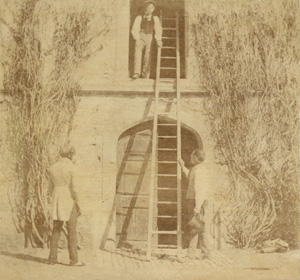
The Ladder from "The Pencil of Nature", plate XIV. 1844. Varnished salted paper print, mounted to board. 16,8 x 18 cm (mount ca. 23,4 x 30,5 cm). With an ink outline around the image; original paper label on the verso reading “PATENT TALBOTYPE or SUN PICTURES,” numbered “14” in ink, and annotated in ink: “At Lacock Abbey, Wilts.”
A central figure in the invention of photography, Henry Fox Talbot developed the negative-positive process and understood photography as both a scientific and artistic medium, laying the groundwork for all later photographic reproduction. This print of The Ladder was most likely varnished by Talbot himself; as noted by Larry Schaaf, such varnishing was uncommon and undertaken only briefly as part of early experiments to improve the permanence of photographic prints. With only three other varnished examples known, the present work constitutes an important and rare document in the early history of photography. – Board time-stained at edges. Print slightly faded with yellowed varnish; otherwise in good condition.
Lit.: Larry J. Schaaf. The Photographic Art of William Henry Fox Talbot. Princeton: Princeton University Press, 2000, see pp. 200-201.
Teynard, Félix
Dendérah (Tentyris), Temple d'Athôr - Face Posterieure
Los 4119
Ergebnis (inkl. Aufgeld) *
2.000€ (US$ 2,299)
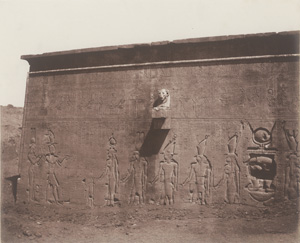
Dendérah (Tentyris), Temple d’Athôr - Face postérieure (plate 24, “Égypte et Nubie”). 1851-52. Salted paper print, printed 1853-54, mounted on the original album page. 25,2 x 31 cm (mount 39,5 x 50,5 cm). Title, plate number, and publisher’s imprint printed below the image on the mount.
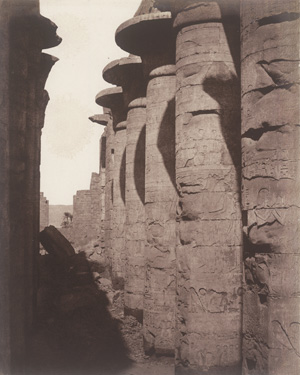
Félix Teynard, an engineer and self-taught photographer, traveled through Egypt between late 1851-1852 with the aim of producing photographic views of architectural monuments to supplement the engravings published following the Napoleonic expeditions (1809-1829). Working with a large-format camera, he used the waxed paper negative process popularized by Gustave Le Gray, enabling him to achieve exceptional detail under difficult conditions. Around 160 photographs from this journey were published in Égypte et Nubie: sites et monuments les plus intéressants pour l’étude de l’art et de l’histoire, of which only about a dozen complete copies survive. Teynard’s photographs were met with considerable critical acclaim and were exhibited at the Exposition Universelle in Paris in 1855. – A small tear and some light handling creases on the mount; slight signs of retouching along the margins of the print; otherwise a strong print in near excellent condition.
Teynard, Félix
Karnak (Thèbes). Palais - Salle Hypostyle - Colonnade Centrale Vue du Point J.
Los 4120
Ergebnis (inkl. Aufgeld) *
5.000€ (US$ 5,747)
Karnak (Thèbes). Palais – Salle hypostyle – Colonnade centrale, vue du point J (plate 89, Égypte et Nubie). 1851-52. Salted paper print, printed 1853-54, mounted on the original album page. 30,6 x 25,6 cm (mount 50,5 x 39,5 cm). With the title, plate number, and publisher’s imprint printed below the image on the mount.
Some light handling creases on the mount; slight signs of retouching along the margins of the print, two foxing spots in the sky area as well as a small fungal spot; otherwise a strong print in very good condition.
[*]: Regelbesteuert gemäß Auktionsbedingungen. [^]: Ausgleich von Einfuhr-Umsatzsteuer.
* Alle Angaben inkl. 25% Regelaufgeld ohne MwSt. und ohne Gewähr – Irrtum vorbehalten.
Galerie Bassenge
Erdener Str. 5A
14193 Berlin
Öffnungszeiten:
Montag bis Donnerstag, 10–18 Uhr,
Freitag, 10–16 Uhr
Telefon: +49 30 8938029-0
Fax: +49 30 8918025
E-Mail: info (at) bassenge.com
Impressum
Datenschutzerklärung
© 2026 Galerie Gerda Bassenge
Galerie Bassenge
Erdener Str. 5A
14193 Berlin
Öffnungszeiten:
Montag bis Donnerstag, 10–18 Uhr,
Freitag, 10–16 Uhr
Telefon: +49 30 8938029-0
Fax: +49 30 8918025
E-Mail: info (at) bassenge.com
Impressum
Datenschutzerklärung
© 2026 Galerie Gerda Bassenge