
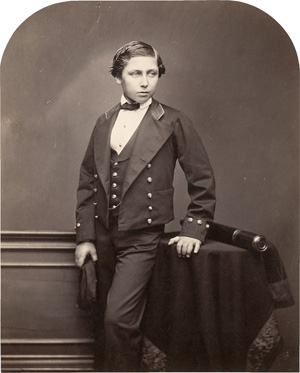
British Royal Family
Portraits of Albert Edward, Prince of Wales, later King Edward VII (1841-1910)
Los 4033
Ergebnis (inkl. Aufgeld) *
1.625€ (US$ 1,868)
Photographer: John Jabez Edwin Mayall (1813-1901). Portraits of Albert Edward, Prince of Wales, later King Edward VII (1841-1910). 1857, 1858, and ca.1860. 3 albumen prints, 2 top arched and mounted to board. Each circa 26 x 20,5 cm.
Mounts slightly soiled, prints with some surface scuff marks, unmounted print with some creases, stronger vertical crease in mid section, small tear in upper edge and faded, otherwise two mounted prints with strong contrasts and in very good condition.
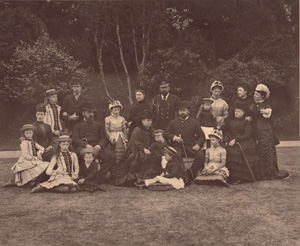
British Royal Family
Queen Victoria and Royalty at Osborne, August 11, 1881
Los 4035
Ergebnis (inkl. Aufgeld) *
438€ (US$ 503)
Photographer: Cornelius Jabez Hughes (1819-1884). Queen Victoria and Royalty at Osborne, August 11, 1881. Albumen print, mounted to board. 19,7 x 23,8 cm. Photographer's name printed and sitter's names annotated in ink below the image on the mount.
Born in England in 1819, Hughes began his photographic career in 1847 as an assistant in the studio of J.J.E. Mayall in London. After briefly working in Glasgow, he returned to London in 1855 to assume ownership of Mayall's studio. Hughes later built his own studio on the Isle of Wight, where he often photographed Queen Victoria. Toward the end of his life he teamed up with his assistant, Gustav Mullins, to form a new partnership, Hughes & Mullins. Hughes was popular both as a portrait photographer and as a writer on the subject of photography. – Mount with slight traces of use, small crease in upper left corner of print, a few surface scuff marks, otherwise in very good condition.
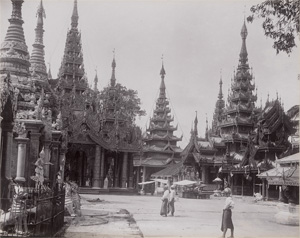
Photographer: Philip Adolphe Klier (1845-1911). Views of Rangoon. 1880s. 12 albumen prints (1 duplicate), most mounted to board. Each between 19,5 x 26,5 cm and 20,5 x 26,8 cm or reverse (mounts between 27 x 34 cm and 29,5 x 40,5 cm or reverse). Each signed, titled, and numbered in the negative in the lower margin.
This lot comprises a range of views of Rangoon, including landscape scenes in the Cantonment Gardens with ponds, bridges, garden pavilions, and surrounding trees, as well as the Shwedagon Pagoda and its precincts, showing terraces, stairways, stupas, and shrine buildings, with groups of monks and laypeople visible within the temple complex. – Some scuff marks, creases and fading, otherwise all in good to very good condition.
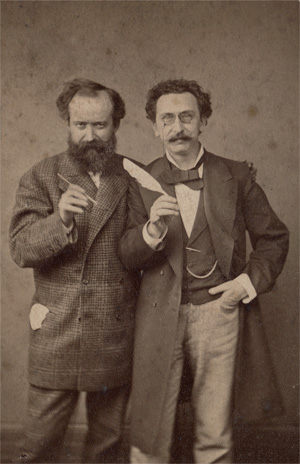
Busch, Wilhelm
Wilhelm Busch and Paul Lindau
Los 4038
Ergebnis (inkl. Aufgeld) *
625€ (US$ 718)
Photographer: Ernst Hanfstaengel (1840-1897). Wilhelm Busch and Paul Lindau. 1877. Albumen print on carte-de-visite mount. Annotated in pencil on mount verso.
Wilhelm Busch and Paul Lindau became acquainted in Munich after 1873 through the artists’ society “Allotria,” whose members included Franz von Lenbach, Friedrich August von Kaulbach, Lorenz Gedon, and Hermann Levi. Lindau, who held Busch in particularly high esteem, sought a closer personal and artistic relationship. A prominent editor, playwright, and theater director, Lindau achieved success in the 1870s with his stage works - most notably Maria und Magdalena - and later reached a wide readership with his “Berlin” novel cycle (1886-88) and travel writings. The present image originates from the same photographic sitting that also produced the circular composition The Three Graces, depicting Lenbach, Busch, and Lindau together. – Some foxing spots and soiling.
China
Portraits of high ranking Chinese Imperial officials and views of Peking and surroundings
Los 4042
Ergebnis (inkl. Aufgeld) *
13.125€ (US$ 15,086)
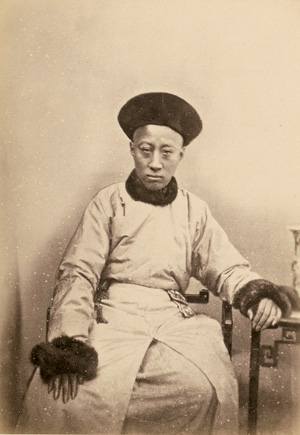
Photographer: Georges Auguste Morache (1837-1906). Portraits of high-ranking Chinese imperial officials and views of Peking and its surroundings. 1863-1866. 27 albumen prints, mounted to board. Each ca. 16,5 x 21 cm and smaller (mounts 44 x 34 cm). Each signed by the photographer in red ink below the image in the lower right corner of the mount; most extensively annotated in German in black ink, and each with title and explanatory text by the photographer in red ink on mount verso. Loose in a contemporary half-linen card portfolio.
Photographs by the amateur photographer Dr. Georges Auguste Morache are among the earliest known photographic views and portraits of people in Beijing and remain extremely rare. Morache had no commercial ambitions as a photographer; his work appears to have been driven primarily by personal curiosity and by the technical challenges of photography, which was still in an early stage of development during his stay in China. He organized his photographs into thematic groups, which he later presented as gifts to family members and close acquaintances.
Among the thirteen portrait photographs in this group, the images of high-ranking officials and dignitaries - identified by name and rank in inscriptions on the verso annotated by Morache - are of particular significance. These include portraits of Ouen-Siang (?), Foreign Minister and Vice-President of the Imperial Council; the Finance Minister and a member of the Imperial Council; the Korean ambassador; a high-ranking Buddhist monk; and several other civilian and military figures. The most widely known image is Morache’s portrait of Prince Gong, who emerged as one of the most influential figures at the Qing court in the aftermath of the Second Opium War.
Today there are only a small number of extant photographs by Morache which are dispersed among museums and private collections. Notably, examples are held in the Stephan Loewentheil Historical Photography of China Collection in New York. A further album, titled Vues de Pékin 1865-67 and comprising 29 photographs signed on the title page, is preserved at the Toyo Bunko (Oriental Library) in Tokyo, formerly part of the George Morrison Collection. The Musée du quai Branly in Paris also holds Morache photographs, and an additional bound album of approximately forty prints resides in a private British collection. The present group therefore constitutes a fifth surviving portfolio. Unlike the photographs in the aforementioned collections, each image here bears Morache’s signature on the front of the mount, possibly intended to distinguish his work from that of other photographers active in Beijing at the time.
Dr. Morache studied surgery at the naval medical school in Brest, continued his medical training in Strasbourg, and later attended the prestigious Val-de-Grâce military hospital in Paris. His professional standing led to his appointment as a medical officer at the French legation in Beijing. In 1863 he traveled to China accompanied by his wife and his mother, Pauline Morache, who maintained close contact with diplomatic and intellectual circles in the city and closely observed local cultural and political life. Pauline Morache recorded her impressions and experiences extensively in German on the versos of the large mounts accompanying the photographs, suggesting a German cultural background. She was acquainted with the Countess of Stolberg-Stolberg, who introduced her to the family of Friedrich Viktor Strauss (later Viktor von Strauss und Torney), a prominent Protestant theologian, religious historian, and translator, best known for producing the first German translation of the Tao Te King. It is therefore highly plausible that the inscriptions on the mounts were written with Strauss directly in mind as their intended reader. – Boards slightly warped; some scuff marks and traces of use; portfolio with scuff marks and slightly rubbed edges; ties missing or torn. Some surface rubbing and scuffing of prints; some slightly faded; otherwise most prints in good to very good condition.
Provenance: Descendants of Viktor von Strauß und Torney (1809-1899)
Lit.: Édouard de Saint-Ours. The Photography of Dr. Georges Auguste Morache (1837–1908): A Selection from the Stephan Loewentheil Historical Photography of China Collection (exhibition catalogue). London, 2016.
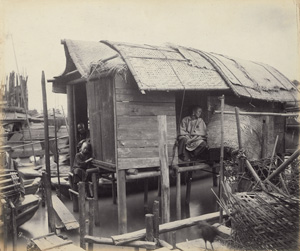
Photographer: John Thomson (1837-1921). Creek Life, Pearl River. 1869-70. Albumen print, mounted to original board. 23,5 x 28 cm (mount ca. 30 x 40 cm). Signed in lower left in the negative, titled in ink and pencil in German below the image on the mount.
A major figure of nineteenth century photography, John Thomson spent ten years in the Far East, the last four of which were in China. He was a prolific writer and skillfully marketed his own work, which was reproduced in many periodicals and books of the time. His vivid portrayal of the people and landscapes of China in the late 1860s and early 1870s is undoubtedly among the finest bodies of work on this subject. – Mount with light foxing, print with slight fading in edges, some light surface scuff marks, otherwise in very good condition.
Lit.: Terry Bennett. History of Photography in China: Western Photographers 1861-1879. London: Quaritch 2010, ill. p. 229.
China
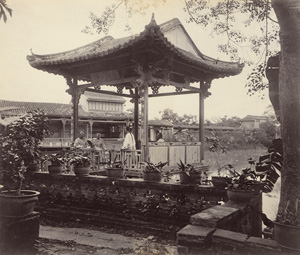
Pavilion in Pun-Ting-Qua's Garden, Canton
Los 4046
Ergebnis (inkl. Aufgeld) *
1.500€ (US$ 1,724)
Photographer: John Thomson (1837-1921). Pavilion in Puntingqua’s Garden, Canton. 1869. Albumen print, mounted to original board. 23,5 x 27,8 cm (mount ca. 30 x 40 cm). Titled in German in ink and pencil below the image on the mount.
Mount with light foxing, print with minimal fading in upper edge, some light surface scuff marks, otherwise in very good condition.
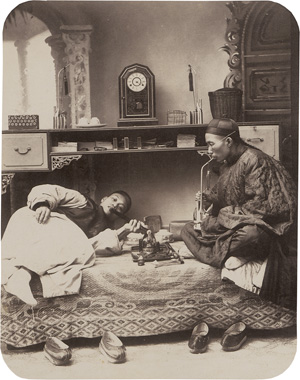
Photographers: William Saunders (1832-1892), Lai Afong (1839-1890), Pun Lun Studio (active 1864-1907), Sze Yuen Ming & Co. (active 1892-1920s) and others. Scenes of daily life in Qing-Dynasty China. 1880s-1890s. 12 albumen prints, mounted to board. Each ca. 26 x 19 cm or reverse. Some annotated in pencil below the image on the mount.
This group of photographs offers a richly detailed view of social, domestic, and professional life in late Qing dynasty China. Several images depict opium-smoking scenes in carefully arranged interiors, with lacquered furniture and ceramics underscoring both the ritualized nature of the practice and its staged presentation. Others show men at leisure - playing games, dining, or posing in formal dress - as well as figures in professional or performative roles, including opera actors and a street porter with his rickshaw. A particularly striking image of a man wearing a punishment cangue provides rare visual evidence of contemporary penal practices. – Some light foxing, discoloration, and a small tear on one mount; some scuff marks and light fading; otherwise all in good to very good condition.
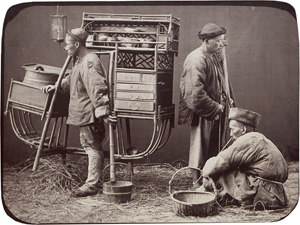
Photographer: William Saunders (1832-1892). Views of Shanghai. 1880s. 6 albumen prints (one duplicate), one mounted to board. Between 19, x 24,5 cm and 21 x 26 cm.
This group of photographs includes a studio portrait of Chinese opera performers and genre scenes of everyday life in and around Shanghai, showing rickshaw transport, street vendors, and scenes of rural and peri-urban labor. One view depicts the Huxinting Tea House (also known as the City Tea House), here shown within its surrounding waterways and timber structures. – Some scuff marks and handling creases, with light fading. especially along the edges; otherwise all in good to very good condition.
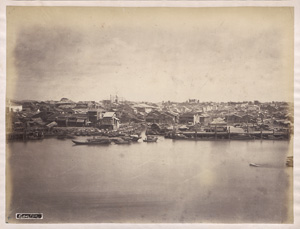
Photographers: Lai Afong (1839-1890) and others. Views of Canton. 1880s-90s. 11 albumen prints, some mounted to card or board. Each between 18,5 x 24,5 cm and 20,5 x 28 cm. Some titled in the negative in lower margin of print.
This group of albumen prints presents views of South China in the late 19th century, centered on Canton (Guangzhou) and the Pearl River, with riverfront panoramas, harbors crowded with sampans and steamers, and temple architecture including ceremonial gateways. The selection also extends beyond Canton to well-known coastal and pilgrimage sites, including a Buddhist monastery at Puto Island (near Ningbo) and a sweeping harbor view likely made in Hong Kong. – Some scuff marks, traces of silver mirroring, and fading, particularly along the margins; otherwise all in good to very good condition.
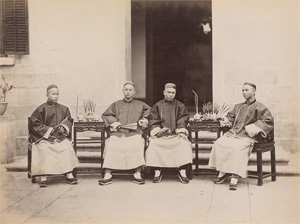
Photographers: Lai Afong (1839-1890), William Pryor Floyd (1834-1900), Herbert Elgar Hobson (1844-1922), and others. Views of Shanghai, Hong Kong, Canton, and Macao. 1880s. 12 albumen prints, mounted to board. Each ca. 21 x 28 cm (mounts ca. 31 x 27 cm). Most annotated in black ink below the image on the mount.
This selection of photographs comprises views of Shanghai, Hong Kong, Canton (Guangzhou), and Macao, alongside some portraits - among them office workers in traditional Chinese dress and palanquin bearers. Also included are a two-part panorama of the Shamian (Shameen) settlement in Canton, as well as views of the Pazhou (Pachao) Pagoda and the Hoi Tong (Hainan) Temple in Canton. – Boards slightly soiled, some fading especially along the edges of prints, otherwise in good to very good condition.
Civil War
Deceased soldiers on the battlefield after Gettysburg
Los 4052
Ergebnis (inkl. Aufgeld) *
788€ (US$ 905)
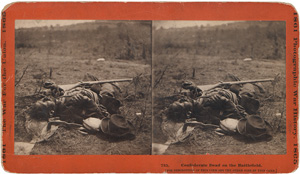
Photographer: Timothy O'Sullivan (1840-1882). Deceased soldiers on the battlefield after Gettysburg. 1863. 2 albumen stereoviews, mounted to orange cardstock. Each ca. 7,8 x 16 cm (mounts ca. 10 x 17,7 cm). Numbered and titled “Confederate Dead on the Battlefield” / “Union Dead at Gettysburg” below the image on the mounts; publisher’s information printed on the verso of the mounts.
These two stark battlefield views record the aftermath of the fighting at Gettysburg, shifting the focus from combat to its human toll. One image shows a fallen Confederate soldier lying supine in sparse terrain, his rifle and personal effects arranged beside him, while the other presents a broader scene of Union dead scattered in rows along a fence at the edge of a wooded area. Issued as part of the "Photographic War History, 1861-1865" series, these stereoviews exemplify the unflinching documentary character of Civil War photography, using the stereoscope to confront viewers with the physical realities of war with striking immediacy. – Edges of card rubbed, some scuff marks and small tears on prints, otherwise in good condition.
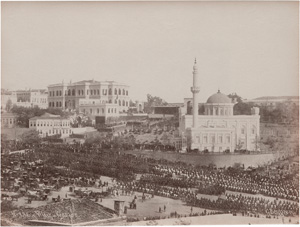
Photographers: Guillaume Berggren (1835-1920), Basile Kargopoulo (1826-1886), and others. Views of Constantinople. 1880s-1890s. 5 albumen prints. Each ca. 20,5 x 26,5 cm. Annotated and/or stamped in black ink on the verso; some signed, numbered and titled in the negative in lower margin.
This lot brings together several views of Constantinople, including the Galata (Karaköy) Bridge and sweeping prospects over the Bosphorus, alongside key monuments such as the Sultan Ahmed Mosque and the gate of Dolmabahçe Palace, as well as a vivid crowd scene depicting Friday prayer in front of the Yıldız Hamidiye Mosque. – Some handling creases and fading of prints, otherwise all in good to very good condition.
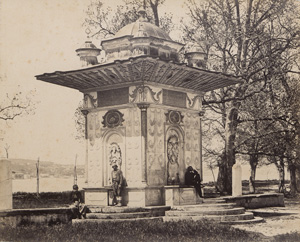
Photographers: Sébah & Joaillier (active 1884-1908), Guillaume Berggren (1835-1920), and others. Views of Constantinople. 1880s-1890s. 8 albumen prints, mounted to board. Each ca. 21,8 x 27 cm (mounts ca. 29 x 33,4 cm). Most titled, numbered, and signed in the negative in the lower margin.
This group comprises views of Constantinople, including the Mihrisah Valide Sultan Fountain, the Küçüksu Pavilion, the waterfront of Büyükdere along the Bosphorus, views of the strait itself, Karacaahmet Cemetery, and scenes from an Istanbul bazaar. One photograph depicts the historic cityscape of Smyrna (modern-day Izmir). – Some very light scuff marks, foxing and fading, otherwise all in good to very good condition.
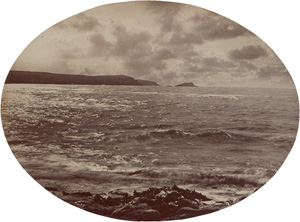
Photographer unknown. Early views of Cornwall. 1860s. 3 oval-trimmed albumen prints, one mounted to card. Each ca. 14,5 x 19 cm (mount ca. 26,5 x 36 cm). Two prints annotated in pencil on the verso.
This small group comprises coastal views around Newquay, Cornwall, including Fistral Bay and the Towan Head area. The photographs emphasize expansive horizons, animated skies, and the shifting play of light across sea and surf. Their atmospheric quality moves beyond straightforward topographical record, aligning instead with the pictorial language of mid-19th-century seascape photography. – Some light scuff and pressure marks, otherwise in near excellent condition.
Crémiere, Léon & Erwin Hanfstaengl
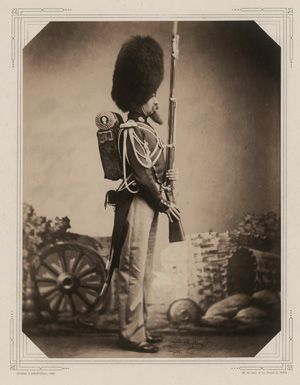
Grenadier of the Imperial Guard
Los 4058
Ergebnis (inkl. Aufgeld) *
1.125€ (US$ 1,293)
Grenadier of the Imperial Guard. 1861. Albumen print, mounted to original card with printed ornamental border. 25 x 19,2 (mount 42,6 x 30,5 cm). Signed "Crémiere & Hanfstaengl Paris 1861" in the negative in lower margin of print. With the photographer’s studio imprint “Crémière & Hanfstaengl, Phot.” and address “28, rue Laval et rue Frochot, 2, Paris” printed below the image on the mount.
This photograph was produced during the short-lived Paris collaboration of Léon Crémière and Erwin Hanfstaengl in the early 1860s, when they operated a joint portrait studio at rue Laval. Combining Crémière’s courtly connections and experience in portraiture with Hanfstaengl’s technical training, their partnership favored carefully staged, formal images suited to official and elite clientele. The depiction of an Imperial Guard grenadier reflects this approach, presenting the soldier as an emblematic figure within the visual culture of the Second Empire. – Corners of the mount slightly bumped; some very light scuff marks and signs of retouching; otherwise a strong print in near excellent condition.
[*]: Regelbesteuert gemäß Auktionsbedingungen. [^]: Ausgleich von Einfuhr-Umsatzsteuer.
* Alle Angaben inkl. 25% Regelaufgeld ohne MwSt. und ohne Gewähr – Irrtum vorbehalten.
Galerie Bassenge
Erdener Str. 5A
14193 Berlin
Öffnungszeiten:
Montag bis Donnerstag, 10–18 Uhr,
Freitag, 10–16 Uhr
Telefon: +49 30 8938029-0
Fax: +49 30 8918025
E-Mail: info (at) bassenge.com
Impressum
Datenschutzerklärung
© 2026 Galerie Gerda Bassenge
Galerie Bassenge
Erdener Str. 5A
14193 Berlin
Öffnungszeiten:
Montag bis Donnerstag, 10–18 Uhr,
Freitag, 10–16 Uhr
Telefon: +49 30 8938029-0
Fax: +49 30 8918025
E-Mail: info (at) bassenge.com
Impressum
Datenschutzerklärung
© 2026 Galerie Gerda Bassenge